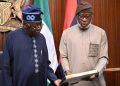




Former Governor of Benue State, Chief Samuel Ortom, has rejected the findings of the state Income and Expenditure Commission of Inquiry, describing the report as a politically driven attempt to discredit his administration.
The reaction comes after the commission submitted its report to Governor Hyacinth Alia following an investigation into the finances and operations of the previous administration.
In a statement issued on Saturday in Makurdi by his media aide, Mr Paul Zege, Ortom dismissed the inquiry as a “political witch-hunt” rather than a genuine accountability exercise.
He argued that the process was designed to indict him and his administration rather than establish objective financial facts.
The former governor insisted that the probe was unnecessary and politically motivated from the outset.
Ortom further stated that the commission’s work was affected by ongoing legal disputes, arguing that the inquiry should not have proceeded while court cases relating to its legality were still pending.
He recalled that earlier probe panels set up by the current administration were challenged in court and subsequently dissolved before a fresh commission was established.
According to him, the current commission also received formal notices connected to unresolved legal proceedings.
The former governor noted that the matter remains active in court, with a hearing scheduled at the Court of Appeal on June 29, while a related case at the Supreme Court challenging the constitutionality of the panels is still awaiting determination.
He questioned the decision of the state government to proceed with the report despite ongoing judicial processes.
Ortom accused the administration of Governor Hyacinth Alia of using the probe report to distract from governance challenges in the state.
He pointed to issues such as insecurity, the welfare of internally displaced persons (IDPs), labour unrest in the education sector, and alleged mismanagement of state resources.
According to him, the government has focused excessively on his administration instead of addressing current developmental concerns.
The former governor maintained that his administration followed due process in managing public finances, stressing that all expenditures were subjected to statutory audits and budgetary approvals.
He insisted that no amount of political pressure or public criticism would alter what he described as the facts of his tenure.
Ortom also challenged the current administration to account for funds received by the state since May 2023, arguing that transparency should begin with sitting officials.
He urged residents of Benue State to critically assess the report, warning against what he described as attempts to divert attention from present governance issues.
The dispute adds to ongoing political tension between the current and former administrations in Benue State.