



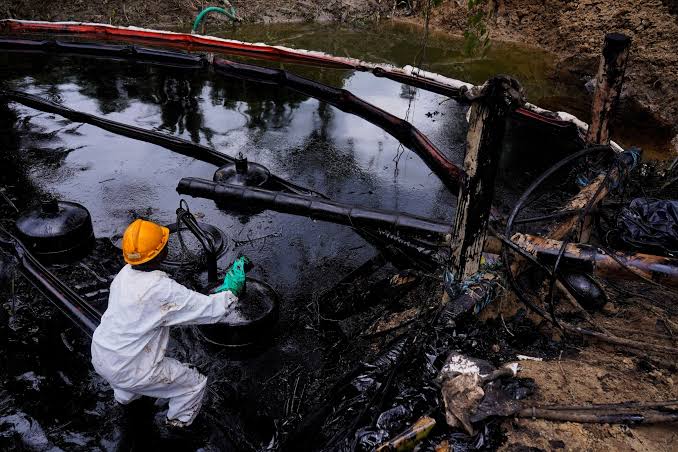
The National Emergency Management Agency (NEMA), environmental regulators and community representatives have called for urgent safety inspections of ageing oil and gas infrastructure following reports of persistent gas seepage and environmental contamination in Uzere, Isoko South Local Government Area of Delta State.
The stakeholders also urged the Federal and Delta State governments to consider relocating residents living in high-risk areas, warning that continued gas emissions and suspected infrastructure failures could threaten public safety.
The recommendations emerged during a meeting organised by NEMA in Asaba on Tuesday, November 3, to assess the situation in Uzere and coordinate a response to the reported oil spill and gas seepage.
The discussions focused on identifying the source of the emissions, examining the condition of petroleum facilities and determining immediate measures to protect affected residents.
Uzere oil spill raises concerns over ageing pipelines and gas wells
Participants at the meeting expressed concern about the condition of oil and gas infrastructure serving the Uzere community.
The incident, which stakeholders linked to an oil spill reported on June 27, has reportedly been accompanied by gas bubbles emerging from the ground and signs of petroleum contamination.
Officials said the situation required detailed environmental investigations and technical assessments rather than temporary measures alone.
They recommended integrity tests on pipelines, inspections of oil wells and a wider environmental audit to determine the extent of the problem.
The meeting also called for cooperation among regulatory agencies, the oil operator, emergency responders and the Delta State Government.
Delta government raises alarm over soil, water and farmland contamination
Victor-Fitzgudo Ogbugo, Permanent Secretary of the Delta State Ministry of Environment, said the incident had disrupted daily life in Uzere.
According to him, residents had reported crude oil mixing with sand, while contamination was affecting the surrounding environment.
He expressed concern about the possible impact on rivers, farmland, crops and food consumed by the community.
Ogbugo warned that prolonged exposure to certain petroleum-related contaminants could pose health risks and called for proper environmental and public health assessments.
He urged the government to require Heritage Oil, the company identified by stakeholders as the operator concerned, to conduct a comprehensive environmental audit.
The official maintained that addressing the incident would require a long-term remediation strategy alongside immediate protective measures.
Officials identify problems with Uzere oil wells 1, 3 and 14
Dr Efe Ikoro, Acting Permanent Secretary of the Delta State Ministry of Oil and Gas, described the situation as an unusual petroleum infrastructure emergency.
He attributed the incident to a suspected well failure involving excessive reservoir pressure, which he said had contributed to the movement of oil and gas through surrounding formations.
Ikoro identified wells 1, 3 and 14 as facilities requiring urgent technical attention.
He called for inspections and repairs to determine whether the wells and associated pipelines remained safe.
The official also recommended immediate medical assistance and the movement of residents away from locations where gas was escaping through the ground.
He suggested that changes in floodwater levels could affect the visible bubbling, although this would not establish that the underlying hazard had been resolved.
Uzere residents demand relocation and emergency healthcare
Fidelis Ojobo, a community representative and former coordinator of the Uzere Branches Forum, called on authorities to prioritise the safety of residents.
He said the community had experienced longstanding challenges associated with petroleum operations and ageing infrastructure.
Ojobo blamed the latest incident on what he described as abandoned wells and deteriorating oil facilities, although regulators have yet to establish the precise source of the gas.
He warned that the possibility of flammable gas accumulating near homes or other ignition sources required urgent attention.
The community representative urged authorities to arrange temporary relocation where necessary, distribute emergency relief materials and provide medical screening for affected residents.
He also requested scientific testing to identify the gases being released and assess their potential health effects.
NUPRC collects gas, water and soil samples for laboratory testing
The Nigerian Upstream Petroleum Regulatory Commission (NUPRC) confirmed that it had responded to concerns raised about conditions in Uzere.
Elleman Abubakar, Deputy Manager of Health, Safety, Environment and Community at the commission, said the regulator received an alert from the community on September 18.
He explained that an investigation revealed troubling conditions and multiple locations where gas was emerging from the ground.
According to Abubakar, the commission arranged evacuation measures and collected gas, water and soil samples from three locations for laboratory analysis.
The test results were still pending at the time of the meeting.
He said further environmental and health studies would be necessary to determine the scale of the problem and appropriate interventions.
NOSDRA says source of gas seepage remains unconfirmed
The National Oil Spill Detection and Response Agency (NOSDRA) also reported observations from its investigation.
Assistant Director Gunsuri Mohammed said the agency received information about the incident on September 29 and visited Uzere on October 3.
During the inspection, officials observed continuous gas bubbles emerging from the soil and indications of groundwater impact.
However, Mohammed said investigators had not established the source of the escaping gas.
He called for additional technical investigations and comprehensive integrity assessments of petroleum facilities in the area.
According to him, some infrastructure was more than 50 years old, raising concerns about its condition and the need for preventive maintenance.
The agency emphasised that identifying the source of the emissions was essential before authorities could determine a lasting solution.
Security agencies warn of safety and economic risks
Representatives of the Nigerian Army, Delta State Fire Service and Department of State Services also participated in the meeting.
They pledged support for measures aimed at protecting residents, securing petroleum installations and preventing further damage.
The agencies stressed the importance of responding quickly to potential fire hazards and other threats associated with uncontrolled gas emissions.
Participants also raised concerns about possible disruption to petroleum operations and government revenue.
A production figure of approximately 450,000 barrels per day was mentioned during the meeting, but the report did not establish that this represented output from Uzere itself.
The figure therefore requires independent verification before being attributed to the affected community or oil facilities.
NEMA plans community visit and coordinated emergency response
NEMA Director-General Zubaida Umar, represented by Dr Godwin Tepikor, Director of Planning, Research and Forecasting, said the situation required coordinated action by government agencies and other stakeholders.
She explained that the meeting was intended to bring relevant institutions together, establish responsibilities and develop a practical response.
According to Umar, a team would visit Uzere to assess the affected locations and engage directly with community representatives.
The planned assessment would help determine the responsibilities of NEMA, the Delta State Government and the petroleum operator.
The agency said decisions on additional interventions would follow the field assessment and discussions with relevant stakeholders.
What happens next in Uzere?
The immediate priorities identified at the meeting include locating the source of the gas seepage, assessing the safety of oil wells and pipelines, and protecting residents from possible exposure.
Laboratory findings from the samples collected by regulators are expected to provide important evidence about the nature of the emissions and contamination.
Authorities will also need to determine whether temporary evacuation, longer-term relocation or environmental remediation is required.
Until the investigations are completed, the precise cause of the gas seepage and the full extent of the environmental and health risks remain unresolved.