


*ADDRESS DELIVERED BY THE HONOURABLE MINISTER OF INFORMATION AND NATIONAL ORIENTATION, MOHAMMED IDRIS, FNIPR, AT THE 2026 ALL NIGERIA EDITORS CONFERENCE, ENUGU, 24 SEPTEMBER 2026.
PROTOCOL
I am pleased to be with you at this year’s All Nigeria Editors Conference here in Enugu.
The theme of this conference, “The Ballot, the Media and the Task of Keeping Democracy Alive,” could not have come at a more important time. The sub-theme, “When Lies Look Real: Detecting and Debunking AI Disinformation Before, During and After Election,” takes the discussion even further.
Nigeria will hold its next general elections in 2027. INEC has scheduled the Presidential and National Assembly elections for 16 January 2027 and the Governorship and State Houses of Assembly elections for 6 February 2027. We are therefore entering a period in which the quality of information available to citizens will matter enormously.
The ballot is important, but democracy does not begin and end at the polling station. Democracy depends on citizens having access to credible information with which to make informed decisions.
That is where the media comes in. Editors occupy a particularly important position because they determine what enters the public conversation, what receives attention, how issues are framed and, increasingly, what citizens see on their phones and social media platforms.
This responsibility has become more difficult. Artificial intelligence has made it possible to create convincing photographs, videos, audio recordings and documents that may appear genuine when they are not. A false statement can be produced in the voice of a public official. A fabricated video can be circulated within minutes. An old photograph can be presented as a current event.
The danger is not simply that people may believe a lie. The greater danger is that citizens may eventually stop believing anything. When the public can no longer distinguish between what is true and what is fabricated, trust in the media, elections and public institutions begins to suffer.
This is why fact-checking can no longer be treated as an activity that happens after publication. Verification has to be part of the newsroom culture. Editors must ask basic but important questions: Who said this? What is the evidence? When was this photograph taken? Is this video original? Has the source been independently verified? Is the headline supported by the story? Are we reporting a fact, an allegation or an opinion? These questions may sound simple, but they are powerful safeguards against misinformation.
The media also has a responsibility to report government performance with the same discipline it applies to other public institutions.
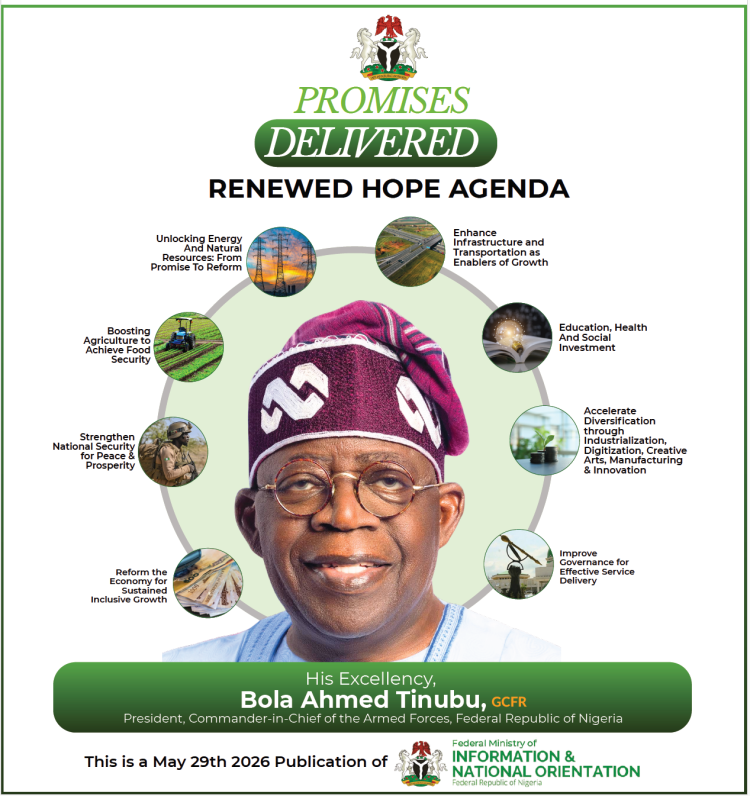
Under President Bola Ahmed Tinubu’s Renewed Hope Agenda, Nigeria has gone through major economic reforms, including the removal of the petrol subsidy and changes to the foreign exchange system. These reforms have required significant adjustments across the economy. At the same time, the Federal Government has reported improvements in revenue mobilisation, increased resources available to states and local governments, stronger investor confidence and increased investment across sectors.
The administration has also placed significant emphasis on infrastructure. As of May 2026, the Federal Government reported that more than 2,700 kilometres of highways and major roads were under construction, reconstruction or rehabilitation. Rail projects are also advancing, while investments are being made in power, housing, agriculture, and digital connectivity.
There have also been interventions in education and human capital development. The Nigerian Education Loan Fund has expanded access to higher education financing, while programmes targeting young people, small businesses, digital skills and entrepreneurship have continued to grow.
These are matters that deserve proper reporting. A responsible press should neither exaggerate achievements nor ignore them. It should examine them, verify them, ask difficult questions, and allow citizens to understand both the progress and the shortcomings. That is how public trust is built.
The same principle applies to democracy itself. President Tinubu signed amendments to the Electoral Act into law in February 2026. Whatever one’s political position, changes to the electoral framework deserve careful public examination. Nigerians need to understand what has changed, what remains the same and what the implications are for political parties, candidates, voters and election administrators.
The media has an important role in explaining these issues in language ordinary citizens can understand. We must also remember that democracy is not only about national elections. It is about governance at every level.
The Federal Government has pursued financial autonomy for Nigeria’s 774 local government councils, recognising that governance must be felt where citizens live. Local governments are closest to the people and are responsible for services that affect everyday life. The media must therefore pay attention to what happens at that level: how resources are used, what projects are delivered and whether citizens are receiving the services to which they are entitled.
This is also where journalism can make a direct contribution to development. An editor who ensures that a community’s concerns receive attention is contributing to accountability. A reporter who follows the implementation of a public project is contributing to transparency. A newsroom that accurately explains a government policy contributes to informed citizenship.
The media should also resist the temptation to become part of the political contest. Elections will always produce strong opinions. Political parties will defend their records. Candidates will make promises. Supporters will criticise their opponents. The job of the professional journalist is not to amplify every claim simply because it is politically attractive. The job is to establish what is true, provide context and allow citizens to make their own judgments.
As we approach 2027, I encourage editors to strengthen collaboration with fact-checking organisations, technology experts, election authorities and other credible sources. Newsrooms should invest in digital verification skills and develop clear internal procedures for dealing with AI-generated content.
The Federal Ministry of Information and National Orientation is also committed to strengthening media and information literacy. Nigeria’s partnership with UNESCO on the International Media and Information Literacy Institute is an important step in building citizens’ ability to navigate an increasingly complex information environment.
However, government cannot do this alone. The media, technology companies, civil society, political parties, electoral institutions and citizens all have a role to play. Let me therefore commend the Nigerian Guild of Editors for bringing this conversation to the centre of national attention.
The task before us is bigger than protecting the credibility of one election. It is about protecting the credibility of our democracy.
Let us ensure that technology does not become a tool for deceiving citizens, and that, when Nigerians go to the polls in 2027, they do so in an information environment where facts can still be found, verified and trusted.
The ballot belongs to the people. The responsibility of the media is to help ensure that the information surrounding that ballot is worthy of a democracy.
I wish you fruitful deliberations and a successful conference.
Thank you.