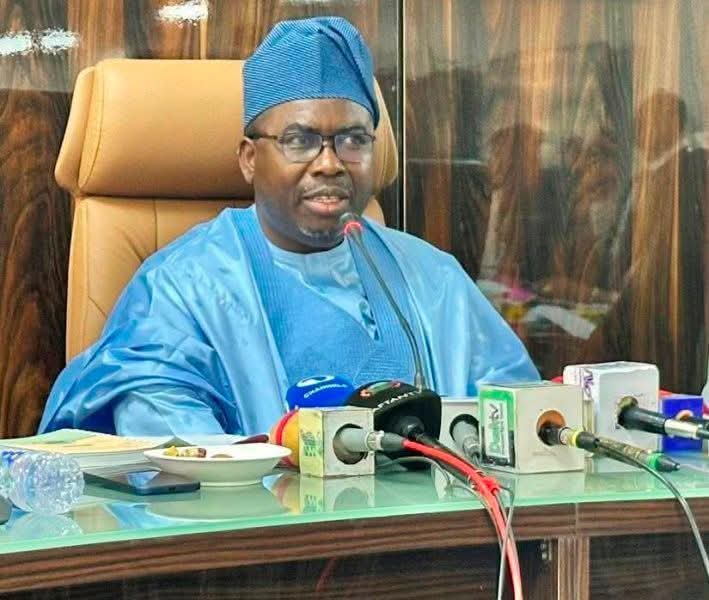
*OPENING REMARKS BY THE HONOURABLE CHAIRMAN, INDEPENDENT NATIONAL ELECTORAL COMMISSION (INEC), PROF. JOASH AMUPITAN, SAN, AT THE 24TH ALL NIGERIA EDITORS CONFERENCE (ANEC 2026) IN ENUGU ON THURSDAY, SEPTEMBER 24, 2026
PROTOCOLS
His Excellency, the Executive Governor of Enugu State
The President of the Nigerian Guild of Editors, Mr. Eze Anaba
Members of the Standing Committee and Officers of the Guild
Distinguished Veterans and Captains of the Media Industry
Managing Directors, Publishers, Editors-in-Chief, Directors of News
Honourable National Commissioners
Resident Electoral Commissioners here present
Civil Society Partners and Guests
Distinguished Ladies & Gentlemen
INTRODUCTION
It is a profound honour to stand before the intellectual engine room of Nigerian journalism today. I am deeply grateful to the leadership of the Nigerian Guild of Editors for inviting me as Special Guest of Honour at the 24th All Nigeria Editors Conference.
Gathering in Enugu—a city defined by resilience, intellect, and civic courage—is deeply symbolic. To address over 500 media decision-makers, proprietors, and editors in the heart of the Coal City as our democratic journey approaches key national milestones is both a privilege and a high institutional responsibility.
Your chosen theme, “The Ballot, the Media and the Task of Keeping Democracy Alive”, along with its sub-theme on artificial intelligence and synthetic disinformation, speaks directly to the existential questions of our time. You gather not merely to discuss newsroom mechanics or publishing economics, but to deliberate on preserving constitutional democracy itself.
2. The Ballot, the Press, and the Nation
Democracy is fundamentally an act of collective faith, anchored on an unwritten covenant between citizen and state: that the citizen’s voice matters, their choice is sovereign, and the mechanisms translating that choice into governance are untainted, transparent, and fair.
The ballot is the instrument of that sovereign choice. Yet, a ballot in isolation is silent; it requires an informed electorate to give it intent and an institutional mirror to reflect its outcome truthfully to the world. That mirror is the media.
Under Section 22 of the Constitution of the Federal Republic of Nigeria 1999 (as amended), the press is explicitly charged with holding government accountable to the people. In the context of elections, this constitutional obligation elevates the newsroom into the nation’s democratic courtroom—where electoral rules are scrutinised, political arguments weighed, administrative performance audited, and election results communicated to a waiting public.
Without a free, rigorous, and courageous media, citizens vote in the dark. Conversely, without a credible, transparent, and legally sound electoral process, press freedom becomes an empty exercise in documenting administrative failure. The electoral management body and the press are bound in shared constitutional stewardship: we protect the ballot, and you protect the truth surrounding it.
As Albert Camus aptly put it, “Integrity has no need of rules.” However, in discharging our national duties, our rules and professional standards are our shield. We must remain above suspicion before over 200 million Nigerians and the international community. A flawed election process or a corrupted information space is a wound to the nation’s soul. Together, we must ensure that under our watch, that soul remains vibrant and intact.
Media Welfare is Critical to Democratic Integrity
While we discuss high ideals of democratic defense, information integrity, and technological resilience, we must confront an uncomfortable reality: we cannot demand unyielding ethical fortitude from a journalist whose basic economic survival is constantly threatened. A reporter operating under extreme financial insecurity, unpaid salaries, and inadequate welfare cannot serve as an unassailable fortress against political inducement, fake news, and brown-envelope pressures.
I speak directly to the Managing Directors, Publishers, Chief Executive Officers, and media owners gathered in this hall: media performance depends heavily on staff welfare. If we truly view journalists as frontline guardians of democracy, their socio-economic security must be treated as a strategic priority, not an administrative afterthought. A poorly compensated journalist is vulnerable; a financially neglected newsroom is fertile ground for compromise, weakening the democratic architecture we seek to protect.
To protect our democracy, we must protect the economic dignity of the journalist. When a reporter is assured of a decent living wage and structured welfare, they gain the independence required to reject financial inducements, interrogate fake narratives, and report election processes with uncompromising objectivity.
I share this perspective as an administrator who understands that organisational integrity begins with workforce dignity. Within INEC, we came to the profound realisation that we could not demand absolute neutrality, zero corruption, and flawless execution from our field officers without first taking decisive care of their institutional welfare.
As such, the Commission has taken concrete steps to transform the compensation structure of our workforce:
Creation of CEMBSS: We established the Consolidated Election Management Body Salary Structure (CEMBSS), pulling our staff outside the regular Civil Service structure to reflect the specialised, high-stakes nature of election administration, effective 1st January 2026.
New Salary Package: We are implementing an upgraded salary and welfare package for INEC Staff, Commission Members, and Resident Electoral Commissioners (RECs), currently at an advanced stage.
150% Overhead Increase: The Commission increased Overheads to State Offices by 150% effective 1st July 2026, ensuring operational posts at state and local government levels have the financial resources to execute duties without friction or compromise.
If an election management body can overhaul its financial structures to protect institutional integrity, I urge the leadership of the Nigerian media industry to undertake a similar commitment. Investing in staff welfare is a civic duty essential to keeping Nigerian democracy alive.
When Lies Look Real: AI Disinformation, and Responsible AI Governance
This call for media integrity and economic resilience comes as the information landscape undergoes revolutionary disruption. Your sub-theme—”When Lies Look Real: Detecting and Debunking AI Disinformation Before, During and After Election”—strikes at the heart of the modern threat environment.
We have moved far beyond simple political bias, hyperbole, or unverified rumours into an era of synthetically manufactured reality. Generative artificial intelligence, voice cloning, deepfake video synthesis, and automated bot networks have democratised mass deception. Malicious operatives no longer need a printing press or broadcast license to deceive millions. With modest computing power, they can produce:
A photorealistic video of an electoral official purportedly declaring false results in a dark room;
A cloned audio file of an INEC Resident Electoral Commissioner instructing staff to manipulate voting devices on election eve;
A synthetically generated letterhead carrying the Chairman’s forged signature, announcing the sudden postponement of voting in select states;
Manipulated result sheets engineered to mimic official security features, flooded onto social media minutes after polling closes to create an illusion of fraud before collation even begins.
The primary danger of synthetic disinformation is not merely that it tricks citizens into believing a specific falsehood, but it causes the systemic destruction of public trust. When everything can be faked, citizens begin to doubt genuine, verified facts provided by constitutional authorities.
When deepfakes render lies believable, real truth is greeted with skepticism. Cynicism replaces civic engagement, leading voters to ask: Why stand in line for hours if the outcome is already manipulated on a screen? That mental retreat is where democracy begins to decay.
Disinformation attacks the electorate’s cognitive sovereignty, turning elections from a peaceful contest of ideas into a volatile battleground of manipulated emotions, ethnic tension, and pre-packaged outrage. For an election management body, administrative success on the ground can be instantly erased on a smartphone screen by a well-timed, algorithmically boosted deepfake.
INEC’s Proactive Offensive: Deploying Responsible AI & Global Tech Partnerships
However, our stance on Artificial Intelligence must not be one of mere institutional anxiety or defensive retreat. While AI presents clear risks when weaponised by bad actors, it also offers unprecedented capabilities for election management when harnessed responsibly, ethically, and strategically.
Earlier this month, I had the privilege of attending the Global Conference on Responsible AI and Elections in Ottawa, Canada. In my address to delegates, I made it clear that for a nation of Nigeria’s demographic and operational scale—managing over 93 million registered voters, 176,847 polling units, and deploying more than 185,000 Bimodal Voter Accreditation System (BVAS) devices—AI adoption cannot be treated as a mere IT project. It must be executed as a comprehensive, structural institutional reform.
To turn technology into an instrument of electoral integrity, INEC has taken proactive, concrete measures:
Deploying AI for Result Integrity: We have commenced deploying intelligent AI tools directly within our Results Management process. This technology automatically scans and detects discrepancies or administrative errors in result records before final validation.
Mandatory Human Oversight: Technology must complement, rather than replace, constitutional institutions. As I declared in Ottawa, “AI must strengthen electoral integrity, improve public service, and always remain under human control.” Every automated result check remains strictly subject to human auditing and legal verification.
Institutionalising AI Governance: The Commission established a dedicated Artificial Intelligence Division within our ICT Department. We crafted a comprehensive AI Roadmap and Governance Framework built upon five core pillars, which are Human Oversight, Transparency and Accountability, Data Protection, Cybersecurity, and Public Trust.
Legal & Regulatory Anchorage: These technological advancements do not exist in a legal vacuum. They are firmly backed by the Constitution of the Federal Republic of Nigeria 1999 (as amended), the Electoral Act 2026, the Nigeria Data Protection Act 2023, and the Cybercrimes Act 2024, ensuring complete legal verifiability for electronic result transmission, biometric accreditation, and digital record processing.
Deepening Global Tech & Cybersecurity Alliances: On the sidelines of the Ottawa conference, we engaged in strategic bilateral meetings to fortify our digital infrastructure. We held high-level sessions with senior Microsoft and Google executives focusing on cybersecurity resilience, cloud infrastructure protection, and threat mitigation. Simultaneously, we met with the Chief AI Advisor at the International Foundation for Electoral Systems (IFES), establishing technical capacity-building frameworks, risk management protocols, and responsible AI integration strategies ahead of 2027.
Through these global partnerships and internal reforms, INEC is building a strong technological defense to safeguard the transparency and credibility of the ballot box.
Institutional Readiness & Zonal Assessments: The March to 2027
Heading into the recent Osun Off-cycle Governorship Election on August 15, 2026, the public space was flooded with speculation regarding logistics, technological readiness, and voter credentials. The Commission responded with operational discipline and administrative integrity.
Out of 3,763 polling units in Osun, 3,556 polling units—representing 94.5%—opened for accreditation and voting precisely by 8:30 a.m. We expanded hardware deployment to 5,130 BVAS devices, with 1,328 dedicated backup units. Original result sheets (Form EC8A) were scanned and uploaded directly to the INEC Result Viewing (IReV) portal. However, success is a demanding master. Osun was a single-state exercise, 2027 will be across 36 states and the Federal Capital Territory. The Presidential and National Assembly Elections holds on Saturday, 16th January 2027. The Governorship and State Houses of Assembly Elections holds on Saturday, 6th February 2027.
The statutory timeline is fixed, and the clock is ticking. To ensure excellence, on Monday, September 7, 2026, in Lagos, we formally commenced a nationwide six-zone Interactive Meetings and Readiness Assessment tour.
As civil rights icon John Lewis famously reminded us: “Democracy is not a state. It is an act, and each generation must do its part to save it.” Our presence in the field is the concrete act required of our generation to safeguard Nigerian democracy.
The Gatekeeper’s Duty: A Call for Media Rigour
However, INEC cannot secure the information space alone. We control the electoral infrastructure, but you control the distribution channels of public information.
As Editors, you are primary gatekeepers of public discourse. The desk of an Editor is the final barrier between a verified fact and a nation-altering falsehood. In an era dominated by social media algorithms that reward outrage, speed, and virality over accuracy, the traditional newsroom must reassert its role as the supreme sanctuary of truth.
The pressure on modern newsrooms to be first is immense. But in national elections, it is vastly more important to be right than to be first. Rushing to publish unverified, sensational claims—whether a fake result sheet on social media, a doctored video, or an unconfirmed statement—grants institutional legitimacy to deliberate deception, causing damage to public peace that is almost impossible to reverse.
I appeal to the Nigerian Guild of Editors to view media gatekeeping as a critical component of national security and democratic defense. To effectively combat AI-driven disinformation before, during, and after elections, we must build a collaborative firewall.
As media organisations, let us institutionalise fact-checking desks and integrate digital verification tools, deepfake detection software, and forensic image analysis into daily breaking news workflows.
Let’s resisting premature result declarations. Under the Electoral Act, statutory authority to declare election results rests exclusively with INEC. Amplifying unverified, privately collated figures published by political actors on social media creates conflicting public narratives that undermine official outcomes.
We should use our platforms to educate citizens on spotting synthetic content, fake letterheads, and algorithmically generated rage-bait.
A Shared Responsibility for Democratic Survival
Distinguished Editors, media proprietors, ladies and gentlemen, as John F. Kennedy wisely observed, “Democracy is never a final achievement. It is a call to an untiring effort.”
The ballot and the press are bound by history, law and purpose. We are twin guardians of the same national dream: a sovereign, peaceful, and prosperous Nigeria governed by the uncoerced will of its people.
The Commission is doing its part. We ask the media leadership gathered here to do its part. Fortify your newsrooms against AI-driven disinformation, prioritise verification over speed and stand as an unyielding fortress of truth.
As we set out on the road to 2027, I am reminded of the words of Nelson Mandela: “It always seems impossible until it’s done.” Conducting a seamless, transparent election across 176,000 polling units in a nation as vast and vibrant as Nigeria is a Herculean task, but it is a task we are uniquely prepared for.
On behalf of the Independent National Electoral Commission, I wish the Nigerian Guild of Editors a highly successful, fruitful, and impactful 24th All Nigeria Editors Conference.
Thank you, and may God bless the Federal Republic of Nigeria.
*Prof. Joash Amupitan, SAN
Honourable Chairman,
Independent National Electoral Commission (INEC).