Colonial America generally describes the period of American history between
the Pilgrims’ arrival in the New World and the victory of the colonists
over England in the American Revolution (1607–1776).
Colonial America is a fascinating chronicle full of both adventures and
mistakes that interwove difficult but necessary life lessons into the
American experience.
At its foundation, it is the story of immigrants who gathered at the far
side of the Atlantic and risked their lives for religious freedom and a
belief in a new society.
Oyotunji, African Village is the first intentional community based on the
culture of the Yoruba and Dahomey tribes of West Africa.
It was founded, (1970) in the Americas.
In 2016, after over forty-five years of sustaining the only Kingdom based
on traditional Yoruba sociology and value,the village brings to the
Low-country and greater global community the depth of culture, beautiful
art, grandeur of customs and resilient history of the New World Yoruba.
Oyotunji village in South Carolina, USA, is not part of the United States,
according to King (Oba) Ofuntola Oseijeman Adelabu Adefunmi I, who founded it in 1970, and moved it to its present site near Sheldon because its old
neighbours complained about the tourists.
Oyotunji, African Village is the first intentional community based on the
culture of the Yoruba and Dahomey tribes of West Africa.
It was founded, (1970) in the Americas.
In 2016, after over forty-five years of sustaining the only Kingdom based
on traditional Yoruba sociology and values, the village brings to the
Low-country and greater global community the depth of culture, beautiful
art, grandeur of customs and resilient history of the New World Yoruba.
Oyotunji village in South Carolina, USA, is not part of the United States,
according to King (Oba) Ofuntola Oseijeman Adelabu Adefunmi I, who founded
it in 1970, and moved it to its present site near Sheldon because its old
neighbours complained about the tourists.
The community was founded by a black America named Walter Eugene King, who
was born on October 5, 1928 in Detroit, Michigan, USA.
Oyotunji’s king is His Royal Majesty, Oba Adejuyigbe Adefunmi II who began
his destiny on earth on December 21, 1976.
Born as the 14th child of 22 children to His Royal Highness, Oba
Efuntola Adefunmi I, and the third child of five born to Iya Esu Ogo
Oyewole, Adejuyigbe Adefunmi II was raised in the Kingdom of Oyotunji
African Village and began drumming at the age of seven, according to
findings.
He was rooted in the traditional lifestyle of Oyotunji African Village
settlement in North America and witnessed thousands of Africans in America
that came to his father’s Kingdom in search of broadening their cultural
awareness.
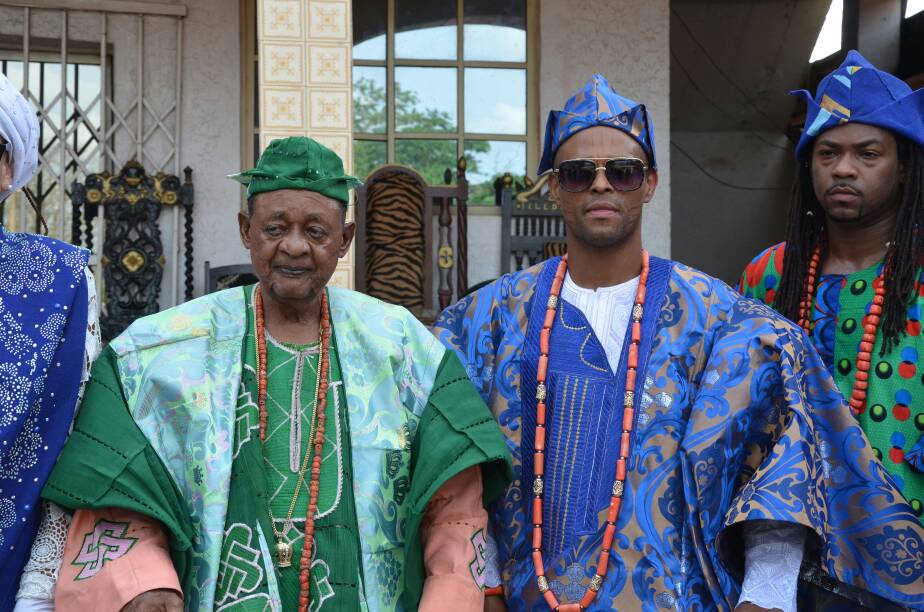
Recently the ruler of Oyotunji vllage in South Carolina, USA, and his
entourage paid what they referred to as ‘ancestral homage’’ to the Alaafin
of Oyo, Oba [Dr.] Lamidi Olayiwola Adeyemi 111, in his ancient palace in
Oyo town.
A civic reception was organized by the Alaafin for the visitors who were
elated and could not hold back their joy for what they called
‘’identification with their roots’’.
One enviable highpoint in the life of the Alaafin is his deep knowledge and
high sense of recounting historic events with facts and figures, and with
an accuracy that will beat the imagination of youthful intellectuals.
The Alaafin, at his age still remembers events of over a hundred years old,
and still writes his scripts unaided.
He is a consummate reader and would pass any day, for a Professor of
ancient/modern history and archaeology.
In his address at the occasion, Oba Adeyemi expressed dismay at the extent
to which the Yoruba have sold out their own culture and have adopted
foreign gods as the object of their spiritual religion.
Said he, ‘’as a people, our culture, politics and religious experience have
been extremely unfulfilled. The Yorubas are now falling in the same
condition through which the African Americans had allowed themselves to be
seduced by preachers of a foreign gospel. We know that the universalist
inspiration which has come to the Yoruba through Christianity and Islam has
reduced their concern or allegiance to their own god and by extension to
their own nationality. The Yoruba will be very much reduced in their
political, cultural and spiritual development by their seduction into these
alien religions. Concerted efforts must be intensified at increasing
inspiration to become national or to recognise nationhood. So with that, we
see the Yoruba in the diaspora, as it is popularly called, to be the Yoruba
that will greatly guide and influence the Yoruba in the ancient homeland,
who for the most part are tending to move away from a sense of preservation
of their own culture and tradition, particularly religion.
He observed that it is time Yoruba at home and in Diaspora start partnering
for synergy.
‘’Without doubt, we can find strength in unity . This has become imperative
so that whenever our brothers and sisters in Diaspora come home, they won’t
be complainers about how things are not working, but rather, they would see
themselves as partners and partakers in the overall development for a
better future of their home land. Partnership is a voluntary collaborative
agreement between two or more parties in which all participants agree to
work together to achieve a common purpose’’.
Partnerships, he explained, share interest, concerns and create visions for
the future.
‘’In this technology-driven age, when the whole world has virtually
dissolved into a global village, meaningfully partnering is a foundation
for success. This is because such collaboration enables continuous
improvement which is created when it doesn’t seem possible to solve a
problem or address the situation by just one group – due to magnitude, lack
of knowledge or vague nature of the issue at stake; or when the cost of
solving a problem or addressing an issue gets too costly for one group to
tackle’’.
In an enterprise therefore, the paramount ruler pointed out that the best
partnerships are those (either formal or informal) that have an
organization or a structure with shared vision, mission and goals,
involving people for maximum utilization of emerging and existing
technologies.
In this regard, the kind of partnering one envisages between the Yoruba at
home and in Diaspora is the type that will provide necessary developmental
planks such as intellectual, technological, communication and marketing
plans for the homeland that is urgent for modern transformation. This is
with a view that such an alliance will produce results that will benefit
all group and process members’’.
Oba Adeyemi also commended the Oyotunji people for their resistance of the
United States Government’s step to prevent the inscription of tribal marks
on their faces, as identities of their ancestral roots.
Speaking with journalists, Oba Adejuyighe Adefunmi 11, said at the time of
their interest in going into African past, the Yoruba tradition was the
only one available, adding that It was not even available in the United
States as they have have to travel to Maxtansas in Cuba.
‘’It was through Cuban-Americans that we were guided into consultation and
contact with a group of descendants of Egungunme tradition. Later, we
learnt that we had made the best, perhaps the finest choice because Yoruba
was universally spread out and had germinated in South America all the way
up at that time to Cuba. We learnt further that there are large numbers of
African-American people who were descendants of the Yoruba tradition and
culture and through books written by researchers even in South Carolina and
also into the former Louisiana territory owned by France in previous
generations that there had been a huge importation of Yoruba and Dahomian
people. It meant that here already was a latent reservoir of descendants of
the Yoruba people’’.
On his name?
Oba Adefunmi stated that they had reclaimed our name, Adefunmi, before
theylater became familiar with Yoruba history through Oro Idile when it was
discovered that there was a chieftancy located at the ancient Oyo, named
Adefunmi.
On what his childhood was like?
‘’ Our childhood was typical of that of second and third generation
descendants of a slave Yoruba. We were born into freedom but our
grandmother often remarked of her birth during the slave era here in the
U.S.A. Our childhood was one of extreme poverty, of being moved from one
location to another as our family sought ways and means to earn its living
and to support itself in the city of Detroit, Michigan. It was also at
Detroit that our parents had met and were married. We were raised in a
Christian environment’’.
‘’We attended high school in the U.S., all these under our slave name of
Walter King. During the period of our education, we started commercial art
at Cast Technical High School in Detroit. Our father died when I was 14
years old in Detroit. Our mother had relocated to the suburb of Detroit but
was compelled to return to the inner city after the death of our father.
Our family members, for the most part were welfare recipients and we as
African-Americans were subject to various discriminatory practices
prevailing in Detroit at that time. I was born in 1928, the year before the
great economic depression in the U.S. which was not relieved until the
installation of President Franklin D. Roosevelt in 1930’’.
On the real turning point in his life that really brought him full circle
to embrace African Culture?.
Oba Adefunmi retorted thus, ‘’the most significant event that took place
was reading a text called My Africa written by the Igbo writer, Mbonu
Ojike, who had written a chapter on religion that excited us and
illuminated our knowledge and mind when he argued that whether man created
God or God created is an unsettled argument. He also pointed out the
failings and falsity of Christianity and Islam in the life of the people in
Nigeria. He also commented very profoundly on the discriminating attitude
and practice of the white American community’’.
‘’The chapter on religion was so illuminating and penetrating that
immediately after studying and meditating on it, we renounced our Christian
faith, the slave tradition of Christianity and we began to search for a
more African form of religion. We were also impressed by the writings of
J.A. Rogers, a popular Africanist in the 20’s, 30’s and 40’s whose articles
appeared regularly in Michigan Chronicle and Pittsburg Courier. These
articles also opened up our mind and encouraged us to search for our
African heritage at 14 years of age..
On how he would call his favorite pastime
It has always been art works. Our ancestors have bequeathed to us skill and
talent in the arts. We always elaborated on that and wherever we went; we
participated with other artists. At Detroit, we engaged in very creative
pursuit for the most part to show that art was influenced by the racial
attitude and condition of the African American people, arts painting ,
sculpture and more recently, we have extended our artistic talents and
skills to writings. These have always been our main diversion from the
ordinary world of an African America
On the advice he would give to African Americans trying to find their own
root?
African Americans attempting to find their own roots will be better served
by adopting the Yoruba tradition which for over 30 years, we have been able
to introduce into the U.S. We see the African Americans have a profound
desire to re-identify with their ancestors and with an ancestral tradition.
We know that among vast numbers of African American intellectuals, there is
a lack of fulfillment in their development and advancement in the
Yoruba-American economic world. They found also that Christianity is
unfulfilling and that Islam is misleading. So in consequence, African
Americans are better served by a knowledge of the custom and tradition of
their Yoruba ancestry.
On advise for the younger Yoruba generation?
Younger Yoruba generation will be able to advance to the extent that they
increase the knowledge or institution among African Americans, who will
serve the need for knowledge improvement through television and
resurrection and introduction of stories and background images that
established a sense of celebration of their African ancestry.
How can a contemporary Yoruba personality support Oyotunji
Our main necessity or requirement or needs for Africans or native Yoruba
can best be served by supplying us with increased knowledge with teachers
of language and history, in other words, Yoruba preachers preaching Yoruba
tradition, religion, ideals of marriage as well as spiritual behavior. If
the coming generations of African Americans are able to receive these types
of training and exposure, then there is every indication that this will
become a lasting impression and institution which can be enlarged upon by
African Americans. The more aggresively the Yoruba culture is advertised
and subscribed to among them, the better for us all. Lastly, there is the
need for support of our cultural programs. We certainly appreciate the Egbe
Isokan Yoruba for their institution of Yoruba cultural month at Washington,
D.C. If we can extend this particular celebration to other locations with
African American presence, Nigerians would have made the most of their
sojourn and contact with African American community meaningful.
It is proof of a base and low mind for one to wish to think with the masses
or majority, merely because the majority is the majority. Truth does not
change because it is, or is not, believed by a majority of the people. ”