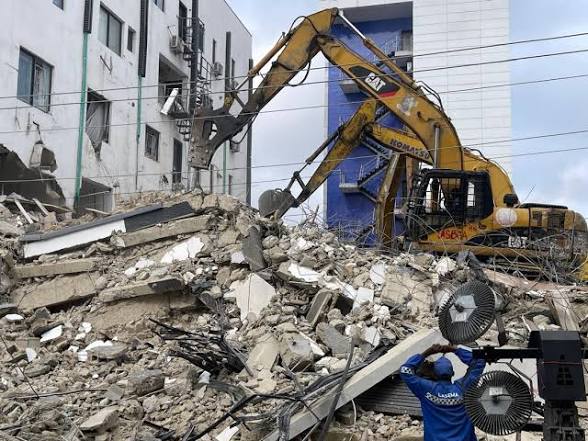
Nigeria is strengthening its capacity to investigate engineering failures following a study that recorded 111 validated building-collapse incidents and 321 deaths between 2015 and 2025.
The latest response is the launch of the Certified Forensic Engineering Failure Investigator (CEFFI) programme, aimed at developing specialists who can investigate the technical causes of structural and other engineering failures.
The programme was inaugurated in Abuja through a partnership involving the Chartered Institute of Forensics and Certified Fraud Investigators of Nigeria (CIFCFIN), the Council for the Regulation of Engineering in Nigeria (COREN) and the Nigerian Building and Road Research Institute (NBRRI).
The initiative comes against the backdrop of persistent building collapses across Nigeria, particularly in rapidly urbanising areas.
A 2026 study published in the University of Abuja Journal of Engineering and Technology examined 111 validated building-collapse cases recorded between 2015 and 2025. The researchers reported 321 deaths and 344 injuries. They identified structural defects, poor construction practices and inferior materials among the leading identifiable triggers, while noting that many cases did not have clearly established causes.
Forensic investigation seen as missing link
Speaking during the induction of the first group of CEFFI professionals, CIFCFIN President and Chairman of its Governing Council, Iliyasu Gashinbaki, said the scale of engineering-related losses showed the need for more systematic investigations.
Gashinbaki said forensic engineering should help investigators establish what happened, preserve relevant technical evidence and determine whether negligence, malpractice, fraud or deliberate breaches of safety requirements contributed to a failure.
He urged regulators, contractors, project owners, professional organisations and law-enforcement authorities to ensure that investigations do not stop once damaged structures are repaired, demolished or abandoned.
The objective, he said, should be to establish the facts surrounding a failure and use those findings to prevent similar incidents.
COREN seeks wider pool of specialists
COREN President, Sadiq Abubakar, said the programme would combine conventional engineering knowledge with forensic investigation techniques.
He described the training as an important step towards addressing gaps in the way engineering failures are investigated, particularly in Nigeria’s construction and built environment.
Abubakar called for a larger pool of professionally trained investigators who could be deployed to examine structural failures and other engineering incidents.
He said the approach should not be limited to buildings, but should also cover sectors including mining, oil and gas, telecommunications, transportation, aviation and aerospace.
COREN has also previously indicated plans to develop a register of engineers trained in failure analysis and forensic investigation, with the specialists expected to support investigations into building collapses and other engineering failures.
Nigeria’s building-collapse problem predates CEFFI
The recurring collapse of buildings is not a new problem in Nigeria.
Historical studies trace documented cases back several decades. One widely cited chronology records the collapse of a multi-storey building under construction at Mokola in Ibadan in October 1974, where 27 people were reported killed.
Research published over the years has repeatedly pointed to problems involving construction materials, design, workmanship, supervision, foundations, maintenance and compliance with approved building requirements.
A 2011 study covering historical cases from 1974 to 2006, for example, identified poor-quality materials and workmanship, excessive loading, design errors, maintenance problems and other factors among the contributors to building collapse.
The persistence of the problem has also prompted repeated government and professional interventions.
NBRRI has investigated collapses for years
NBRRI has long been involved in technical investigations of failed structures.
The institute says its mandate includes research into building construction, engineering materials, foundations, earthworks and construction methods.
Its published technical reports document investigations into several major building failures. In one investigation, NBRRI identified poor concrete quality, inadequate construction practices and insufficient technical supervision among factors associated with a collapse.
Another report on the collapse of a building at Adenubi Close, Ikeja, Lagos, examined site conditions, construction documents, laboratory results and interviews as part of the investigation.
The institute has also previously highlighted problems such as substandard materials, poor workmanship, weak supervision, absence of qualified professionals, inadequate designs and unsuitable site conditions.
Why engineering failure investigations matter
The challenge is not simply identifying a structure that has failed. A useful investigation must establish the sequence of events and distinguish between immediate failure and the underlying conditions that made it possible.
That can require examination of structural drawings, construction records, materials, soil conditions, workmanship, loading, alterations, maintenance history and regulatory approvals.
NBRRI’s published material has previously noted difficulties investigators sometimes face in gaining access to collapse sites and obtaining relevant information from contractors or authorities.
A stronger forensic system could therefore provide a formal mechanism for preserving evidence and producing technical reports that can be used by regulators, courts, professional bodies and project owners.
Fire losses add to the wider safety challenge
The building-collapse figures are part of a broader pattern of physical and economic losses associated with failures and disasters affecting Nigeria’s built environment.
A separate 2026 investigation by BusinessDay estimated that fire incidents between 2022 and 2025 destroyed about N4.6 trillion worth of goods, property and business assets. That figure comes from a different dataset and should not be treated as part of the 111-collapse study.
The investigation reported that repeated market fires had particularly severe consequences for informal businesses, many of which have limited insurance protection.
From reaction to evidence
For decades, building collapses in Nigeria have frequently triggered emergency rescue operations, public concern and calls for sanctions.
The more difficult question has been what happens after the debris is cleared.
The CEFFI initiative is intended to strengthen that post-failure process by creating professionals equipped to examine engineering evidence and document the causes of failure.
Whether the programme produces a measurable reduction in building collapses will depend not only on training investigators, but also on whether their findings are acted upon by regulators, project owners, professional bodies and other enforcement institutions.
For Nigeria’s construction sector, the stated goal is straightforward: turn lessons from failed structures into better engineering practice and reduce the human cost of preventable failures.