


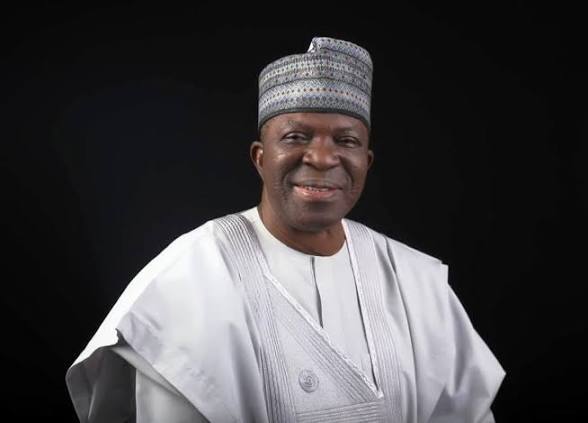
Nigeria is seeking stronger border monitoring and documentation systems while maintaining the principle of free movement of people within the Economic Community of West African States (ECOWAS).
The Director-General of the National Boundary Commission (NBC), Adamu Adaji, said authorities should be able to identify and document people entering or leaving Nigeria without unnecessarily restricting legitimate cross-border movement.
Adaji made the remarks in an exclusive interview with our correspondent in Abuja on Sunday.
He said ECOWAS free movement should not be interpreted as an absence of border controls, arguing that security and immigration authorities still have responsibilities within Nigeria’s territory.
The ECOWAS Protocol on Free Movement of Persons, adopted in 1979, gives Community citizens rights relating to entry, residence and establishment. For the first phase, eligible citizens may enter another member state without a visa for stays of up to 90 days, provided they use an official entry point and carry the required travel documents and international health certificate.
The protocol also allows member states to refuse admission to Community citizens who fall within categories of inadmissible immigrants under their national laws.
Security remains a concern
Adaji said border agencies must strengthen surveillance and information gathering to prevent legitimate movement from being exploited for criminal activity.
He identified terrorism, kidnapping and arms trafficking among the security concerns affecting some border areas and called for greater attention to people using unofficial routes.
The NBC chief said authorities should work towards reducing and eventually eliminating unauthorised crossings through better surveillance, documentation and cooperation among security agencies.
Nigeria’s approach is increasingly tied to technology. The Ministry of Interior said in 2026 that the Nigerian Immigration Service had been improving border governance through technological measures, including automated e-gate systems at airports. (Ministry of Interior)
Free movement does not mean undocumented movement
The distinction is important because the ECOWAS framework itself incorporates travel-document requirements.
Under Article 3 of the 1979 protocol, an ECOWAS citizen seeking to enter another member state must possess a valid travel document and an international health certificate. A visitor staying no more than 90 days may enter without a visa through an official entry point.
The protocol defines a valid travel document as a passport or another recognised document establishing the traveller’s identity and photograph.
Nigeria’s Immigration Service also provides an ECOWAS Travel Certificate for eligible Community nationals, describing it as a recognised travel document for movement within the ECOWAS sub-region. (Nigeria Immigration Service)
Consequently, border screening and identity documentation are not necessarily incompatible with the principle of regional free movement.
Nigeria promotes cross-border cooperation
Adaji said Nigeria was also using cross-border cooperation mechanisms to improve security and relations with neighbouring countries.
He cited the Cross-Border Cooperation Platform as a means of encouraging neighbouring states to exchange information and intelligence and coordinate responses to shared challenges.
The NBC’s statutory mandate includes monitoring trans-border relations, promoting cross-border cooperation and advising the Federal Government on matters affecting Nigeria’s international boundaries. (National Boundary Commission)
The commission operates through a multi-agency structure that includes the Nigeria Immigration Service, Nigeria Customs Service, Nigeria Police Force, Defence Headquarters, National Intelligence Agency, Department of State Services and other government bodies. (National Boundary Commission)
Border communities are part of the security system
Adaji also stressed the role of people living in communities along Nigeria’s international borders.
He said residents should be supported with infrastructure and other facilities that would strengthen their relationship with government and encourage them to report suspicious activities.
Border communities can have particularly close links with neighbouring populations because national boundaries often divide communities that share languages, family ties, markets and historical relationships.
The NBC’s mandate reflects this reality. Its stated objectives include both making boundaries identifiable and promoting good neighbourliness and trans-border cooperation. (National Boundary Commission)
Technology and intelligence sharing
Adaji called for greater use of surveillance technology, including cameras and other systems capable of monitoring difficult-to-access areas.
The proposal fits into a broader shift towards technology-supported border management in Nigeria.
The Federal Ministry of Interior has reported efforts to strengthen migration management and border governance through technological innovation, while Nigeria has also worked with international partners on measures aimed at combating human smuggling, trafficking and transnational organised crime. (Ministry of Interior)
The challenge is particularly significant along stretches of border where official crossing points are separated by large distances or where terrain makes continuous physical monitoring difficult.
The wider ECOWAS migration framework
Free movement is one of the foundations of regional integration in West Africa.
ECOWAS says its free-movement protocol was adopted in 1979 and forms one of the key pillars of its regional integration and development agenda. The organisation’s migration directorate describes its current approach as supporting safe and well-governed migration while implementing the free-movement framework. (ECOWAS)
The original protocol envisaged three stages: the right of entry and abolition of visas, the right of residence and the right of establishment.
Member states also agreed under the protocol to exchange information on matters affecting its effective implementation.
In April 2026, ECOWAS interior, immigration and border-management ministers met in Abidjan for a migration dialogue focused on harmonised migration governance and integrated border management. (ECOWAS)
That regional discussion illustrates that free movement and border management are being treated as connected policy issues rather than mutually exclusive objectives.
Nigeria’s position
For Nigeria, the task is therefore to manage several interests simultaneously: allowing legitimate travel and trade, complying with regional obligations, identifying people crossing its borders and responding to security threats.
Adaji said clearer boundaries would assist authorities in understanding and managing activities taking place within Nigerian territory.
He argued that stronger coordination among Nigerian agencies and neighbouring governments would help ensure that legal cross-border movement continues while security risks are addressed.
The NBC has itself described its international-boundary role as involving both physical boundary management and the promotion of trans-border cooperation. (National Boundary Commission)
For communities that depend on cross-border trade and social links, the effectiveness of that approach will depend on whether improved security measures can be implemented without unnecessarily obstructing lawful movement.
Nigeria’s stated objective, according to Adaji, is to achieve both: secure borders and continued legitimate movement within the ECOWAS framework.