


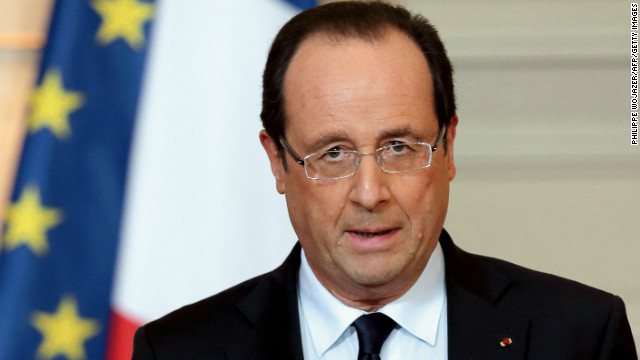
 French President Francois Hollande was under growing pressure on Monday to follow the example of Britain and the U.S. in seeking parliamentary approval for potential military action against Syria.
U.S. President Barack Obama’s announcement on Saturday that he would consult Congress about a military intervention left Hollande alone in threatening to “punish” Syria without a green light from elected representatives.
Prime Minister Jean-Marc Ayrault was to meet with the leaders of parliament on Monday to try build support for a US-led military campaign ahead of a debate on Wednesday.
Ayrault is expected to present them with intelligence on Syrian President Bashar al-Assad’s chemical weapons arsenal which the government says proves the regime’s involvement in a large-scale attack near Damascus last month.
It was uncertain whether the intelligence would appease calls by the opposition for the debate in parliament to be followed by a vote.
So far the government has rejected a vote, pointing to the fact that as head of the armed forces the president is not required to secure parliament’s approval before going to war.
The continuing debate in Western capitals around the legitimacy of airstrikes comes as UN chemical weapons inspectors begin analysing samples taken from the sites of the August 21 attack.
The UN has asked the team of inspectors to hurry the analysis of the samples.
U.S. Secretary of State John Kerry said on Sunday that separate U.S. tests had proven the use of sarin gas.
The U.S. Senate is to begin hearings this week on possible military action, but a vote on the authorisation of force is not expected until Congress officially returns from its recess next Monday.
Syrian Deputy Foreign Minister Faisal al-Mokdad, meanwhile, warned that any strike on Syria would benefit al-Qaeda-linked Islamist extremists.
“Any attack against Syria is support for al-Qaeda and its affiliates, whether Jabat al-Nusra or the State of Islam in Syria and Iraq,’’ al-Mokdad said.
The British broadcaster also quoted al-Mokdad as saying that U.S.-led military action would increase “hatred for the Americans’’.
Russia, a strong ally of the al-Assad regime, continued to express scepticism, with Foreign Minister Sergei Lavrov saying evidence presented by the U.S., Britain and France was unconvincing.
Lavrov added that when Moscow asked for more details, it was being told that they are secret. “That means that there are no facts on which to base international cooperation,” he said.