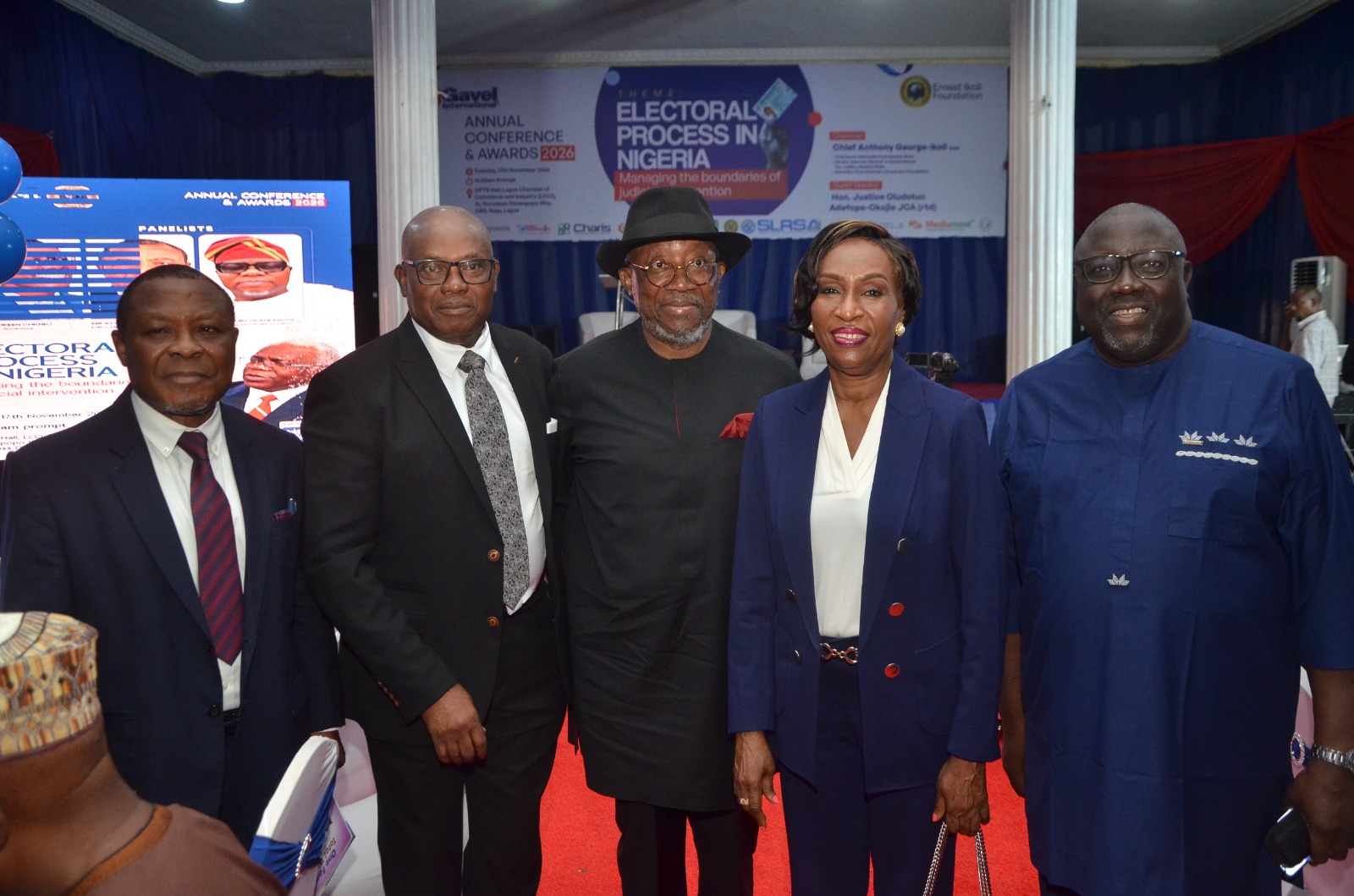
A Retired Justice of the Court of Appeal, Mrs Oludotun Adefope-Okojie, said 103 of the 1,209 petitions filed after the 2023 general elections in Nigeria succeeded.
Adefope-Okojie disclosed this recently in Lagos while delivering the 2026 Gavel International Annual Lecture, titled “Electoral Process in Nigeria: Managing the Boundaries of Judicial Intervention”, at the Lagos Chamber of Commerce and Industry, Alausa, Ikeja.
She said the remaining petitions were withdrawn, struck out, dismissed or refused, describing the situation as evidence that the high volume of election litigation had not translated into widespread vindication.
According to her, the 1,209 petitions were filed against 1,280 contested offices, representing approximately 94.5 petitions for every 100 seats.
She said the figures reflected a serious trust deficit in Nigeria’s electoral process, noting that the country recorded a significantly higher rate of election petitions than some other democracies.
Adefope-Okojie said Nigeria’s electoral disputes were partly driven by political parties’ failure to comply with their constitutions in selecting candidates.
She identified flawed party congresses, wrongful substitution of successful candidates and the imposition of handpicked candidates as some of the factors responsible for pre-election litigations.
The retired judge also listed ballot snatching, vote rigging, vote buying, manipulation and falsification of results among electoral malpractices that had forced aggrieved candidates to seek redress in court.
She, however, cautioned against excessive judicial intervention, saying the courts should protect the choices of voters rather than replace them.
“The ideal situation should be that the vote of the people should be decided at the polling unit, rather than the court of law,” she said.
Adefope-Okojie urged political parties to comply with their constitutions and electoral laws, while calling on the judiciary to ensure that election disputes were determined fairly and transparently.
She also advocated a review of judicial approaches to electoral evidence, arguing that the burden of proving irregularities should not make it practically impossible for petitioners to establish their cases.
She said the introduction of the Bimodal Voter Accreditation System (BVAS) and the Independent National Electoral Commission (INEC) Result Viewing Portal (IReV) under the Electoral Act 2026 offered opportunities for the use of objective, machine-generated evidence.
Adefope-Okojie further said the ultimate goal should be a democratic system in which elections were won and lost at the ballot box, rather than in courtrooms.
The Chairman of the occasion, Chief Anthony George -Okoli (SAN) in his opening remarks, said the authority of a court rested on public confidence and that was damaged when judges were perceived as the real decision-makers in the choice of who governs.
George-Okoli said judiciary remained essential and courts should not become substitute for electorate.
According to him, judicial intervention is constitutionally inevitable band democratically necessary but judicial substitution of the electorate is democratically fatal.
The learned silk said: “When voters believe their votes count only if judges agree, democracy dies.
“Let the polling unit be conclusive, the court corrective and let the people remain sovereign.
“The phrase ‘victory’ in the courtroom should never again become a substitute for victory at the polls, except where the law are honesty and strictly applied.
“When the ballot is credible andbth3 bench is restrained and respected, democracy in Nigeria will rest on firm ground, unity in heritage, strength in equality and sovereignty in the ballot.”
Falana Urges Judiciary to Stop Sacrificing Justice for Technicalities
Human rights lawyer and Senior Advocate of Nigeria (SAN), Mr Femi Falana, urged the judiciary, lawyers and Nigerians to ensure that justice is not sacrificed for technicalities in the determination of election petitions.
Falana, while moderating a panel discussion, commented on the lecture delivered by Adefope-Okojie urged the media to adopt, promote and circulate the lecture paper, describing it as timely ahead of the 2027 general elections.
According to him, the lecture challenges the judiciary, lawyers, Nigerians and the media to ensure that the country gets its electoral process right.
“My lord is saying that never again should we sacrifice justice for technicality.
“MY lord is saying that enough is enough and we must stop imposing on our people those who did not win the election,” he said.
Falana also faulted the three stages of litigation available for governorship election petitions, compared with two stages for presidential and legislative election disputes.
He described the arrangement as discriminatory and said there was no basis for it.
He recalled that he had appealed to members of the national and state assemblies not to extend governorship election petitions to the Supreme Court, warning that doing so would create problems for the apex court.
Falana said attempts since 2011 to restore the previous legal arrangement had failed.
He urged the judiciary to address the challenges associated with election petitions before another round of electoral litigation begins.
The Publisher of Realnews Magazine, Dr. Maureen Chigbo
has urged journalists to educate Nigerians on the electoral process to promote credible elections and ensure effective democratic governance.
Chigbo, while speaking as a panellist, said journalists had a responsibility to educate themselves and the public on the provisions of the Electoral Act 2026 and the Constitution, particularly the roles of the judiciary, INEC and political parties.
Chigbo, who recently monitored an election in Cape Verde, described the exercise as peaceful and orderly, with no intimidation or harassment of voters.
She said that in the 15 wards monitored, only two unarmed policemen were seen, adding that electoral officials arrived on time and voting commenced at 8.00 a.m.
The publisher contrasted the experience with elections in Nigeria, where, according to her, electoral officials often arrive late at polling units and election materials are not deployed on time.
She said the judiciary, INEC and political parties must understand their respective responsibilities and boundaries to prevent confusion in the electoral process.
“If any of the three parties that are involved in the electoral process fail to do what is right, then we are going to have a party at the end of the day and the country will not be at home,” she said.
Chigbo urged journalists to publish relevant provisions of the electoral laws and sensitise citizens on their roles, stressing that failure to do so could lead to disorder in society.
The Publisher of Gavel International, Mr Mustapha Ogunsakin, in his welcome address, described the theme of the 2026 lecture and award as timely ahead of Nigeria’s 2027 general elections.
Ogunsakin said the theme raised fundamental questions about the relationship between the judiciary, electoral institutions and the electorate, particularly the need to protect the integrity of elections without undermining the constitutional responsibilities of other institutions or the sovereignty of the Nigerian people.
The publisher described the guest speaker as a distinguished judicial officer whose career at the High Court and Court of Appeal was marked by intellectual depth, discipline, courage and commitment to justice.
Ogunsakin recalled serving with Adefope-Okojie on a seven-member tribunal of enquiry into the bomb scare and other security incidents at the Ikeja High Court premises in 2005.
He said her exceptional leadership, intellectual dexterity, wisdom and fearlessness ensured that the tribunal completed its assignment within the time stipulated by the government.
According to him, the tribunal’s recommendations provided an enduring framework for strengthening security arrangements within the state’s court premises.
He expressed confidence that the guest lecturer’s presentation would enrich national discourse and offer valuable perspectives on how the judiciary could protect electoral integrity while remaining within its constitutional boundaries.
Ogunsakin also congratulated the awardees, saying their contributions to the legal profession, journalism, public service and national development represented enduring examples of excellence and commitment to society.
The awardees at the event were Mr Christopher Ojo (SAN), Dr. Olisa Agbakoba (SAN), Mr Tayo Oyetibo (SAN), Mr George Etomi, Mr Kqyode Filani, Mr Iniruo Wills, Mr Eze Anaba, Dr. Musikilu Mojeed, Ms Ibiba Don-Pedro, Mr Ayo Aminu and Mr Oladotun Oladipo.