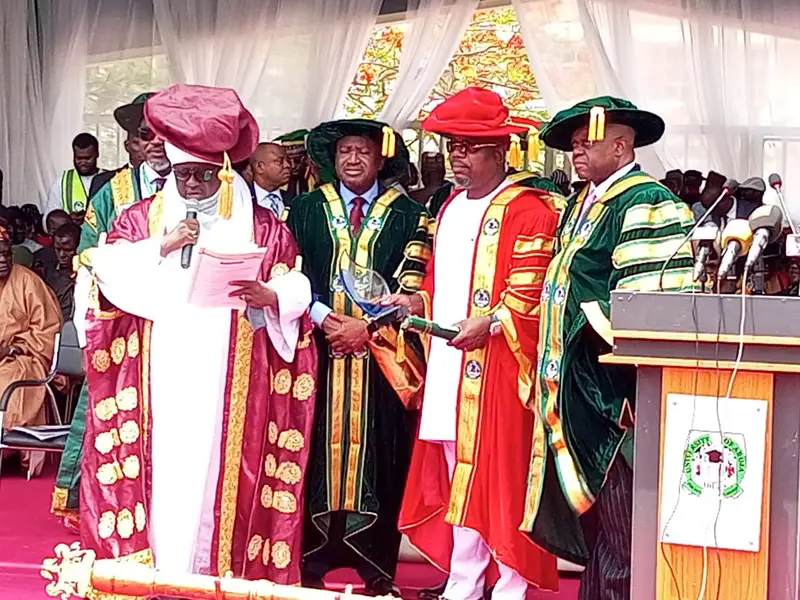
The University of Abuja, recently renamed Yakubu Gowon University, has graduated over 17,200 students across multiple academic sessions during its combined convocation ceremony held in Abuja.
The event also featured the conferment of honorary doctorate degrees on three distinguished Nigerians, including Paul Odili, Prof. Yusuf Ali (SAN), and Emmanuel Iza, in recognition of their contributions to national development.
Speaking at the ceremony, the Vice-Chancellor, Prof. Hakeem Fawehinmi, said the institution is undergoing significant transformation aimed at enhancing academic excellence and research capacity.
He explained that the university is focusing on infrastructure expansion, staff development, and strategic collaborations to improve learning outcomes and global competitiveness.
Providing a breakdown of results, Fawehinmi noted that the 29th convocation (2022/2023 session) produced 7,158 graduates, including 48 First Class degrees.
For the 30th convocation (2023/2024 session), a total of 5,466 students graduated, with 29 achieving First Class honours.
He added that between March 2024 and March 2026, the institution awarded degrees to 4,573 postgraduate students, covering postgraduate diplomas, master’s degrees, PhDs, and professional doctorates.
The vice-chancellor urged graduates to maintain integrity, discipline, and strong character, stressing that personal values would play a key role in their future success.
He also encouraged them to serve as ambassadors of the university and uphold its reputation globally.
Fawehinmi highlighted key infrastructure developments completed by the current administration, including a new Senate chamber complex, modern research laboratories, upgraded science facilities, and improvements to campus road networks.
He noted that a Computer-Based Test (CBT) centre had also been partially completed to enhance digital learning and examination processes.
Ongoing projects include additional student hostels, a Centre of Excellence in Public Leadership and Governance, and specialised facilities for sickle cell research and training.
The vice-chancellor further revealed that the university is among six institutions selected for a $4 billion Federal Government intervention programme aimed at improving training in health-related fields.
In his remarks, the Pro-Chancellor, Sen. Olanrewaju Tejuoso, called for increased private sector investment to address infrastructure gaps, particularly in student accommodation.
He noted that student enrolment has grown significantly without a matching expansion in hostel facilities and urged investors to partner with the institution.
Tejuoso also warned against illegal encroachment on university land, stating that management would take firm steps to protect its assets.
Representing the Minister of Education, Dr Tunji Alausa, the Permanent Secretary, Abel Enitan, reaffirmed the Federal Government’s commitment to strengthening Nigeria’s education sector.
He described education as a key driver of innovation, economic growth, and national stability, adding that ongoing reforms are aimed at improving governance and academic standards.
One of the honorary award recipients, Paul Odili, pledged support for the university’s development efforts and encouraged graduates to remain resilient in pursuing their goals.
The convocation ceremony underscored the institution’s ongoing reforms, infrastructure development, and commitment to building partnerships for sustainable growth.