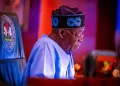
President Bola Tinubu has called on African governments to invest more in homegrown defence technology, military expertise and regional cooperation as emerging security threats continue to reshape the continent’s security landscape.
The president made the appeal on Monday, October 26, 2026, during the opening of the maiden Africa International Defence Exhibition (AFRIDEX 2026) at Eko Atlantic in Lagos.
Represented by Senate President Godswill Akpabio, Tinubu warned that African countries could no longer rely solely on traditional military approaches to confront increasingly sophisticated security challenges.
He identified artificial intelligence, cyber warfare, space-based technology and autonomous defence systems as developments changing how countries respond to modern threats.
Africa Must Build Its Own Defence Strength
Tinubu said Africa needed to move beyond dependence on imported military equipment and develop the technical knowledge, institutions and industries required to protect its people.
He urged governments to create opportunities for young African innovators, engineers and technology professionals to contribute to the continent’s security.
According to the president, investing in local expertise would enable African countries to maintain their defence equipment, develop new technologies and respond more effectively to emerging threats.
He explained that insecurity had become a shared challenge, with criminal and extremist activities affecting communities across national borders.
From insurgency in the Sahel to maritime crime in the Gulf of Guinea, he said the consequences were being felt through lost lives, disrupted businesses, displacement and declining economic opportunities.
Tinubu Calls for Stronger Military Cooperation
The Nigerian leader stressed that no African country could adequately address today’s security threats without working closely with its neighbours.
He advocated stronger intelligence sharing, coordinated military operations, joint training and greater investment in African-led peacekeeping efforts.
Tinubu also highlighted the importance of protecting the Gulf of Guinea, describing maritime security as essential to international trade, energy supplies and economic stability.
He said meaningful defence cooperation should produce long-term benefits for African countries rather than end with the purchase of military hardware.
Such partnerships, he explained, should help local companies grow, improve technical skills and strengthen the ability of African institutions to maintain and operate modern defence systems.
Nigeria’s Security Challenges Demand Greater Investment
Reflecting on Nigeria’s security situation, Tinubu acknowledged the heavy toll of terrorism, banditry, insurgency, piracy and other forms of organised crime.
He praised members of the Nigerian Armed Forces for their service and recognised personnel who had lost their lives while protecting the country.
The president maintained that military personnel needed dependable equipment, continuous training and strong institutional support to carry out their responsibilities.
He also stressed that effective security operations must respect human rights, professional military standards and democratic civilian oversight.
According to him, Nigeria remains committed to expanding domestic defence production and building partnerships that improve national security without undermining public accountability.
Lagos Highlights Role of Technology in Security
Lagos State Governor Babajide Sanwo-Olu, represented by Deputy Governor Obafemi Hamzat, described security as an essential foundation for economic growth and investment.
He said AFRIDEX offered African governments, defence manufacturers and security professionals an opportunity to develop practical solutions to shared security challenges.
Sanwo-Olu noted that modern security systems increasingly depend on surveillance technology, effective communication, cooperation between agencies and public confidence.
He disclosed that the Lagos State Government was rebuilding its Command and Control Centre while expanding closed-circuit television surveillance to improve security monitoring and coordination.
The governor also encouraged stronger partnerships across maritime, aviation, land, space and cybersecurity operations.
DICON Seeks Stronger African Defence Industry
The Director-General of the Defence Industries Corporation of Nigeria (DICON), Maj.-Gen. Ibrahim Alaya, said the exhibition was intended to promote technological innovation and strengthen Africa’s defence manufacturing capacity.
He explained that DICON, established in 1964 to produce military equipment for Nigeria’s security institutions, was undergoing reforms aimed at improving its operations and industrial relevance.
Alaya identified the Defence Industries Corporation of Nigeria Act 2023 as an important step towards expanding local production and encouraging partnerships with private manufacturers, research organisations and international technology companies.
He said the exhibition would provide opportunities for investment, technical cooperation and the development of sustainable defence industries across Africa.
Rather than measuring success only by attendance or the equipment displayed, Alaya said the real value of AFRIDEX would be determined by the partnerships and industrial projects established after the event.
AFRIDEX Brings Defence Leaders Together in Lagos
The maiden Africa International Defence Exhibition brought together military leaders, security agencies, defence manufacturers, policymakers and procurement specialists from Africa and other parts of the world.
Participants explored developments in military technology and opportunities to strengthen cooperation across land, air, maritime, cyber and space defence.
The opening ceremony also featured the unveiling of Nigeria’s first 3D-printed uncrewed surface vessel, according to the event information accompanying the News Agency of Nigeria report.
Tinubu urged participants to ensure that the exhibition produced practical agreements capable of improving security across the continent.
He maintained that the ultimate purpose of defence investment was to create safer communities where farmers could work without fear, children could attend school and businesses could operate freely.