

President Bola Tinubu says investing in education remains the best way to honour the legacy of Herbert Macaulay, Nigeria’s foremost nationalist.
Tinubu said Macaulay’s life of courage and sacrifice laid the foundation for independence, and the present generation must sustain it by building informed citizens and visionary leaders through education.
The President spoke on Saturday at the 80th remembrance anniversary of Macaulay during a memorial colloquium in Lagos.
Tinubu, represented by Prof. Afolabi Lesi, Deputy Vice-Chancellor of the University of Lagos (UNILAG), said education remained critical to nurturing informed citizens, developing visionary leaders and building a prosperous nation.
He said the conviction was central to his administration’s Renewed Hope Agenda, which prioritised improved access to quality education, skills development and innovation.
According to him, the Federal Government is implementing far-reaching reforms to prepare Nigerian youths to compete successfully in the global economy.
He listed the Nigerian Education Loan Fund (NELFUND), skills development initiatives and support for young entrepreneurs through start-up grants among the measures aimed at advancing educational opportunities and economic empowerment.
The President said nation-building required visionary leadership, responsible citizenship and sustained commitment to the common good.
He described Macaulay as a visionary leader, uncompromising patriot and fearless advocate for justice and self-determination.
“His life of courage, sacrifice and service laid the foundation for the nationalist movement that ultimately led to Nigeria’s independence,” he said.
Tinubu commended the Macaulay family, Chief Olabode George, the organisers of the memorial colloquium and others committed to preserving the memory and ideals of the nationalist.
He urged leaders at all levels to reflect on the legacies they wished to leave behind, saying Macaulay’s life challenged the present generation to serve Nigeria with integrity, courage and selfless devotion.
Former President Goodluck Jonathan, the chairman of the occasion, challenged Nigeria’s political leaders and citizens to reflect on whether the country had lived up to the dreams and aspirations of its founding nationalists.
He asked whether Herbert Macaulay, Nnamdi Azikiwe, Obafemi Awolowo, Ahmadu Bello and other heroes of the independence struggle would be proud of today’s Nigeria or regret the outcome of their sacrifices.
Speaking on the theme, “Nationalism and Nation Building,” the former president said the vision of Nigeria’s founding nationalists went beyond the transfer of political power from colonial authorities to Nigerians.
“They envisaged a sovereign, united and prosperous country where citizens would enjoy equal rights, economic opportunities, quality education, accessible healthcare and the benefits of accountable governance,” he said.
Jonathan appealed that Nigeria must not allow its founding nationalists to regret the struggle they waged for independence.
According to him, the greatest tribute to the nation’s heroes is not merely to celebrate their birthdays or preserve their monuments but to build a country that reflects the ideals for which they sacrificed.
“We must not make Herbert Macaulay, Nnamdi Azikiwe, Obafemi Awolowo, Ahmadu Bello and the other founding nationalists regret, even in their graves, the struggle they waged for our independence,” he said.
George, who spoke on the legacies of Macaulay, said the foremost nationalist laid the foundation for Nigeria’s independence.
He revealed that Macaulay was a thorn in the flesh of colonial masters to the extent that immediately after his death in 1946, his house in Marina, Lagos was demolished and the General Post Office was built on the land.
George, the Atona Oodua of Yorubaland, appealed to the Tinubu-led Federal Government to return the land to the Macaulay Family for a befitting monument in honour of Herbert Macaulay to be constructed by the family.
Earlier, Governor Babajide Sanwo-Olu of Lagos said Macaulay’s legacy of courage, leadership and commitment to public service remained an enduring inspiration.
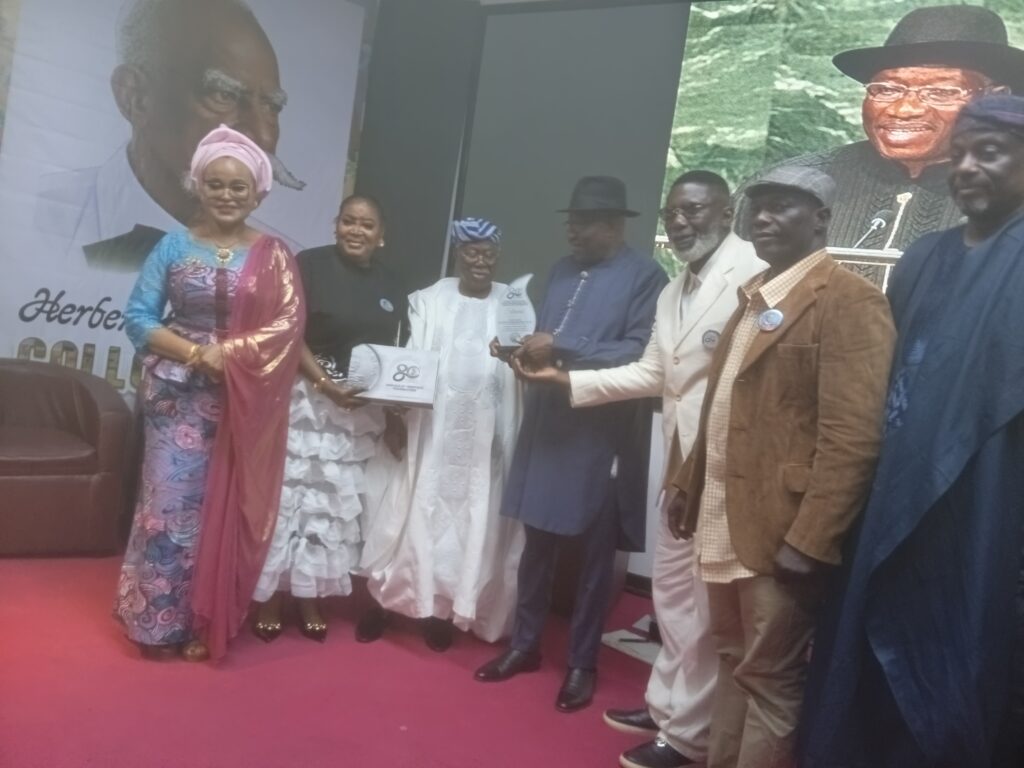
Sanwo-Olu, represented by Mrs Bimbola Hundeyin, Secretary to the Lagos State Government, spoke while receiving the Herbert Macaulay Award for Leadership in Public Service, Cultural Ambassadorship and Urban Development.
He expressed appreciation to the Macaulay descendants’ family and the Macaulay Heritage Foundation for the recognition, describing it as a special honour because of Macaulay’s contributions to Lagos and Nigeria.
Sanwo-Olu described Macaulay as an engineer, architect, political leader and nationalist who championed Nigerians’ right to participate in the affairs of their country when political participation was severely restricted.
According to him, the establishment of the Nigerian National Democratic Party (NNDP) in 1923 by Macaulay was a defining milestone in Nigeria’s political history.
He said Macaulay’s commitment to the welfare of ordinary citizens, fairness in public administration and participatory governance offered important lessons for contemporary leadership.
“The true measure of leadership is not the office one occupies, but the lives one touches, the institutions one strengthens and the legacy one leaves behind,” he said.
He said the Lagos Government’s development agenda was people-centred and guided by integrity, public responsibility and determination to improve the lives of residents.
He added that the government had also invested in creative and cultural industries, recognising the importance of Lagos’ diversity, resilience and enterprise.
He commended the Macaulay descendants’ family, the Board of Trustees and the Macaulay Heritage Foundation for preserving the nationalist’s contributions to Nigeria’s history.
He urged Nigerians to translate Macaulay’s ideals into their conduct, institutions and commitment to nation-building.
Sanwo-Olu said the greatest tribute to the country’s historical heroes was to uphold the values for which they stood.
Delivering the keynote address, Emeritus Professor of History, Akinjide Osuntokun, said Macaulay remained special and unique in history.
Speaking on “Nationalism, Nigeria and Nation-Building,” Osuntokun called for a more inclusive understanding of nationalism and nation-building in Nigeria, warning that ethnic sentiments, tribalism and extreme nationalism could undermine national unity.
Osuntokun argued that Nigeria should be understood as a multinational state rather than a nation-state, given its diverse ethnic, linguistic and cultural identities.
He said the challenge before the country was to develop a shared sense of belonging that would enable its different nationalities to coexist peacefully under one government.
According to him, nationalism should be understood as the willingness of people with common historical, linguistic and territorial connections to live together under a united government.
He, however, warned that nationalism could assume dangerous dimensions when it promoted ethnic superiority, territorial expansion and hostility towards other groups.
Drawing lessons from European history, Osuntokun cited Germany and Italy as examples of countries where nationalist movements contributed to political unification but also demonstrated the destructive consequences of extreme nationalism.
He noted that extreme nationalist sentiments in Germany and Italy contributed to the conflicts and devastation of the 20th century, particularly the First and Second World Wars.
The professor also explained the concept of irredentism, describing it as the desire of a country or ethnic group to reclaim territories or reunite with people considered part of its national community but living outside its borders.
He said although such sentiments existed in Africa, they had largely not developed into major armed conflicts, warning that attempts by African countries to annex territories based on ethnic or linguistic connections could trigger serious crises.
He further argued that anti-colonial nationalism, which brought together different ethnic and religious groups against European colonial rule, did not automatically guarantee unity after independence.
During the discussion, Prof. Adele Jinadu, a renowned Professor of Political Science, who called for understanding of the state-formation process, said Macaulay represented a generation who spoke truth to power.
Jinadu emphasised the role of public intellectuals and professionals to speak truth to power, saying “this is missing today. Intellectuals have kept quiet. We must have national leaders.”
According to him, Macaulay remains significant because of his fight against foreign occupation and for his territory.
Also speaking, Prof. Eghosa Osaghae, the Director-General, Nigerian Institute of International Affairs (NIIA), said federalism had been described as the cure for micro-nationalism with capacity to accommodate separatist agitation.
Osaghae, however, described the federal solution as a continuous process, requiring fine-tuning based on the pressure of political society.
Also speaking, Dr Lanre Arogundade, the Executive Director of the International Press Centre (IPC), highlighted some takeaways from Macaulay’s nationalism for nation-building to include education for all, freedom of expression of media and political movement that truly represent the people.
“Today, there is intolerance of criticism in Nigeria. We think our leaders are gods that cannot be criticised.
“Whereas if Herbert Macaulay did what they do, we would not have independence and democracy they enjoy today,” he said.
The event was attended by dignitaries including Gen. Ike Nwachukwu, Mrs Margaret Shonekan, Prince Tajudeen Olusi, Alhaja Sinatu Ojikutu, a former Lagos deputy governor, and White Cap Chiefs, among others.


Tinubu, Jonathan, Sanwo-Olu, Bode George, Osuntokun, others eulogise Herbert Macaulay at Colloquium
Leave a Reply








Latest Stories





© 2026 Published by SWAAYA LIMITED, Plot 20, Block G, Scheme 1, Residential 3, OPIC Beachland Estate, Lagos/Ibadan Expressway, Lagos. Gabriel Akinadewo, MD/CEO 08023010222, 08094000056, 08052097814.