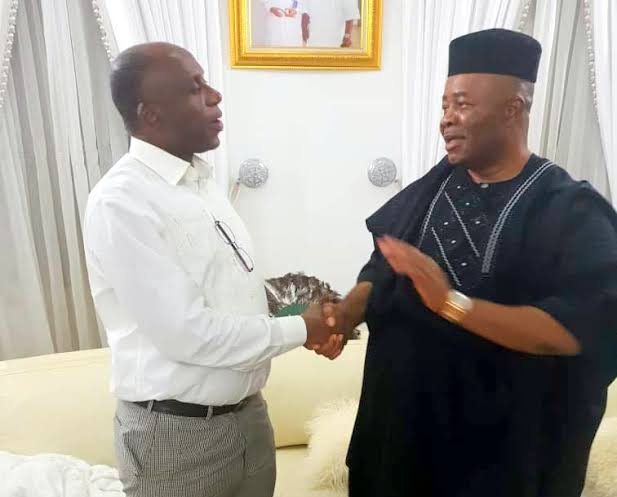
Senate President, Godswill Akpabio, has attacked former Transportation Minister, Rotimi Amaechi, over the financial handling of some projects when he was Rivers Governor between 2007 and 2015.
Akpabio was also Akwa Ibom Governor during the same period.
Amaechi, the ADC Vice Presidential candidate in the 2027 election, alleged during a rally in Bauchi on Saturday that Akpabio, as Niger Delta Minister during the Muhammadu Buhari administration, introduced a 50 per cent deduction from payments to contractors of the Niger Delta Development Commission (NDDC).
But, Akpabio would have none of that.
In a riposte by his Special Adviser on Media and Publicity, Eseme Eyiboh, the Senate President defended his integrity.
Read the statement below:
*AMAECHI’S NDDC ALLEGATION: PUBLIC ACCOUNTABILITY REQUIRES EVIDENCE, NOT CAMPAIGN DECLARATION*
The attention of the Office of the President of the Senate has been drawn to statements attributed to former Rivers State Governor and former Minister of Transportation, Mr Chibuike Rotimi Amaechi, at a political rally in Bauchi State on Saturday, 14 November 2026, alleging that His Excellency, Distinguished Senator Godswill Obot Akpabio, GCON, introduced a 50 per cent deduction from payments to contractors of the Niger Delta Development Commission (NDDC).
The allegation is sufficiently serious to deserve scrutiny. It is also specific to require evidence.
According to published accounts of his remarks, the former Governor offered no contract documents, payment records, identifiable transactions or other verifiable particulars to substantiate his accusation. An allegation delivered before an enthusiastic political audience does not, by that circumstance alone, acquire the status of an established fact.
The distinction between political accusation and demonstrable wrongdoing is fundamental to responsible public discourse. Public figures, particularly those who have occupied high executive offices, should appreciate that distinction and accord public communication the decorum it requires.
*THE BURDEN OF PROOF CANNOT BE REPLACED BY RHETORIC*
If Mr Amaechi possesses credible evidence of unlawful deductions involving NDDC contractors, the appropriate course is to identify the relevant transactions, disclose the supporting records and submit the material to competent investigative authorities and not the act of rabble-rousing.
The questions are straightforward: Which contracts are involved? Which contractors were affected? When were the alleged deductions made? Through what payment arrangements did they occur? What evidence establishes the personal involvement attributed to the President of the Senate?
These are not unreasonable demands. They are the elementary requirements of accountability and standards of proof.
Neither the prominence of an accuser nor the intensity of his language can substitute for answers.
*THE RIVERS STATE RECORD ALSO DESERVES SCRUTINY*
Mr Amaechi served as Governor of Rivers State from 2007 to 2015, a period during which his administration initiated major infrastructure, education, healthcare and transportation projects.
That record is a legitimate subject of public examination, including the relationship between expenditure, project completion, operational sustainability and value for money.
Two particularly consequential examples are the Port Harcourt monorail project, which became the subject of sustained controversy over its reported cost, incomplete implementation and eventual inability to provide the anticipated public transportation service and, the Malaria-free Rivers State initiatives.
The history of these projects raised questions that cannot be resolved through political exchanges alone: What expenditure was incurred? What proportion of the original transportation objectives was achieved? What institutional and contractual decisions contributed to the project’s difficulties? What lessons should public authorities draw from its implementation?
These questions are appropriate because public accountability does not begin and end with one’s political opponents.
It extends to every public official entrusted with resources, authority and responsibility.
*POLITICAL COMPETITION MUST NOT DISPLACE PUBLIC RESPONSIBILITY*
The approaching 2027 general elections will inevitably produce disagreements among political actors. Such disagreements are normal in a democracy.
However, electoral competition does not diminish the obligation to speak responsibly about matters capable of affecting public confidence and trust in institutions.
The NDDC was established to address longstanding developmental challenges in the Niger Delta. Allegations concerning its contracts, finances and administration should be investigated through credible processes rather than reduced to instruments of political confrontation.
The people of the Niger Delta deserve functioning infrastructure, transparent procurement, completed projects and measurable developmental outcomes. Their interests should remain central to any serious discussion about the Commission.
*A CALL FOR EVIDENCE AND INSTITUTIONAL ACCOUNTABILITY*
Mr Amaechi is entitled to raise concerns about public administration. He is equally obliged to distinguish what he can substantiate from what he merely alleges.
The same standard applies to every public officeholder.
We therefore invite him to place any credible documentary evidence in his possession before the appropriate authorities so that the issues he has raised may be examined objectively and in accordance with the law.
Public accountability is strengthened when accusations are tested against evidence, when public expenditure is examined against outcomes, and when institutions are permitted to discharge their responsibilities without political interference. The Godswill Akpabio’s era as Governor of Akwa Ibom State speaks eloquently and directly to this logarithm.
Ultimately, the credibility of a public allegation must rest not on the volume of its delivery, the status of its author or the occasion on which it is made, but on the quality of the evidence supporting it.
Let the facts speak.
*Rt. Hon. Eseme Eyiboh, MNIPR
Special Adviser on Media and Publicity
Office of the President of the Senate.