



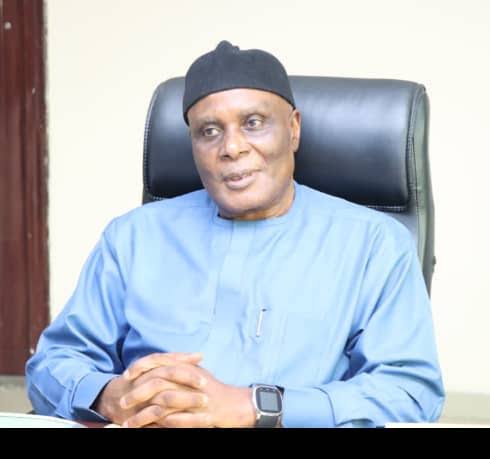
Former Cross River State Governor Clement Ebri has urged newspaper publishers across Nigeria to see technology as an opportunity for growth rather than a threat to the survival of print journalism.
Ebri made the call on Thursday during the reopening of the renovated Cross River State Newspaper Corporation, popularly known as the Nigerian Chronicle, and the commissioning of the newly upgraded government printing press in Calabar.
Reflecting on his association with the newspaper, the former governor acknowledged that digital technology had changed how people access, consume and distribute information.
However, he argued that technological advancement should not signal the end of traditional newspapers but should instead provide new opportunities for media organisations to expand their influence.
“Technology should not be the undertaker of the newspaper; it should become its new vehicle,” Ebri said.
Print and digital media must work together
Ebri encouraged the Nigerian Chronicle to develop a stronger online presence while maintaining the credibility and professional standards associated with traditional journalism.
He advised the newspaper to embrace multiple platforms, including print editions, websites, social media channels and emerging digital tools, to reach wider audiences.
The former governor said print and digital journalism should not be viewed as rivals, stressing that both forms of media serve different but important purposes.
“Digital is immediate, while print offers enduring archival value,” he said.
He challenged the management of the newspaper corporation to focus not only on restoring the publication’s former reputation but also on transforming it into a modern media organisation capable of competing in the future.
According to him, the important question is no longer how to preserve the Nigerian Chronicle, but how to reposition it as a relevant institution in a rapidly changing media environment.
Ebri calls for restoration of Chronicle archives
The former governor also called for the rebuilding of the newspaper’s library and archives, describing them as important records of Cross River State’s history.
He recalled that the 2020 EndSARS protests led to the destruction of equipment, books, documents and historical materials belonging to the corporation.
Ebri warned that losing institutional records could affect society’s ability to preserve its history accurately.
“A newspaper that has documented the history of a people for decades cannot afford to lose its own history,” he said.
He appealed to former employees, readers and members of the public to support the rebuilding effort by donating old editions of the Chronicle, photographs, documents and other historical materials.
According to him, preserving the archives would help protect the collective memory of Cross River people and prevent important historical records from disappearing.
Nigerian Chronicle revival requires innovation
Ebri said the successful revival of the newspaper would require continuous investment, innovation, professionalism and commitment to credible journalism.
He urged stakeholders to support the publication through readership and advertising while also demanding high ethical standards from its management and journalists.
Veteran journalist Ray Ekpo described the event as a homecoming and praised Governor Bassey Otu for restoring the newspaper’s facilities.
Ekpo said print journalism remained valuable despite the rise of digital platforms, recalling his years of service at the Chronicle, where he progressed from a features writer to editor.
He noted that journalists of his generation achieved significant milestones despite working with limited resources and traditional equipment.
Government announces employment plans
Former Cross River Commissioner for Information, Dr Erasmus Ekpang, said the rehabilitation of the newspaper corporation was not only about infrastructure but also about strengthening its workforce and future operations.
Ekpang disclosed that approval had been granted for the recruitment of 30 temporary workers for the printing press and 25 permanent employees for the Nigerian Chronicle.
He said the move was part of the state government’s broader job creation programme.
The event was attended by Governor Bassey Otu, Minister of Information and National Orientation Mohammed Idris, and other government officials.
Background Information
The global newspaper industry has experienced major changes due to: Growth of online news platforms, declining print circulation, social media influence, digital advertising competition, artificial intelligence in journalism
Many traditional newspapers are now adopting hybrid models combining: Print editions, websites, mobile applications, social media publishing, digital subscriptions