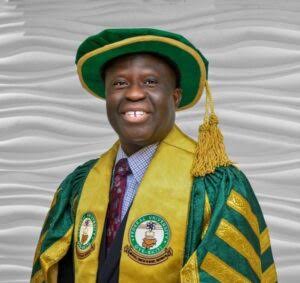
The Nigerian Senate has confirmed the nomination of Prof. Abayomi Fasina, former Vice-Chancellor of the Federal University Oye-Ekiti, as a non-career ambassador.
Fasina’s confirmation followed the presentation and adoption of a report by the Senate Committee on Foreign Affairs.
The committee, chaired by Sen. Sani Bello, recommended his confirmation after conducting a screening exercise.
Presenting the report, Sen. Simon Lalong of Plateau South said the committee interviewed Fasina and found his responses satisfactory.
Lalong said the nominee answered questions relating to his qualifications, public service record and suitability for the ambassadorial role.
He explained that the committee considered the nomination in line with Section 171(4) of the 1999 Constitution, as amended.
The section requires Senate confirmation for ambassadorial appointments made by the President to become valid.
Lalong said the committee received both petitions opposing and supporting Fasina’s nomination.
According to him, all submissions were reviewed carefully alongside available evidence and relevant official reports.
He said allegations of sexual harassment against the former vice-chancellor during his time at FUOYE had been investigated by the university’s Governing Council and the Nigeria Police.
The committee said the allegations were not substantiated by those investigations.
Lalong added that the Department of State Services and the Nigeria Police Force cleared the nominee.
He said committee members also found Fasina articulate and satisfactory during the screening.
The committee therefore recommended his confirmation, saying constitutional requirements had been met and no official finding disqualified him from the appointment.
During debate on the report, Sen. Adams Oshiomhole of Edo North opposed immediate confirmation.
Oshiomhole raised concerns over allegations reportedly involving two women and said some issues were said to be before competent courts.
He argued that although Fasina remained innocent until proven guilty, confirming him before any judicial resolution could appear insensitive to women who had raised concerns.
In response, Lalong said the committee did not receive court documents or evidence confirming that there were pending legal proceedings involving the nominee.
He maintained that allegations alone were not enough to deny confirmation.
Lalong added that the Senate had a duty to uphold the principle that an accused person remains innocent until proven guilty by a court.
Sen. Cyril Fasuyi of Ekiti North also opposed the nomination.
He said FUOYE, where Fasina served as vice-chancellor, is located in his constituency and that the allegations had been widely discussed in the state.
Fasuyi urged the Senate to order further investigation before reaching a final decision on the nomination.
However, Sen. Abdul Ningi of Bauchi Central supported the confirmation.
Ningi said the committee had reviewed the concerns raised and also considered petitions and counter-petitions relating to the nominee.
He said the committee established that competent authorities, including the university’s Governing Council and the Nigeria Police, investigated the allegations and found them unsubstantiated.
He therefore recommended that Fasina be confirmed as a non-career ambassador.
Senate President Godswill Akpabio also addressed the chamber before the confirmation.
Akpabio said the documents before him showed that investigations by the university council and the police did not establish a case of sexual harassment against the nominee.
He said the Senate could only rely on documents officially placed before it, not hearsay or informal conversations.
Akpabio added that the committee report cleared Fasina and affirmed his competence, integrity and suitability for the ambassadorial appointment.
He urged senators to be guided by evidence in their deliberations.
The Senate thereafter confirmed Fasina as a non-career ambassador.
Fasina was born on July 17, 1961, in Lagos.
He is described as an academic, soil scientist and university administrator with more than four decades of experience in teaching, research and public service.