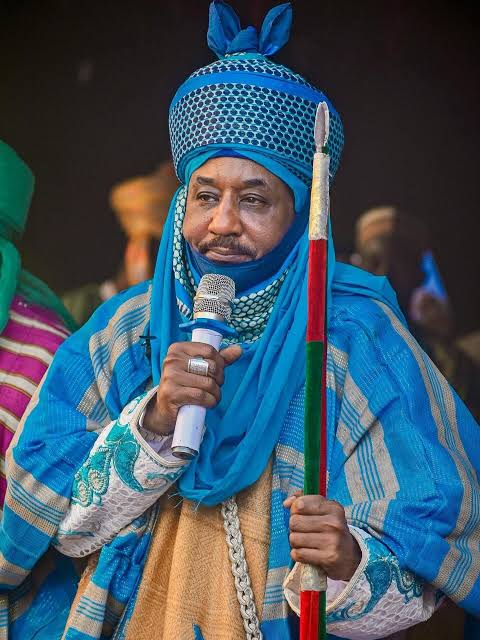
The Emir of Kano, Muhammadu Sanusi II, has urged the Federal Government to respond more openly to criticism over Nigeria’s economic difficulties, warning that concerns about poverty and hardship should not automatically be interpreted as political attacks on President Bola Ahmed Tinubu.
Sanusi said Nigerians experiencing economic difficulties deserve to have their concerns acknowledged, even as the government pursues reforms intended to strengthen the economy.
The former Central Bank of Nigeria governor made the remarks on Tuesday while addressing the Oxford Global Think Tank Leadership Conference virtually.
He called for greater understanding between political leaders and citizens, stressing that constructive criticism should contribute to better governance rather than create unnecessary hostility.
Sanusi Warns Against Dismissing Public Complaints
Speaking at the conference organised by the Oxford Global Think Tank, Sanusi expressed concern about how government officials sometimes respond to public discussions about economic hardship.
He argued that complaints about poverty, rising living costs and declining living standards should be treated as legitimate concerns requiring policy attention.
According to the traditional ruler, criticising economic conditions does not necessarily mean opposing the government or attacking the president.
He urged public officials to recognise the difference between political hostility and genuine concerns about the welfare of Nigerians.
Sanusi also called for an end to the division between government supporters and critics, arguing that both groups have a shared responsibility to contribute to national development.
Nigeria’s Debt Servicing Raises Fresh Concerns
The Emir also questioned the sustainability of Nigeria’s public spending, warning that the country cannot achieve meaningful fiscal discipline without controlling government expenditure.
Citing figures he attributed to the World Bank, Sanusi said debt servicing consumed 124 per cent of Federal Government revenue during the first half of 2026.
He described the situation as a warning about the pressure debt obligations could place on public finances.
Sanusi stressed the need for structural reforms that would improve fiscal sustainability and prevent excessive spending from undermining economic recovery.
He maintained that government must make difficult choices about how limited public resources are allocated.
Fuel Subsidy Removal Alone Is Not Enough, Sanusi Says
Sanusi acknowledged the significance of the economic measures introduced by the Tinubu administration, including the removal of petrol subsidies and changes to Nigeria’s foreign exchange system.
However, he argued that these policies should form part of a broader reform programme rather than being treated as complete solutions to the country’s economic problems.
He identified electricity, agriculture, road infrastructure and technology as important sectors requiring strategic investment.
According to him, government spending decisions involve trade-offs because resources committed to one sector cannot simultaneously be used elsewhere.
He therefore urged policymakers to establish clear priorities based on Nigeria’s most pressing development needs.
Sanusi Acknowledges Progress Under Tinubu’s Economic Reforms
Despite his criticism of government spending and social protection policies, Sanusi recognised what he described as measurable improvements in some economic indicators.
He cited economic growth, declining inflation and stronger foreign exchange reserves as areas where progress had been recorded.
According to figures presented during his address, Nigeria’s economic growth had increased from an average of 0.9 per cent under the previous administration to approximately 4.5 per cent.
He also referred to inflation declining from above 30 per cent to around 14.6 per cent, with a projection of 12.5 per cent in 2027.
Sanusi further cited foreign reserves of approximately $55 billion as another sign of improving macroeconomic conditions.
He maintained that these developments deserved recognition, while emphasising that stronger economic statistics must eventually translate into better living conditions for ordinary Nigerians.
The figures were presented as part of Sanusi’s assessment and should be distinguished from independently verified official statistics.
Poverty, Hunger and Healthcare Remain Major Challenges
The Emir warned that improvements in headline economic indicators do not necessarily mean that Nigerian households are experiencing immediate relief.
He identified poverty, hunger, maternal mortality, child malnutrition, education and healthcare as major challenges requiring urgent government intervention.
Sanusi argued that economic reforms should have been accompanied from the beginning by stronger social protection programmes to support vulnerable households.
He said measures designed to cushion the effects of subsidy removal and other economic changes were essential to protecting Nigerians who were already struggling financially.
His comments highlighted the difference between achieving macroeconomic stability and ensuring that economic growth produces tangible improvements in people’s lives.
Sanusi Calls for Greater Inclusion of Women in Governance
Beyond economic policy, Sanusi raised concerns about the limited representation of women in government and public decision-making.
He argued that women should have a stronger voice in designing policies affecting families, children and communities.
The Emir identified maternal healthcare, childhood nutrition and early childhood development as areas where women’s experiences could contribute significantly to policy decisions.
He called for more meaningful female participation across different levels of government.
According to him, inclusive decision-making would help ensure that policies address the everyday challenges faced by households.
Electricity, Agriculture and Technology Key to Economic Growth
Sanusi also urged the Federal Government to focus on sectors capable of supporting long-term economic expansion.
He identified reliable electricity supply, improved agricultural productivity and investment in technology as important drivers of future growth.
He argued that progress in these areas could stimulate business activities, improve productivity and create more economic opportunities.
The former CBN governor maintained that Nigeria needs a combination of fiscal discipline, structural reforms and targeted social investment to achieve sustainable development.
Government and Citizens Must Work Together
Concluding his remarks, Sanusi called for a more cooperative relationship between the government and the public.
He urged political leaders to avoid treating critics as enemies and encouraged citizens to recognise genuine progress where it occurs.
The Emir maintained that Nigeria’s economic challenges require collective effort, open dialogue and policies that respond to the needs of the population.
His message centred on the need to balance economic reforms with public welfare, accountability and greater responsiveness to citizens’ concerns.