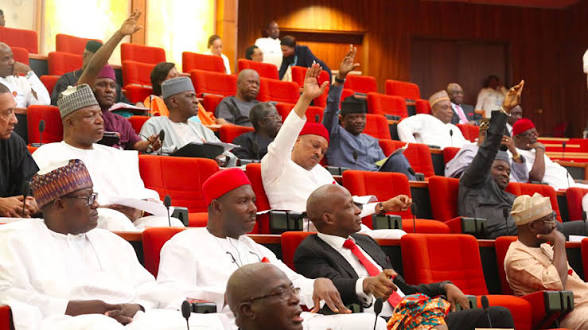
The Nigerian Senate has begun moves to introduce a comprehensive framework for regulating, coordinating and monitoring foreign aid, grants and donations received in the country.
The proposed legislation, sponsored by Senator Ibrahim Dankwambo of the Peoples Democratic Party (PDP), Gombe North, passed second reading during Wednesday’s plenary.
The bill, titled the Foreign Aid, Grants and Donations Regulation, Coordination, Transparency and Disclosure Bill, 2026, seeks to establish clearer rules for the management and disclosure of foreign financial assistance in Nigeria.
Leading the debate, Dankwambo said Nigeria received significant support from bilateral and multilateral partners through humanitarian assistance, technical support, grants and concessional financing.
He noted that such funding had supported important sectors, including healthcare, education, agriculture and emergency response.
However, the lawmaker expressed concern that the system for managing foreign assistance remained fragmented and lacked a unified mechanism for coordination and transparency.
According to him, donor-funded initiatives are sometimes spread across different Ministries, Departments and Agencies without sufficient coordination.
He also raised concerns about projects being implemented outside the national budget, duplicated across institutions or poorly aligned with Nigeria’s development priorities.
Dankwambo argued that these challenges could reduce efficiency, weaken value for money and undermine public confidence in the management of foreign resources.
The proposed bill is based partly on constitutional provisions governing public funds and oversight by the National Assembly, as well as provisions of the Fiscal Responsibility Act, 2007.
The senator maintained that once foreign aid enters Nigeria and is used for public purposes, it should be subject to appropriate transparency, accountability and oversight mechanisms.
He said the proposed legislation would address what he described as a gap in the existing system by ensuring that foreign aid could not operate outside national accountability structures.
“The issue is not that Nigeria lacks institutions,” Dankwambo argued. “The challenge is the absence of a binding framework that brings all the relevant actors under one coordinated system.”
The lawmaker explained that various government institutions currently perform different roles in the management of foreign assistance.
The Federal Ministry of Finance engages with donors, the Budget Office handles the integration of some projects, while the Debt Management Office manages concessional borrowing.
The Office of the Accountant-General of the Federation also tracks certain disbursements.
However, Dankwambo said the existing arrangements did not provide a single statutory framework requiring all relevant stakeholders—including non-governmental organisations and sub-national governments—to disclose and coordinate their activities.
The bill proposes the creation of a National Donor Coordination Framework built around existing government structures.
It also seeks mandatory registration of foreign aid-related activities, the creation of a central database, integration of aid into national planning and stronger alignment with Nigeria’s development priorities.
During the debate, Senator Adams Oshiomhole of the All Progressives Congress (APC), Edo North, supported the need for stronger oversight of foreign funding.
Oshiomhole warned that foreign funds could, in some circumstances, be used by individuals or groups to pursue activities that could threaten national unity and stability.
He therefore called for effective enforcement mechanisms and sanctions for individuals or organisations that fail to disclose foreign funding as required by law.
The senator said the proposed framework should help protect Nigeria’s peace, unity and national interest without undermining legitimate foreign assistance.
Senate President Godswill Akpabio commended Dankwambo for sponsoring the legislation.
Akpabio noted Dankwambo’s previous experience as Accountant-General of the Federation and his knowledge of foreign grants, development assistance and the activities of non-governmental organisations.
Following the debate, the bill was referred to the Senate Committees on National Planning and Economic Affairs, Finance, and Foreign Affairs for further consideration.
The committees were given six weeks to complete their work and report back to the Senate.
If passed into law, the proposed legislation could significantly change how foreign aid, grants and donations are registered, coordinated, disclosed and integrated into Nigeria’s broader public financial management system.