



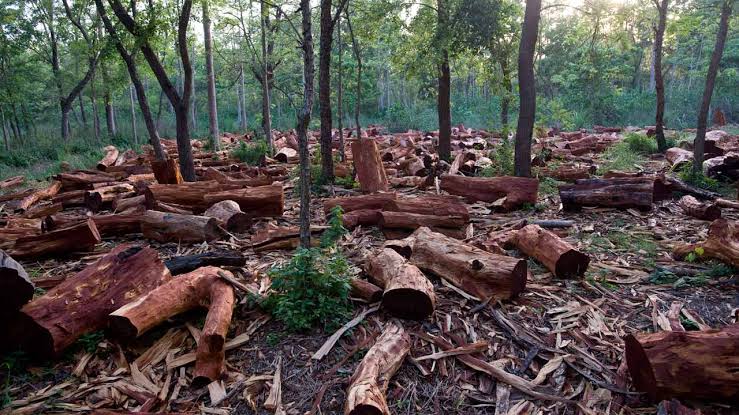
The Nigerian Conservation Foundation (NCF)has raised alarm over rapid deforestation in the country, revealing that Nigeria has lost nearly 90 percent of its forest cover over the past three decades.
The warning was issued in a statement released in Lagos to mark the International Day of Forests observed globally on March 21.
According to the foundation’s Director of Communications, Policy and Advocacy, Mr Kunle Olawoyin the 2026 theme, “Forests and Economies, highlights the critical role forests play in sustaining livelihoods, supporting ecosystems, and driving national development.
Olawoyin noted that Nigeria currently ranks among countries with the highest deforestation rates worldwide, driven largely by illegal logging, agricultural expansion, and rapid urbanisation.
He disclosed that less than 10 percent of the country’s original forest cover remains intact, raising serious environmental and economic concerns.
The foundation also identified widespread dependence on fuelwood and charcoal as a major contributor to forest depletion, particularly in rural communities.
Olawoyin emphasised that forests are essential for agriculture, water regulation, and biodiversity, yet remain undervalued in national planning and policy frameworks.
He listed weak enforcement of environmental laws, rising demand for land and energy, and insufficient investment in reforestation as key drivers of forest loss.
The NCF warned that failure to take urgent and coordinated action could result in severe environmental degradation and economic consequences.
Speaking on the issue, the Director-General of NCF, Dr Joseph Onoja stressed the importance of forests in sustaining life and combating climate change.
He called on stakeholders to halt unsustainable exploitation and prioritise the protection of forest ecosystems.
The foundation highlighted ongoing efforts to reverse deforestation, including the Green Recovery Nigeria Programme which aims to increase forest cover to 25 percent by 2047
As part of its initiatives, the NCF said it planted over 265,000 trees in 2025 in collaboration with partners across different ecosystems.
Other interventions include community-based forest management, biodiversity conservation projects, and partnerships with government and private sector stakeholders to promote sustainable land use.
The organisation urged federal and state governments to strengthen forest governance, enforce environmental regulations, and increase funding for conservation.
It also called on the private sector to invest in sustainable practices, while encouraging individuals and communities to adopt environmentally responsible behaviours, including tree planting.
The NCF reaffirmed its commitment to working with stakeholders to ensure Nigeria’s forests continue to provide ecological and economic benefits for future generations.