*Hails CBN’s successful conclusion of banking sector recapitalisation
The International Monetary Fund (IMF), on Tuesday, projected that Nigeria’s economic growth rate will reach 4.3 per cent by 2027, outpacing estimates for eight advanced economies.
The projection was announced in the Fund’s World Economic Outlook (WEO) report, launched during a news conference at the ongoing IMF-World Bank Spring Meetings in Washington D.C., the United States (U.S.).
At 4.3 per cent, Nigeria’s economy is expected to grow faster than those of eight advanced economies, including the United States (2.1%), Canada (1.9%), Spain (1.8%), the United Kingdom (1.3%), Germany (1.2%), France (0.9%), Japan (0.6%) and Italy (0.5%).
This forecast underscores Nigeria’s potential as a leading growth engine among emerging markets, highlighting opportunities for investment and development.
Equally, the IMF hailed the Central Bank of Nigeria (CBN) for the successful conclusion of the banking sector recapitalisation, noting that stronger capital buffers were already proving effective in cushioning the financial system against external shocks.
The revision of the WEO reflects growing external headwinds, even as the Washington-based institution signalled that underlying conditions could support a gradual rebound beyond the near-term shocks.
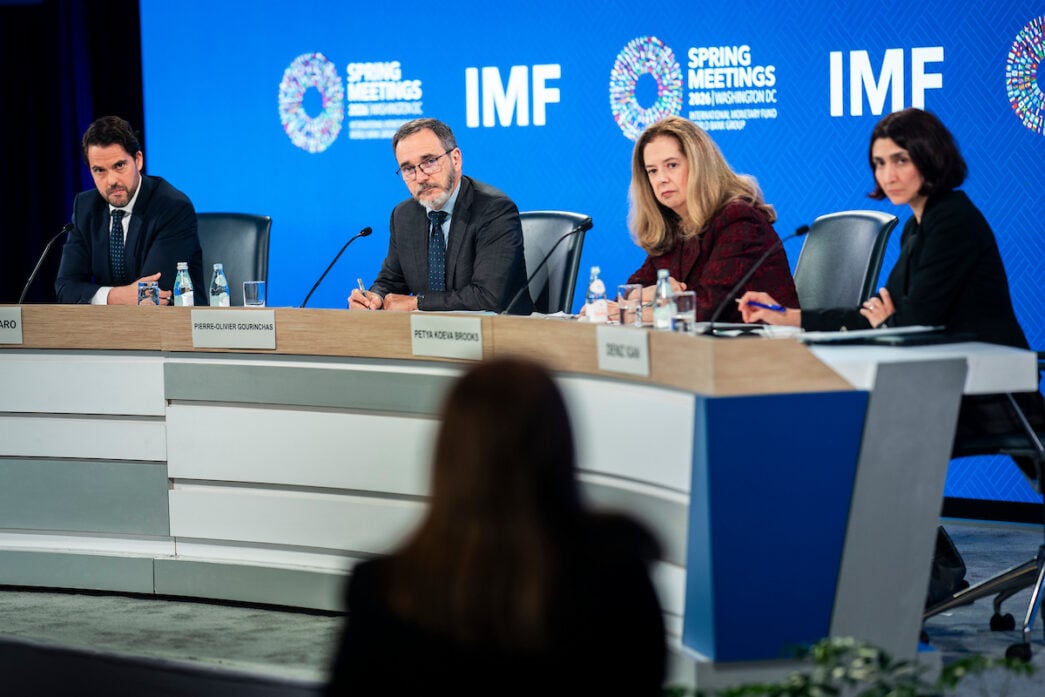
The Division Chief in the IMF’s Research Department, Deniz Igan, reiterated that Nigeria’s outlook reflects a balance of opposing forces.
She pointed out that while on one hand, rising fuel and fertilizer prices, alongside elevated shipping costs linked to geopolitical tensions, were expected to weigh on non-oil activity, on the other, higher crude oil prices offer a partial cushion, preventing a sharper slowdown.
“We have revised Nigeria’s growth as well by 0.3 percentage point to 4.1 in 2026, and that is reflecting a balance of two forces. One is that the war-related higher fuel and fertilizer prices and higher shipping costs that I mentioned are going to weigh on oil activity in Nigeria. There’s some offset coming from higher oil prices, but the end of the day, the balances are for weighing growth in 2026 with some recovery built in 2027”, she said.
On inflation and macroeconomic management, the IMF stressed the importance of maintaining tight monetary policy, with a data-dependent approach that closely monitors exchange rate movements and inflation expectations, as policymakers navigate a more volatile external environment.
“As far as inflation movements go, we believe that tight monetary policy and remaining data dependent and watching very carefully, both exchange rate movements and inflation expectations is going to be crucial to achieve the inflation target of Central Bank”.
The Fund stressed that stronger fiscal positions remained essential for emerging markets to withstand volatile global capital flows and reduce vulnerability to sudden market shifts.
Speaking at the Spring Meetings, IMF Financial Counsellor and Director of the Monetary and Capital Markets Department, Tobias Adrian, said recapitalisation efforts tend to show their value most clearly during periods of stress.
He noted that building a well-capitalised banking system remains central to global financial stability, particularly as economies navigate heightened uncertainty.
He said: “Concerning bank recapitalisation, it is in times of stress where the value of bank capital really comes to the fore. So, what we are aiming at for global financial stability is a banking sector that is capitalised against adverse shocks.
“So yes, the banking recapitalisation is welcome and are paying off, particularly under times of stress concerning debt to GDP and what the IMF is doing”.