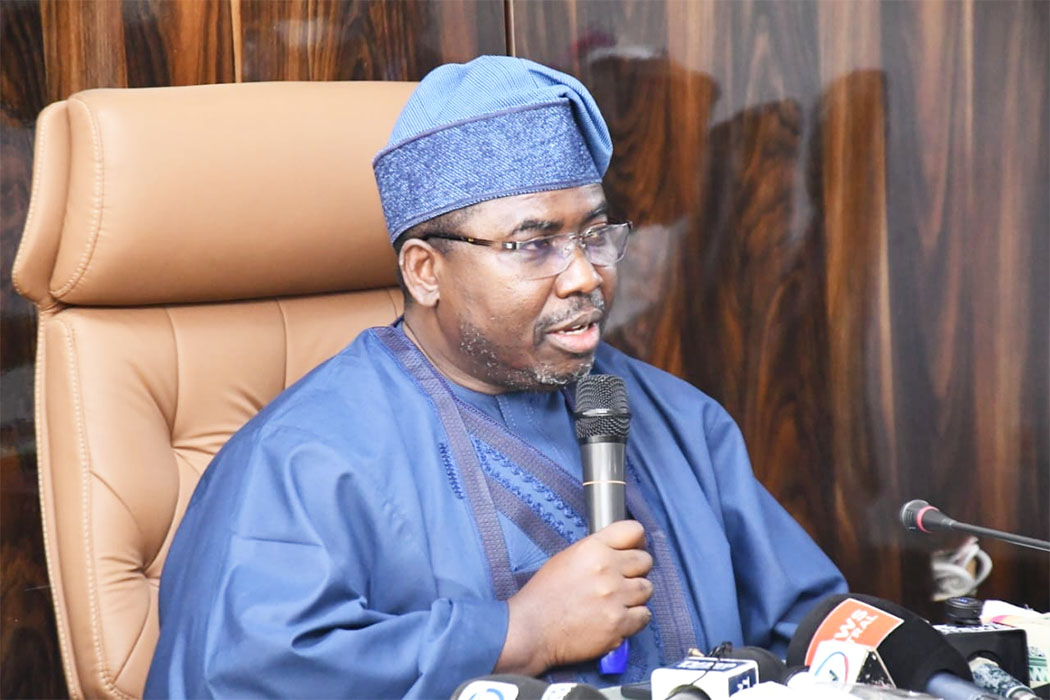
*ADDRESS BY THE CHAIRMAN, INDEPENDENT NATIONAL ELECTORAL COMMISSION (INEC), PROF. JOASH O. AMUPITAN, SAN, AT THE WORLD PRESS CONFERENCE AND NATIONAL STAKEHOLDERS’ MEETING MARKING 100 DAYS TO THE 2027 GENERAL ELECTION ON TUESDAY, 6TH OCTOBER 2026 AT THE BAT-ICC, ABUJA
PROTOCOL
The Inspector-General of Police, Mr. Olatunji Disu
The Director-General, National Youth Service Corps (NYSC)
The Director-General, National Orientation Agency (NOA)
Chairman, Senate Committee on Electoral Matters (INEC)
Chairman, House Committee on Electoral Matters
Chairman, Inter-Party Advisory Council (IPAC)
President, Executive Council, and Esteemed Leaders of the Nigerian Guild of Editors (NGE)
Your Excellencies, Members of the Diplomatic Corps and Development Partners
Leaders of Civil Society Organisations and Religious Bodies
Other Heads of Security Agencies (ICCES)
Election Observers
Honourable National Commissioners
Secretary to the Commission
Resident Electoral Commissioners
Members of the INEC Press Corps and Gentlemen of the Press
Distinguished Ladies and Gentlemen
Fellow Nigerians
1. INTRODUCTION
It is my honour to welcome you to this World Press Conference and National Stakeholders’ Meeting, convened to mark a critical threshold in our national democratic journey: exactly 100 days to the first ballot of the 2027 General Election.
This 100-day milestone is not just a countdown; it is a call to action. It marks the beginning of the final phase of our preparations to ensure that the 2027 General Election is not only successful but serves as a global benchmark for transparency, integrity, and peace.
Since assuming leadership of the Commission on 23rd October 2025, this administration has successfully conducted major off-cycle elections—including the Anambra, Ekiti, and Osun Governorship Elections, the FCT Area Council Polls, alongside critical federal and state bye-elections. From the Reports submitted by local and international observers, every single one of these polls passed the benchmark of electoral integrity, underscoring our unwavering adherence to operational efficiency and credibility.
Crucially, these off-cycle elections provided a vital testing ground for key structural upgrades. They reaffirmed that the early deployment of ad-hoc staff and sensitive materials, an agile logistics infrastructure, and precision-driven, intelligence-led security arrangements are the non-negotiable foundation for seamless election delivery nationwide.
On 26th February 2026, the Commission issued the Revised Timetable and Schedule of Activities for the 2027 General Election, establishing 14 critical statutory milestones. I am pleased to report that we have successfully executed nine of these major milestones. This statutory timeline has been translated into an operational execution plan synchronised across our 23 Headquarters Departments and Directorates, 36 State Offices, the Federal Capital Territory (FCT), and all 774 Local Government Area (LGA) offices nationwide.
2. FUNDING AND FINANCIAL READINESS
Executing a national election of this magnitude requires robust financial backing and fiscal discipline. The Federal Government has maintained its commitment to democratic governance through the timely release of statutory budgetary allocations to the Commission. Operating under a framework of transparent fiscal management, these funds have enabled us to meet international vendor obligations, finance the production of critical election technology, upgrade physical infrastructure, and sustain multi-stakeholder operational deployments nationwide. However, we expect the prompt release of the remaining budget to ensure seamless execution of the remaining activities.
3. VOTER REGISTER, CVR AND PVC COLLECTION
In line with Section 10 of the Electoral Act, Phase I of the Continuous Voter Registration (CVR) ran from 25th August to 10th December 2025 and registered 2,611,266 voters. Phase II ran from 5th January to 17th April 2026 and registered 4,121,835. Phase III ran from 11th May to 26th July 2026 and registered 3,867,997. The total registration was 10,772,421, following the conclusion of Automated Biometric Identification System (ABIS) verification. The National Register of Voters now stands at 103 million.
The top 10 states by number of registered voters are:
1. Lagos – 7,488,633
2. Kano – 6,570,276
3. Kaduna -4,662,640
4. Katsina – 3,876,051
5. Rivers – 3,736,434
6. Oyo – 3,588,111
7. Delta -3,525,988
8. Benue – 3,057,225
9. Ogun – 3,037,981
10. Bauchi – 3,012,547
At the other end of the table, Ekiti State has the lowest number of registered voters, with 1,055,708. It is followed by Bayelsa, which has 1,200,691 registered voters. The FCT ranks next from the bottom with 1,732,043, followed by Yobe with 1,733,671 and Gombe with 1,768,566.
Male voters account for 53,528,218, representing 51.75 per cent of the register, while female voters number 49,900,497, representing 48.25 per cent. The age profile shows that the register is dominated by voters aged 35 to 49 years, who account for 43,265,946 voters, or 41.83 per cent of the total.
They are followed by voters aged 18 to 34 years, numbering 29,777,578, representing 28.79 per cent. Voters aged 50 to 69 years account for 22,982,900, or 22.22 per cent, while those aged 70 years and above are the smallest age group, with 7,402,291 voters, representing 7.16 per cent.
The register records 232,658 Persons With Disabilities, spread across 10 disability categories. This represents roughly 0.23 per cent of the total 103.43 million registered voters.
The largest category is “Others”, with 101,183 voters, accounting for 43.49 per cent of all registered People With Disabilities (PWD). This is followed by albinism, with 44,023 voters (18.92 per cent), and physical impediment, with 27,141 (11.67 per cent).
Those registered under blindness number 19,939 (8.57 per cent), while deafness accounts for 14,326 (6.16 per cent). The register also contains 8,832 voters with autism (3.80 per cent), 7,723 with cognitive or learning disabilities (3.32 per cent), and 5,755 with little stature (2.47 per cent).
The smallest categories are Down syndrome, with 2,080 voters (0.89 per cent), and spinal cord injury, with 1,656 voters (0.71 per cent)
In compliance with Section 19(1) of the Electoral Act 2026, the Register of Voters will be displayed for public scrutiny from 9th to 15th October 2026, not later than 90 days before the General Election. Claims and objections arising from the nationwide display at Registration Areas will be addressed thereafter. The distribution of Phase 1 PVCs to all Local Government Centres will commence on Friday, 9th October, 2026.
It is important to note that in the third phase of the CVR, we introduced, for the first time in Nigeria, the Online Registration Portal technology for registrants to eliminate barriers of distance and time. Furthermore, we introduced Printable PVC technology in line with Section 18(1) of the Electoral Act 2026 to ensure that waiting months for a card becomes a relic of the past.
The Register of Voters for the 2027 General Election is expected to be presented to political parties on 15th December 2026.
4. POLITICAL PARTY CANDIDATE NOMINATIONS
Under Section 29 of the Electoral Act 2026, political parties submitted candidate lists through the INEC Candidates Nomination Portal (ICNP), supported by Form EC9 affidavits of constitutional compliance.
To protect the integrity of party nominations and prevent unlawful exclusion or arbitrary candidate substitution, the Commission implemented an administrative safeguard, which was the pre-uploading of candidate names onto the INEC Candidates Nomination Portal, strictly verified against INEC’s primary election monitoring reports and internal party appeal outcomes.
Presidential & Vice-Presidential Nomination Summary: 18 out of 22 registered political parties submitted 36 Presidential/Vice-Presidential candidates. Three parties (Accord, APGA, and Youth Party) nominated no presidential candidates, while the New Nigeria Peoples Party (NNPP) withdrew its presidential nomination during the substitution window.
National Assembly: 21 of 22 political parties sponsored 1,313 candidates for the Senate and 3,547 candidates for the House of Representatives. Personal particulars were published on 1st August 2026, and the Final List of Candidates was published on 12th September 2026, subject to court orders.
Governorship & State Houses of Assembly: 21 out of 22 political parties nominated 936 Governorship/Deputy Governorship candidates and 9,692 State House of Assembly candidates. Personal particulars were published on 29th August 2026, with the Final List set for publication on 10th October 2026.
The complaints arising from the nomination process include unlawful withdrawal and substitution of candidates, typographical errors, and other legal issues relating to nominations. All 112 formal complaints received from aspirants, candidates, and parties regarding the nomination process were investigated and resolved except those pending in the Court.
However, we have recently received complaints from some political parties and aggrieved aspirants, drawing our attention to the recent Supreme Court decision in INEC v. Zenith Labour Party delivered on 24th September, 2026, affirming the constitutionality of section 77(5)-(7) of the Electoral Act, 2026 and also upholding our Revised Timetable and Schedule of Activities for the 2027 General Election. We only received the certified true copy of this judgment this morning, and it is being reviewed.
5. RESTORED AND NEWLY CREATED CONSTITUENCIES
Pursuant to court judgments restoring previously suppressed constituencies, the Commission restored 27 state constituencies between June and August 2026 in Benue, Delta, Jigawa and Kogi States. In addition, two new State Constituencies (Warri South West II and Warri North II) were created in the Warri Federal Constituency of Delta State to resolve the protracted problem arising from the inability to implement the Supreme Court decision in Hon. George U Timinimi & Ors V. INEC before the 2023 General election.
Political party primaries and candidate nominations for these constituencies have been completed.
6. PROCUREMENT READINESS
The Commission has moved from planning and tendering into active contract execution, production, delivery and construction.
• Offshore production and fleet: Contracts have been awarded, and production is advanced for 57,000 new BVAS devices, additional voting cubicles and ballot boxes. Some of the newly acquired BVAS have been delivered. Delivery of new operational vehicles is ongoing nationwide.
• Civil works: Construction of dedicated BVAS storage facilities and Local Government Area offices is progressing, alongside nationwide office renovations. The contract for solar power installation across all the Commission offices has been awarded.
• ICT infrastructure: Upgrades to critical ICT applications and core infrastructure are being implemented.
• Non-Sensitive Materials: Some States have started receiving some non-sensitive materials.
• Sensitive materials: Procurement for the printing of ballot papers and result sheets is nearly completed and advancing towards final contract award.
The Procurement Department continues to monitor supplier, contractor and inter-departmental delivery schedules closely, so that all procurement is aligned with statutory timelines.
7. LOGISTICS STRATEGY AND OPERATIONAL DEPLOYMENT
An election is fundamentally the largest peacetime logistics operation undertaken in our nation. Delivering non-sensitive and sensitive materials to 176,846 polling units across 8,838 Registration Areas, spanning urban centers, remote riverine communities, difficult mountainous terrains, and desert fringes, requires a strong logistics framework. Building on the operational lessons from recent off-cycle elections, the Commission has finalised an integrated, multi-modal deployment strategy:
Transport Union Partnerships and Fleet Mobilisation: The Commission has renewed and strengthened its Memorandum of Understanding (MoU) with key transport unions, including the National Union of Road Transport Workers (NURTW), the Road Transport Employers Association of Nigeria (RTEAN), and the Maritime Workers Union of Nigeria (MWUN). This framework guarantees the early pooling, vetting, and mobilisation of over 100,000 vehicles and 4,000 boats to move personnel and materials.
Specialised Terrain and Riverine Deployment: For difficult-to-access terrains in the Niger Delta, Lake Chad Basin, and high-altitude areas in the North-East and North-West, we have secured dedicated speedboats, 4×4 off-road vehicles, and local pack transport. Escort protocols and maritime safety equipment, including life jackets and waterproof material containers, are being procured.
Early RAC Activation and Poll Opening Mandate: To guarantee that polling units open strictly at 7:30am nationwide, all non-sensitive materials are being pre-batched to LGA hubs prior to each election. Sensitive materials will move from CBN vaults to LGAs 72 hours before polls, reaching all 8,838 Registration Area Centres (RACs) and Super RACs by 4:00pm on the eve of the election.
Reverse Logistics and Material Audit: A structured reverse logistics protocol has been established to govern the secure retrieval, auditing, and central archiving of BVAS devices, election result sheets (Forms EC8A), and unused ballot materials immediately following final collation.
8.ELECTORAL TECHNOLOGY, AI GOVERNANCE, AND MOCK ACCREDITATION
Technology remains the bedrock of our commitment to transparent results. The ICT Directorate has scheduled the following milestones:
• Upgraded BVAS Infrastructure: The Bimodal Voter Accreditation System (BVAS) devices have undergone extensive software hardening, battery optimisation, and biometric calibration to prevent accreditation bypass and eliminate manual manipulation. We have acquired 57,000 new BVAS for optimal performance.
• eEC8A System and Result Transparency: Building on successful deployments in recent off-cycle elections, our enhanced eEC8A system ensures that polling unit result sheets are verified, cryptographically authenticated, and uploaded directly from polling units to the public view portal, IReV.
• Downloadable PVC: This technology was introduced pursuant to section 18(1) of the Electoral Act. It was tested during the Osun election and also used to enable voters whose PVCs were stolen before the election to exercise their voting right.
• National inventory and functionality testing: A nationwide audit of BVAS inventory, with activation testing and GPS tracking verification, has just been concluded.
• BVAS configuration and security on-boarding: State-level device configuration, with enrolment onto the SureMDM platform will soon commence.
• Quality assurance: A six-day stress-testing exercise across all configured BVAS devices has been scheduled for 23rd to 28th October 2026.
• Technical support capacity: State-level training of Registration Area Technical Support personnel (RATECHs) has been scheduled for November 2026, culminating in a strategic briefing on 13th December 2026. LGA readiness audits will follow on 13th and 14th January 2027.
• Election-day support: RAC refresher training across all 8,838 Registration Area Centres on the eve of the Presidential election, and on-site RATECH support on both election days, 16th January and 6th February 2027.
• Digital/on-line basic lessons will be deployed to supplement the training received by Ad Hoc staff.
Artificial Intelligence Governance: The Commission has established a dedicated Artificial Intelligence Division within the ICT Department. Automated AI auditing tools are being integrated into our results verification process under a five-pillar AI Governance Framework, operating under mandatory human oversight. An AI Governance framework/Policy is being finalised by the Commission. In partnership with international technology leaders, we are integrating AI-driven anomaly detection tools to monitor database traffic and shield our public portals against cyber intrusions or unauthorised alterations.
Nationwide Mock Accreditation: A comprehensive election simulation and mock accreditation exercise will hold nationwide in November 2026 to test personnel, hardware, and network protocols under operational conditions.
9. ELECTION SECURITY, ANTI-VOTE-BUYING, AND ADMINISTRATIVE DISCIPLINE
Electoral integrity requires physical security and ethical discipline. Using its Risk Management Tool (ERM) and the Election Violence Mitigation and Advocacy Tool (EVMAT), the Commission is monitoring political activities, tracking risk incidents, and undertaking field risk assessments in order to further fine-tune its security strategy for the 2027 General Election. The number of security personnel to be deployed for the 2027 General Elections will be announced by the Police, which is the lead agency on election security.
Electoral Security Training: Working through the Inter-Agency Consultative Committee on Election Security (ICCES), we are going to initiate joint security training for thousands of Electoral Security Personnel (ESPs) across national, state, and LGA commands. Precision-driven and intelligence-led security deployment will be done to guarantee the safety of voters, electoral materials, election personnel and all stakeholders in the electoral process.
Enforcement Against Vote-Buying: In collaboration with the Federal Minister of Justice, the EFCC, ICPC, and NFIU, joint financial monitoring and undercover surveillance teams will be deployed to track illicit campaign spending and poll-site financial inducements. Violators will face immediate arrest and prosecution under the Electoral Act 2026.
10. ELECTION AND PARTY MONITORING
The Commission completed the formal registration of three new political parties between 10th December 2025 and 16th February 2026. It carried out the annual verification of registered political parties to assess constitutional compliance from 13th to 30th April 2026, and it monitored party primaries nationwide from 23rd April to 30th May 2026.
Between 28th October 2026 and 1st January 2027, the Election and Party Monitoring Department will sensitise parties on the Political Party Financial Reporting and Audit System (PFRAS) and track campaign finances at national, state and LGA levels to enforce constitutional spending limits.
In November, the Commission will accredit election observers and publish the approved list on the INEC website and in national newspapers. We will also train party representatives and manage portal uploads of agent particulars for all 2027 polls.
11. ZONAL READINESS ASSESSMENTS
Through its Planning and Monitoring Department, the Commission has embarked on a Zonal Readiness Assessment programme across all six geopolitical zones. Tours of the South-West and North-West are complete. These hands-on assessments allow us to gauge each state’s readiness, identify local vulnerabilities and close gaps early. The remaining four zones will follow in structured succession, and the Department will keep tracking the Election Project Plan and the Schedule of Key Operational Activities.
The Election Monitoring and Support Centre (EMSC) dashboard will monitor the implementation of the 2027 General Election activities across all 36 states and the FCT, and 774 Local Government Areas, to ensure compliance with the Commission’s processes.
The Situation Room Data Support Centre (SRDSC) will be activated six days before day; it will run on election day and seven days after the election to provide real-time monitoring and coordination of critical election activities.
12. INCLUSIVITY, STAKEHOLDER ENGAGEMENT, AND HEALTH PROTOCOLS
Gender and Disability Access: The Commission, through the Gender and Inclusivity Department, is advancing targeted interventions to expand electoral access for women, youths and Persons with Disabilities (PWDs). The Commission is also procuring Braille Ballot Guides across all 36 States and the FCT, Braille-transcribed voter education materials, EC30 PWD posters for deaf voters, and magnifying glasses for visually-impaired citizens and persons with albinism. Certified Sign Language Interpreters will be stationed at all State Collation Centres.
Grassroots Outreach: Building on completed milestones, including state-level voter education alignment and political party dialogues on female representation, the Commission is rolling out pre-implementation activities in all geopolitical zones. These include youth peace advocacy, state-level disability workshops, town hall meetings for rural women in all 774 LGAs, and native-language voter mobilisation across the 109 Senatorial Districts, in partnership with civil society, community and faith-based organisations.
Electoral Health Procurement: To preserve staff health and device integrity, first aid kits will be supplied to all 8,838 Registration Areas Centres, hand sanitisers to all Polling Units, and cleaning agents (methylated spirit and cotton wool) to all 176,846 Polling Units for BVAS sensor maintenance.
13. VOTER EDUCATION AND PUBLICITY (VEP)
As of 11th September 2026, the VEP Department is implementing its approved 2027 Election Project Plan across the Headquarters and all State Offices, guided by the revised VEP 2027 General Election Activities Calendar. On 18th August 2026, the Commission held a Joint VEP/Gender and Inclusion Implementation Meeting to align voter education with our gender and disability-inclusion frameworks. This was followed on 19th and 20th August by the VEP Strategic Communication Workshop, which equipped State Heads of VEP with standardised messaging and campaign management strategies.
Creative scripting and narrative development for nationwide civic education are ongoing. Voter education jingles are being produced for radio and television, with translations into local languages managed by State Offices. We are also assessing and onboarding prominent public figures and cultural icons to lend their voices to voter enlightenment.
At the grassroots, field training is under way for State Voter Education Desk Officers and the Assistant Electoral Officers in all 774 LGAs. We continue to support the National Orientation Agency (NOA) in leveraging community structures nationwide. Direct outreach will be delivered through mobile cinema units (Cine Rovers) and LGA town hall sessions. The Commission has also sponsored student debates on the electoral process in selected universities across the country. The last one held at the University of Jos on Wednesday, 30th September. The grand finale will be held in Abuja this month, where the winners will be presented with various prizes.
Countering disinformation: Public enlightenment is not only about telling Nigerians how to vote. It is also about protecting the information they rely on. The Commission has consistently raised awareness on fake and misleading information, and we will intensify that effort as the elections draw near. Generative AI, voice cloning and deepfake videos now make it cheap to fabricate the voices of election officials, doctored result sheets and fake letterheads, and to spread them faster than they can be verified. The greater danger is not any single falsehood. When deepfakes render lies believable, real truth is greeted with scepticism, and cynicism replaces civic engagement.
We are responding on three fronts. The first is technology, through the AI Division and the AI auditing tools I mentioned earlier. The second is public education, so that citizens can recognise synthetic content. The third is partnership with you in the media. I repeat the charge I gave to members of the Nigerian Guild of Editors recently in Enugu. Establish fact-checking desks and use digital forensic tools. Verify with INEC before you publish. Resist the declaration of privately collated results, because under the Electoral Act, the authority to declare results rests exclusively with this Commission. In national elections, it is far more important to be right than to be first.
Media accreditation: The Commission is upgrading its Media Accreditation Portal, which will go live before the end of October 2026 to receive applications from credible international and domestic media organisations. I encourage every organisation planning to cover the 2027 General Election to use this window, apply early and complete the process, so that accreditation is orderly and no organisation is left out at the last minute.
14. TRAINING AND CAPACITY BUILDING
Ladies and gentlemen, an electoral management body can possess the most sophisticated logistics network and the most advanced technology, but operational excellence ultimately rests on the integrity, competence and preparation of its people. For this reason, the Commission has put in place a rigorous, multi-layered capacity-building programme to ensure that every official is thoroughly equipped to deliver a flawless election.
Our training strategy began with strengthening our normative and legal foundations. In line with the Electoral Act 2026 and our revised Guidelines, we updated and procured the Manual for Election Officials and the Basic Security in Election Duty (BaSED) Handbook. Recognising that electoral credibility extends to the courtroom, the Commission, through the Electoral Institute and in collaboration with the National Judicial Institute, is developing a pioneering curriculum and set to pilot targeted courses for Judicial Officers who will adjudicate pre- and post-election matters.
To ensure procedural uniformity in the field, we are conducting an intensive Training-of-Trainers programme for 996 core trainers: 148 Headquarters facilitators, 74 State and Assistant State Training Officers, and 774 Local Government Training Officers. This cohort will in turn train 259 Heads of Department, 774 Electoral Officers and 2,322 Assistant Electoral Officers in election management, procedural compliance and the legal framework.
Our training mandate also extends beyond internal staff to the wider electoral ecosystem. Through joint workshops organised by the Electoral Institute, we will train national and state leaders of the Inter-Party Advisory Council together with political party representatives and agents, members of the INEC Press Corp and Election Security Personnel on the electoral processes, operational guidelines and inclusivity.
The last level of our capacity building will be the training of all categories of adhoc election personnel in preparation for the 2027 General Election.
15. AD HOC PERSONNEL
No election is delivered by permanent staff alone. For the 2027 General Election, the Commission will require 707,384 ad hoc personnel for the Presidential and National Assembly elections on 16th January, and the same number for the Governorship and State Houses of Assembly elections on 6th February. That is a total of 1,414,768 engagements across 176,846 polling units, compared with about 1.2 million in 2023.
As in previous cycles, the bulk of this workforce will be drawn from the National Youth Service Corps. In 2023, more than 70 per cent of our ad hoc staff, nearly 850,000 people, were corps members and student volunteers. The NYSC remains the most resourceful, disciplined and dependable pillar of our electoral process, and we are committed to strengthening the insurance, welfare and security arrangements for every corps member who serves.
Recruitment is under way. The INEC Portal for Recruitment of Election Staff (INECPRES) opened at 8:00am on Friday, 18th September 2026 and will close at midnight on Wednesday, 18th November 2026. It is accessible through the INEC website, on both mobile and web applications, and a 24-hour helpdesk is available to applicants. Positions are open to Supervisory Presiding Officers, Presiding Officers, Assistant Presiding Officers, Registration Area Centre Managers and RATECHs. Eligible applicants include serving corps members, recent former corps members, students of tertiary institutions, qualified public servants and ICT professionals. I urge all eligible Nigerians to apply early, and to supply accurate and verifiable information.
Selected personnel will undergo cascade training in structured phases nationwide, covering Supervisory Presiding Officers, Presiding Officers, Assistant Presiding Officers, Collation Officers and Returning Officers. Mandatory refresher sessions will hold on the eve of each election.
16. NATIONAL SITUATION ROOM AND COLLATION CENTRE
Through the Commission Secretariat Directorate, pre-election activities for the activation of the National Situation Room and Collation Centre have begun, including engagements with facility vendors. The Centre will open in accordance with the election timelines.
17. INTERNATIONAL COOPERATION, PROTOCOL, AND SERVICE DELIVERY (SERVICOM)
The IC&P 2027 Election Project Plan provides the framework for managing international observer protocols, stakeholder engagement, Situation Room support, and post-election debriefing, grounded in early inter-departmental coordination, security readiness, and validated timelines.
Complementing these international partnerships, the Commission—through its SERVICOM Unit—continues to strengthen public service delivery, operational transparency, and staff ethics by conducting Freedom of Information (FOI) and capacity-building workshops, as well as launching its revised Integrated and Local Service Charters.
18. CONCLUSION
Gentlemen of the Press, distinguished stakeholders, the Independent National Electoral Commission has moved decisively from planning into execution. Our materials are in production, technology is undergoing rigorous quality assurance, our register is finalised for public display, and our workforce is being systematically trained.
As we begin this 100-day sprint to the 2027 General Election, we reassure the nation and the international community of our total commitment to neutrality, operational excellence, and the sacred integrity of the ballot box.
Let us work together to make the 2027 General Election a moment of pride for our great nation.
At this juncture, I, alongside the Inspector-General of Police and the Director-General of the NYSC, will now open the floor to take your questions and address key operational issues.
Thank you, and may God bless the Federal Republic of Nigeria.
*Professor Joash O. Amupitan, SAN
Honourable Chairman
Independent National Electoral Commission (INEC)
Tuesday, 6th October 2026