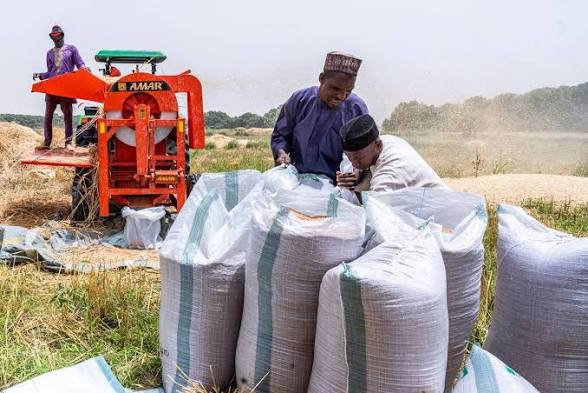
Nigeria’s annual wheat production has increased from about 120,000 metric tonnes to 420,000 metric tonnes following the implementation of the National Agricultural Growth Scheme and Agro-Pocket (NAGS-AP), the Federal Government says.
Prof. Ademola Adenle, Senior Special Adviser on Agriculture and Innovation to the Minister of Agriculture and Food Security, disclosed this in an interview with our correspondent in Abuja.
He attributed the reported increase to the provision of subsidised agricultural inputs to farmers under the government’s agricultural intervention programme.
NAGS-AP boosts access to farm inputs
NAGS-AP is a Federal Government programme designed to improve food production by helping smallholder farmers obtain agricultural inputs.
The programme focuses on inputs including fertiliser, improved seeds, agrochemicals and extension services, with distribution supported through agro-dealers.
Adenle said improved access to these inputs had contributed to higher production across several crops, with wheat recording a particularly significant increase.
“We have recorded about a 300 per cent increase in wheat production,” he said.
According to the official, annual wheat output increased from a baseline of approximately 120,000 tonnes to 420,000 tonnes.
A mathematical clarification
The figures themselves are worth presenting carefully.
An increase from 120,000 tonnes to 420,000 tonnes represents a 250% increase over the original baseline, because the additional 300,000 tonnes is 2.5 times the original 120,000 tonnes.
It means current production is 3.5 times the previous level, or 350% of the baseline.
The 300% increase quoted in the government statement would mathematically correspond to production rising from 120,000 tonnes to 480,000 tonnes.
For accuracy, therefore, the article should attribute the “300 per cent” claim to Adenle while separately stating the actual change in the reported figures.
Government wants to reduce dependence on imported wheat
The intervention forms part of the Federal Government’s wider food-security strategy.
Earlier government plans under NAGS-AP specifically identified wheat as one of the crops targeted for increased production. In 2023, the Ministry of Agriculture announced a dry-season wheat programme with an initial target of 1.25 million tonnes of annual production.
The programme has been implemented across major wheat-producing areas, with the government providing inputs intended to improve yields.
A 2024 report from the USDA Foreign Agricultural Service estimated Nigeria’s 2024/25 wheat production at about 126,000 tonnes, only slightly above the 120,000-tonne baseline cited by the government. That makes the new 420,000-tonne figure particularly significant and also means the methodology and production year behind the government’s latest figure should be clarified.
NAGS-AP has undergone expansion
The agricultural programme has also evolved since its initial implementation.
In February 2026, the Federal Ministry of Agriculture and Food Security said it was reviewing the NAGS-AP framework to improve its effectiveness.
The ministry said the programme covers six major food crops: wheat, rice, maize, sorghum, soybean and cassava. It reported that four seasons of implementation had produced an estimated 2.536 million tonnes of agricultural produce.
Government data also show extensive input distribution under the programme, including fertiliser and wheat and rice seeds.
Land access identified as another agricultural challenge
Beyond input supply, Adenle identified access to land as a structural problem affecting Nigerian agriculture.
He specifically criticised the continued reliance on the Land Use Act of 1978, arguing that its current framework makes access to agricultural land difficult, particularly for smallholder farmers.
According to him, many smallholders operate farms of only about 0.5 to two hectares, limiting their ability to expand production.
He said the government was preparing reforms aimed at addressing the problem.
Proposed reforms to cover the agricultural value chain
Adenle said the planned reforms would extend beyond land access and farm production.
The government intends to address challenges throughout the agricultural value chain, including: production, processing, distribution, marketing, farmer incomes.
He said improving these areas simultaneously would help increase agricultural productivity and strengthen farmers’ earnings.
Nigeria’s wheat challenge in context
Nigeria has historically relied heavily on imported wheat to meet domestic demand, particularly for flour used in bread, noodles, pasta and other food products.
That makes higher domestic production strategically important for food security and for reducing exposure to international commodity prices and foreign-exchange pressures.
However, the latest 420,000-tonne figure should be interpreted carefully. The government statement does not provide enough detail in the supplied report on the acreage harvested, average yield per hectare, number of farmers involved, production season covered or methodology used to calculate the national total.
Those details would be useful for independently assessing the reported increase.