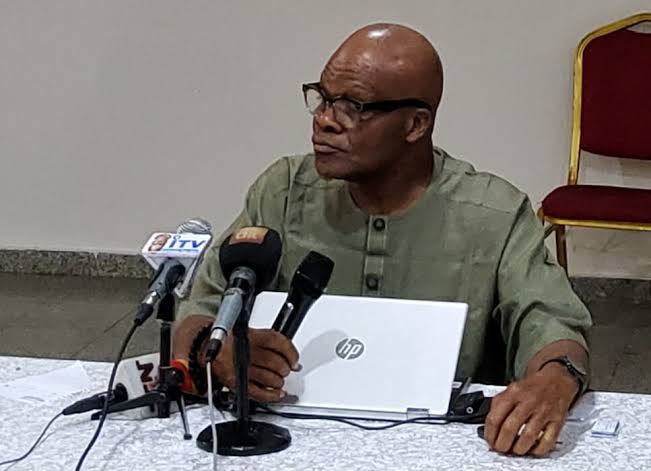
Former Nigeria Football Federation (NFF) Secretary-General Fanny Amun has called for sweeping reforms in the administration of Nigerian football, urging the federation to open its structures to more credible and experienced stakeholders.
Amun made the call on Monday in Abuja after submitting the report of a six-member fact-finding committee established to examine the causes of Nigeria’s recent disappointing performances in international football.
The committee was set up following the Super Falcons’ poor outing at the 2026 Women’s Africa Cup of Nations (WAFCON) in Morocco, which also resulted in Nigeria missing qualification for the 2027 FIFA Women’s World Cup in Brazil.
Amun demands structural changes in football administration
Amun said the country’s football challenges should not be treated as isolated failures but as signs of deeper structural problems requiring urgent attention.
He said the committee examined several areas, including football governance, finance, technical development, grassroots football, player management and league administration.
According to him, the investigation identified challenges affecting player release processes, communication, team preparation, injury management, camp organisation, technical coordination and talent development.
“The challenges facing Nigerian football are systemic and require fundamental reforms rather than temporary solutions,” Amun said.
NFF statute should accommodate more stakeholders
The former NFF official said the federation’s statute should be reviewed to allow genuine football stakeholders with experience and knowledge to contribute to decision-making.
He argued that the NFF Congress should include credible personalities capable of providing effective oversight and meaningful contributions to the growth of the sport.
Amun also proposed limiting congress members to a maximum of two terms to encourage accountability and create opportunities for new ideas.
“Nobody should see football administration as a permanent occupation. There must be room for fresh ideas and new people to contribute,” he said.
Committee recommends technology, better planning
The committee recommended greater use of technology in football administration, including improved player data management and age verification systems.
It also called for stronger monitoring of national teams, improved regulations and deliberate development programmes for both male and female football.
Amun said technical and administrative personnel should receive regular training to improve professionalism within the system.
The report further recommended better league structures and improved preparation strategies for national team competitions.
Calls for transparency and accountability
The committee highlighted allegations involving undue influence in player invitations, financial incentives and unequal payment arrangements involving players and officials.
It also raised concerns about some federation officials remaining in strategic positions for extended periods.
Amun urged the NFF to investigate all allegations thoroughly and strengthen internal accountability mechanisms.
“Every allegation must be properly investigated. Where there are weaknesses, we must correct them and ensure that the system becomes stronger,” he said.
Report implementation key to football revival
Amun warned that the impact of the committee’s work would depend on whether the recommendations were implemented.
He urged football administrators and stakeholders to demonstrate the political will needed to transform Nigerian football.
“The value of this report will be measured by what happens after today. We need implementation, not another report that ends up gathering dust,” he said.
He stressed that the recommendations were not aimed at blaming individuals but at rebuilding a transparent and sustainable football system capable of restoring confidence among Nigerians.
Background Information
The Nigeria Football Federation (NFF) is responsible for managing football development, national teams and competitions in Nigeria.
Over the years, Nigerian football has faced debates around:Governance structures,transparency in administration,grassroots development, league professionalism, national team preparation.
Nigeria remains one of Africa’s most successful football nations, but stakeholders have repeatedly called for stronger systems to sustain international success.