

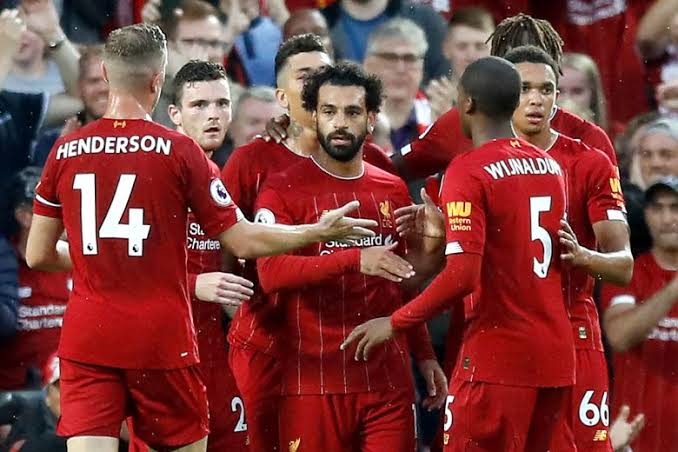
The 2018/2019 season was a year of unprecedented English domination of European club competition, as the English Premier League (EPL) finally turned its financial power into results on the field.
But the year 2019, which can stand for the 2018/2019 season, will be best remembered for a series of stunning comebacks.
For the first time ever, all four finalists in Europe’s two club competitions came from the same country.
Liverpool beat Tottenham Hotspur in the UEFA Champions League final and Chelsea defeated Arsenal for the UEFA Europa League title.
In women’s football, the World Cup, held in France, brought unprecedented interest for the tournament with the U.S. defending their title by beating the Netherlands 2-0 in the final in Lyon.
Interest in the women’s game has arguably never been higher, with broadcast records broken all over the globe in the June to July showpiece.
Olympique Lyonnais continued their domination of the women’s European club game — a 4-1 win over FC Barcelona in Budapest ensuring a fourth straight Champions League title.
The men’s Champions League is often criticised for the predictability of the group stage, which usually sees the established wealthy clubs deal with their less well-off challengers.
Yet while that remains a fundamental weakness of the competition, this year the knockout stage certainly delivered plenty of drama.
Manchester United produced one of the great comebacks.
Under new manager Ole Gunnar Solskjaer they went into their round-of-16 second leg at Paris St-Germain (PSG), having suffered a seemingly deadly 2-0 reverse at Old Trafford.
Yet a stoppage-time penalty kick from Marcus Rashford gave them a 3-1 win at the Parc de Princes and a remarkable aggregate victory on away goals.
Never in 106 attempts in Europe’s top club competition had a team progressed in a knockout tie after a 2-0 home defeat.
The game will go down as one of Manchester United’s great nights, in spite of their being eliminated by FC Barcelona in the quarter-final.
The quarter-finals produced more late drama, this time with the added ingredient of Video Assistant Referee (VAR) controversy.
This was seen in Manchester City being eliminated by Tottenham, on away goals, after the tie ended 4-4.
A late goal from Raheem Sterling looked to have sealed Manchester City’s progress.
It sent their manager Pep Guardiola racing up and down the touchline, leaping into the air, punching the sky in wild jubilation.
Manchester City’s wildly celebrating fans thought their outlandish dream of a quadruple of titles was still very much alive.
Then — as Turkish referee Cuneyt Cakir signalled the goal had been disallowed for an offside following video review — Guardiola fell to his knees, head in hands, in utter despair.
Yet even that night of drama was overshadowed by what followed in the last four.
Liverpool were presumed dead and buried after losing 0-3 to FC Barcelona.
But then, at a fervent Anfield, they were simply unstoppable as they swept aside the Spaniards 4-0 with two goals each for Divock Origi and Georginio Wijnaldum.
Then, incredibly, 24 hours later, came another astonishing comeback.
In Amsterdam, Ajax skipper Matthijs de Ligt’s fifth-minute header and a superb 35th-minute effort by Hakim Ziyech put Ajax 3-0 up on aggregate against Tottenham at half-time.
This seemingly secured their first final for 23 years.
Brazilian Lucas Moura, however, scored a second half hat-trick, including the aggregate winner, six minutes into stoppage time, as Spurs went through on away goals.
It was perhaps inevitable that the final, won 2-0 by Liverpool in Madrid, felt something of a let-down.
But fans of European football could hardly complain after a season which saw such extraordinary thrills.
UEFA’s newest competition, the Nations League, proved to be a bigger success than most imagined and ended with Portugal beating the Netherlands 1-0 in the final in Porto.


English clubs triumph in Europe’s year of comeback shocks


Leave a Reply





Latest Stories



© 2026 Published by SWAAYA LIMITED, Plot 20, Block G, Scheme 1, Residential 3, OPIC Beachland Estate, Lagos/Ibadan Expressway, Lagos. Gabriel Akinadewo, MD/CEO 08023010222, 08094000056, 08052097814.