*COMMUNIQUÉ ISSUED BY THE NIGERIAN GUILD OF EDITORS AT THE END OF THE 22ND ALL NIGERIA EDITORS CONFERENCE (ANEC 2026), HELD IN ENUGU FROM SEPTEMBER 24–26, 2026
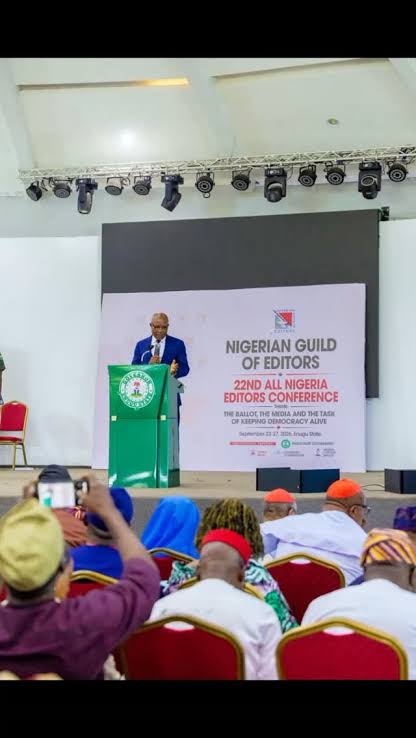
The Nigerian Guild of Editors (NGE) convened the 22nd All Nigeria Editors Conference (ANEC 2026) in Enugu, Enugu State, from September 24 to 26, 2026.
The Conference was chaired by His Royal Majesty, Igwe Nnaemeka Alfred Achebe, Obi of Onitsha, while His Eminence, John Cardinal Onaiyekan, Archbishop Emeritus of Abuja, delivered the keynote address.
The Vice President of the Federal Republic of Nigeria, Senator Kashim Shettima, participated virtually as Special Guest of Honour, while the Governor of Enugu State, Dr Peter Ndubuisi Mbah, served as Chief Host.
The Conference brought together more than 500 participants, comprising editors, publishers and senior media practitioners from print, broadcast and digital platforms across Nigeria, as well as political, traditional, religious, academic, regulatory and development-sector leaders.
The Conference focused on the theme, “The Ballot, the Media and the Task of Keeping Democracy Alive,” and examined, among other issues, the growing challenges posed by artificial intelligence, disinformation and misinformation ahead of the 2027 general elections and security concerns.
PRESENTATIONS
Among the major presentations at the Conference were:
Mazi Afam Osigwe, SAN, former President of the Nigerian Bar Association — “Election Petitions in the Digital Age: Independence, Evidence, BVAS and the Courts.”
Professor Auwalu H. Yadudu, Department of Law, Bayero University, Kano — “Public Trust, Electoral Justice and Democratic Stability.”
Mr Martin Oloja, former Managing Director/Editor-in-Chief, The Guardian Newspapers — “Terrorism Without Becoming a Tool for Terrorists.”
Dr Richard Okoye, Founder/Chief Medical Director, Save a Life Hospital — “Managing Stress, Deadlines and Personal Wellbeing.”
Professor Chinyere Stella Okunna, Deputy Vice-Chancellor, Paul University, Awka — “Election Security in Democratic Governance.”
Professor Farooq A. Kperogi, Professor of Journalism and Emerging Media, Kennesaw State University, Georgia, USA — “When Lies Look Real: Detecting and Debunking AI Disinformation Before, During and After Election.”
Following extensive presentations, discussions and deliberations, the Conference:
Reaffirmed that democracy requires the active participation, vigilance and responsibility of citizens and institutions.
Noted that the ballot remains the principal instrument through which citizens exercise their sovereign will, but that its value depends on credible information, public confidence in the electoral process and the assurance that votes will be properly counted and respected.
Observed that voter apathy is influenced by several factors, including poor governance, electoral violence and intimidation, administrative shortcomings, declining public confidence and concerns about the relationship between electoral outcomes and subsequent judicial decisions.
Examined landmark electoral cases and noted concerns expressed in sections of the public that judicial interventions in some electoral disputes have appeared to displace outcomes recorded at the ballot box. The Conference, therefore, called for electoral adjudication that is timely, transparent, predictable and impartial, while fully respecting judicial independence and ensuring that genuine electoral irregularities are appropriately addressed.
Identified generative artificial intelligence, deepfakes, voice cloning and automated networks as major emerging challenges to electoral information integrity. The Conference noted that synthetic content can now be produced and distributed rapidly, including fabricated election results, cloned voices of public officials, forged documents, manipulated result sheets and fake reports attributed to established media organisations.
Stressed that the greatest danger is not merely the circulation of individual falsehoods but the broader erosion of public trust when citizens become unable to distinguish authentic information from fabricated content.
Emphasised the importance of maintaining public trust in credible journalism at a time of declining confidence in news and growing dependence on digital and social media platforms.
The Conference reaffirmed the central responsibility of the media to provide accurate, verified and independent information, while governments and other stakeholders have a responsibility to protect media freedom and create an environment in which journalists can operate safely and independently.
Reaffirmed that editorial neutrality means impartiality among legitimate political contenders and does not require silence in the face of verified wrongdoing or the presentation of false equivalence between established facts and unverified claims. The Conference further observed that professional journalism cannot be sustained without adequate working conditions for media practitioners.
Affirmed that election security includes the safety and protection of journalists covering elections. The electoral process cannot be fully transparent where journalists are threatened, attacked, obstructed or prevented from independently observing and reporting events. The Conference, therefore, called on security agencies and all political actors to protect journalists and ensure that they can perform their constitutional and professional responsibilities without intimidation.
Acknowledged measures being undertaken by the Independent National Electoral Commission (INEC) to strengthen its institutional readiness ahead of the 2027 elections, including technological and artificial intelligence initiatives, staff welfare measures and nationwide readiness assessments.
The Conference stressed that all technology deployed in elections must remain subject to human oversight, transparency, accountability and legal verification. It also emphasised the need to safeguard the integrity of the Bimodal Voter Accreditation System (BVAS) and the institutional independence of INEC.
Called for sustained constitutional and electoral reforms to address structural concerns, including:
– The process for appointing the Chairman, National Commissioners and Resident Electoral Commissioners of INEC, as well as State Electoral Commissioners;
– Excessive or intimidating security deployment during elections;
– The growing role of electoral tribunals in determining political outcomes instead of elections being the ultimate determinant of winners;
– Limitations on the ability of ordinary voters to challenge electoral results;
– The absence of a constitutional framework for independent candidacy;
– Ensuring that electoral disputes are resolved within appropriate timelines before the swearing-in of declared winners; and
-Consideration of an appropriate constitutional threshold for presidential elections and provision for a run-off where the highest-scoring candidate does not secure up to 50 per cent of the votes cast.
Recognised existing legal frameworks governing information integrity, elections and digital communication, and urged that these laws be applied fairly and proportionately without undermining legitimate expression, press freedom or the public’s right to information.
Reaffirmed that the media must scrutinise government, political parties and other centres of power while also reporting verified achievements and developments fairly. The Conference called for evidence-based journalism that neither exaggerates failures nor suppresses legitimate achievements.
Urged newsrooms to institutionalise fact-checking and verification systems and integrate appropriate digital-verification, deepfake-detection and forensic tools into editorial workflows.
Urged editors and news organisations to refrain from publishing or amplifying unverified election results, recognising that the statutory responsibility for declaring election results rests with INEC.
Reaffirmed the Nigerian Media Code of Election Coverage (Revised 2022), jointly endorsed by the Newspaper Proprietors’ Association of Nigeria (NPAN), Broadcasting Organisations of Nigeria (BON), Nigeria Union of Journalists (NUJ), Nigerian Guild of Editors (NGE), and Guild of Corporate Online Publishers (GOCOP), as a key professional standard for election reporting. The Conference urged all newsrooms to adopt the Code and train their staff on its provisions ahead of the 2027 elections.
Urged governments at all levels to remain transparent and accountable and to cooperate with the media in the legitimate exercise of its watchdog role, including scrutiny of public programmes and expenditure.
Urged government and political actors to guarantee equitable access to media space for both government and opposition voices while respecting editorial independence.
Urged INEC to develop and implement its AI Governance Framework, ensuring that automated processes remain subject to human oversight, transparency, accountability and legal verification. The Conference further urged the Commission to sustain nationwide readiness assessments, strengthen technical partnerships for cybersecurity and electoral technology, ensure the technical integrity of BVAS and protect the institutional independence of the Commission.
Acknowledged the difficult balance between the public’s right to know about terrorist attacks and the risk that irresponsible reporting may inadvertently amplify terrorist propaganda, aid recruitment, compromise security operations or traumatise victims. The Conference, therefore, endorsed the principle: “Inform, Don’t Amplify,” urging journalists to black out terrorists.
Urged newsrooms to identify terrorist claims clearly as claims until independently verified and to avoid reproducing propaganda, recruitment messages, slogans or graphic material except where there is a compelling editorial justification.
Resolved that acts of terrorism should be reported responsibly and accurately without giving undue publicity or oxygen to terrorist groups or inadvertently encouraging further acts of violence. The Conference reaffirmed the principle of informing the public without amplifying terrorist propaganda.
Reaffirmed the principle that the media should remain “pro-Nigeria, pro-Ballot and pro-People”, rather than aligned with any political party.
Affirmed that the ballot and the press are bound by history, law and shared purpose as essential pillars of Nigeria’s democracy. The Conference called on government, INEC, security agencies, the judiciary, political parties, traditional and religious institutions, civil society, technology platforms and, above all, the media to discharge their responsibilities with integrity, courage and diligence.
Stressed that the credibility of Nigeria’s democracy ultimately depends on an electoral process in which citizens are able to make informed choices, cast their votes freely and have confidence that their votes will be accurately counted and respected.
Expressed profound appreciation to the Government and people of Enugu State for their hospitality and support, and to all speakers, presenters, panelists, sponsors and development partners whose contributions enriched the Conference.