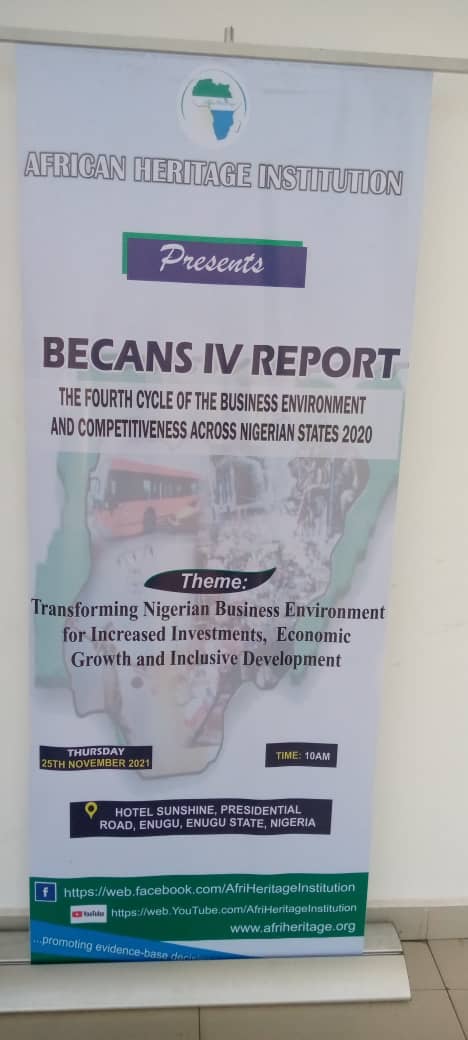
African Heritage Institution (AfriHeritage), a policy formulation research institution in Enugu, has presented its Business Environment and Competitiveness Across Nigerian States (BECANS) iv report to the public, with a call for restructuring and regional integration in Nigeria.
Former Vice Chancellor of Enugu State University of Science and Technology (ESUTH), Professor Chinedu Nebo, made the call in his keynote address at the event held recently at the BON Sunshine hotel, Enugu.
Speaking on the theme “Need for Regional integration in Nigeria: Perspective from the South-East: Approach to transformative change in Nigeria”, Nebo spoke extensively on the popular Igbo proverb ,”Igwebuike”, (Unity is strength).
He explained that “It is within Igwebuike we integrate…When ants gather together, they achieve greatly.
“You integrate a body of different characters. One of those things we say is “Onye aghana nwanne ya”. One person trains another person and gives him an incentive to establish.
He said that for the South-East region to integrate, there must be a strong institution for good governance, security, power supply for Industries, transportation, roads, railways,waterways and relevant education
Nebo frowned at the type of education being given in Nigeria, describing it as “archaic”,
“We are giving people an education that is archaic. It’s a shame. We need to strengthen trade and commerce, binding together so many things we can do, integrate and enhance regional security’.
The Guest Speaker mentioned lack of political and moral will as some obstacles militating against integration.
He blamed governors for always thinking about themselves and their states without thinking of regional integration, saying that” the governors are major obstacles….”Most governors think only of their state. Many do not think about the development of their states. They think of how much they will acquire. If our governors were sensible enough to see igwebuike as a principle for survival, they would do better.
“There is no strategic visioning among our governors. They don’t care to come together to have a regional integration . We also have this problem of inordinate of our leaders,” Professor Nebo said.
He suggested massive utilisation of human resources, language, cultural homogeneity, comparative and competitive advantages, existence of institutions that have the capacity for integration as possible ways to integrate regularly .
What is needed, he said , are ” buy-in of the generality of our leaders, the ruling class, development of a strong political will, galvernizing things that will bring the people together.
He pointed out that the umbrella body of the Igbo race, Ohaneze Ndigbo was not doing enough on integration
“Ohanaeze should be strong to tell the government what to do. Ohanaeze had an agenda of integration not implemented today.
“We are the people so used to disintegration. We need to support restructuring of Nigeria , that will give us the political strength we need. We need to do something about industrial revolution, regional infrastructural development, strategic plan linking the entire area by road, air ,land. We need trainers, establishment of technical training institution”, Professor Nebo said.
Presenting BECANS iv. report, representative of the BECAN IV technical working group, Dr. Dennis Yuni said that Business Environment and Competitiveness across Nigerian States (BECANS) ) is the flagship research, survey and dissemination initiative of African Heritage.
” We do BECANS to analyze the business environment, optimise it for economic growth”.
According to him, the initiative runs in successive cycles of research, surveys, dissemination and policy dialogue for the promotion of better business environment throughout the country. Each cycle begins with desk research (the scientific validation of models, methods and indicators) and followed by survey/data collection, data analysis, report writing, publication, dissemination and dialogue between the government and stakeholders in private sector and civil society.
He said that until recently, most investment climate assessments relied on aggregate indicators of the quality of a country’s policy, regulatory and institutional environment. Investment climate assessments were cross-country comparisons based on universal set of measures.
The presenter noted that while aggregate indicators of investment climate at the national level are useful, the aggregate picture masks differences in business environment across the states. In particular, any national picture of business environment in Nigeria that does not take into account potential differences across subnational jurisdictions cannot give a fair and true picture of the reality. BECANS iv he said, brought in issues of gender and youths Some aspects of indications that were outdated were changed .The report is 119 pages.
Earlier in his welcome address, the representative of the Board of Directors of AfriHeritage, Professor Osita Ogbu, observed that around the world, nations are competing for investors and BECANS reminds States that investors seek for a good environment.
” BECAN in establishing the business environment is also trying to engineer some competitions’
He stressed the need for the government to attract investors into the country and retain them.
In a chat , the Director General of AfriHeritage,Professor Ufo Okeke-Uzodike said that Business Environment Competiveness Across Nigerian States (BECANS), is a brainchild of AfriHeritage which started almost two decades ago.
He explained that BECAN is an evidence-based report that focuses on issues affecting Business Environment in Nigeria, with the aim of identifying the problems in the business communities in Nigeria and proffering solutions to them.
Professor Okeke-Uzodike added that in Nigeria, “We see business environment that results as joblessness, business that does not pay them salaries.
” That is why we have businesses that are suffering when we talk about multiple taxation . It is a problem.Where there are no infrastructure, multiple taxation, harsh policies, business would not survive, he said”
The Director General hinted that AfriHeritage expanded the coverage of BECANS from 88 to 103 in terms of indicators.
Professor Okeke-Uzodike disclosed that the researchers went to 36 states and the federal Capital Territory,(FCT) , that is 37 locations for data collection.
According to him, most of the businesses in Nigeria are small,medium and micro enterprises. The problem is the hassles that go with it “BECAN covers all businesses including small, medium and micro businesses.