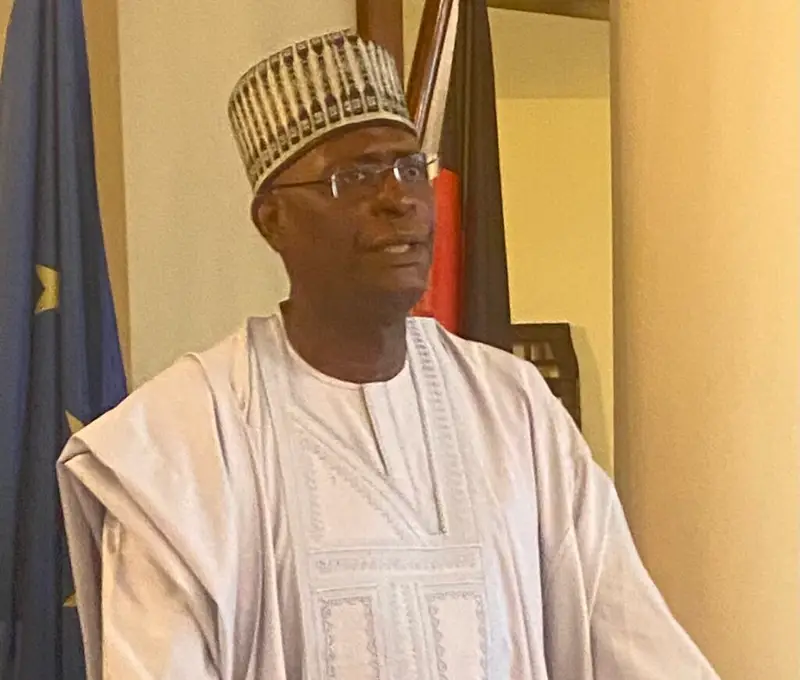
United Nations (UN) Resident and Humanitarian Coordinator, Mr Mohamed Fall, has reiterated the need for global commitment to peace, dialogue and reconciliation to bolster the sustainable growth.
Fall gave the charge in his address on Monday night in Abuja, during the commemoration of the International Day of Peace, observed annually on September 21.
The event was convened under the theme “Actions for peace: Our ambition for the #GlobalGoals” at the Embassy of Germany in Abuja.
He said that the International Day of Peace was conceived and established by the UN General Assembly in 1981, to strengthen the ideals of peace among nations and people.
He therefore emphasised the collective action, trust and solidarity in tackling global challenges.
According to him, “we are meeting not only as a day of a calendar of peace; this is for us a renewed promise of peace, dignity and the future where every woman, man, child, person with disability can live far from fear. It is a message that speaks to Nigeria.
“It speaks to the nation of a great diversity and resilience, but also a nation still facing challenges that test its peace-building process.
“Conflict which Nigeria faces has also forced millions from their home, and they are called displaced people or refugees.
This is why today, we are celebrating more than a date. We are celebrating the journey that take us on to improve the well-being of the people we serve here in Nigeria, but also beyond the border of Nigeria.”
Similarly, the German Ambassador to Nigeria, Annett Gunther, decried gaps in efforts to prevent conflict and sustain peace, revealing that it was to close such that the Peacebuilding Commission, Peace building Fund and the Peace building Support Office were established.
According to her, such have become pillars of a more integrated, inclusive and forward-looking approach to peace building.
She described the anniversary as a symbolic milestone.
“It is an opportunity to renew our shared commitment to the principles that underpin sustainable peace, national partnership, inclusive governance, long-term partnerships and a focus on prevention,” Gunther said.
In the same vein, the Director-General, Institute for Peace and Conflict Resolution (IPCR), Joseph Ochogwu, said that the day coincidentally marked the 25 anniversary since the establishment of the institute.
“We are working bilaterally and multilaterally with the respective institutions from ECOWAS, the African Union, the UN system and other respective multilateral institutions about pursuit of peace,” Ochogwu said.
Meanwhile, Dr Joshua Gana, who represented House Committee on Peacebuilding and Social Cohesion, stressed the need to silence the guns, bridge divides and build societies rooted in justice, dignity and mutual respect.
“Peace cannot be legislated alone, it must be cultivated in classrooms, homes, markets and the hearts of every citizen, which is why today’s collaboration with the United Nations is so vital.
“Together, we must strengthen local peace infrastructures, empower women and youth as agents of change and ensure that our policies are not only well intentioned, but well implemented,” Gana said.
The event featured keynote speeches by Mr Chris Ngwodo, Director-General, Office for Strategic Preparedness and Resilience, the Head, National Peace Committee and Kwon Yonggyu, First-Secretary, Embassy of Korea.
Highpoint of the event was dove release as enduring symbol of peace, freedom and reconciliation, to reflect as expression of Nigeria’s commitment to non-violence, dialogue and nation building.