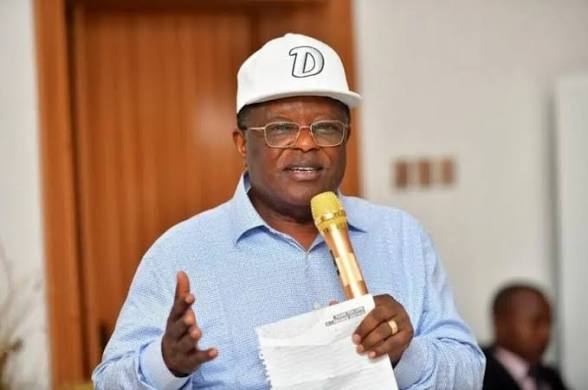
The Minister of Works, Senator Dave Umahi, has addressed public concerns over reported flooding and water retention on sections of the Lagos–Calabar Coastal Highway, explaining that the situation is linked to the project’s original engineering design.
Umahi gave the clarification on Friday during an inspection tour of Sections One and Two of the ongoing highway project alongside members of the National Assembly.
The minister dismissed claims that the project was poorly executed, stating that water seen along the road median was expected due to provisions for a future railway line.
According to him, the central median was deliberately designed to accommodate rail infrastructure as part of a long-term transport integration plan.
“The median was designed for a train corridor. It is about 25 metres wide, almost like another dual carriageway,” Umahi explained.
He added that excavation and sand filling had already been completed in the area, but drainage systems for the railway component had not yet been fully activated.
Umahi acknowledged that water had accumulated in some low-lying sections of the highway, noting that corrective drainage works were ongoing.
He said contractors had been directed to improve water channeling and connect affected areas to existing drainage systems.
“Where there is a depression, water can collect. I take responsibility, and we are addressing it,” he said.
The Works Minister reaffirmed that the Lagos–Calabar Coastal Highway remains on track for completion by 2031, alongside other federal legacy road projects.
He disclosed that Section One of the project, spanning 47 kilometres of six-lane carriageway, had already been completed, despite a three-year contract timeline.
Section Two, covering 55 kilometres, is expected to be substantially completed by November 2026.
Umahi also noted that work is progressing on Sections Three and Four across Cross River, Akwa Ibom, Ogun, and Ondo States.
The minister explained that difficult terrain and environmental restrictions have required adjustments in some parts of the highway route.
He said swampy areas and protected forest zones have made redesigns necessary to comply with international environmental standards.
“Engineering is dynamic. In some locations, we must reroute to protect the environment,” he stated.
Umahi commended Hitech Construction Company, the project contractor, for maintaining progress despite financial constraints.
He described the firm’s commitment as a strong example of public-private partnership in infrastructure development.
“Hitech has continued working on some sections even without payment. That level of commitment is rare,” he said.
The minister also highlighted ongoing work on other major projects, including the Sokoto–Badagry Super Highway and federal road networks in Kebbi, Oyo, Gombe, and Akwa Ibom States.
He reiterated the Federal Government’s commitment under President Bola Tinubu’s administration to complete all four legacy highway projects by 2031.
“All legacy projects will be delivered within the timeline. Nigerians will see results,” Umahi assured.
Umahi urged Nigerians to support the administration’s infrastructure agenda, stressing that sustained cooperation is essential for successful project delivery across the country.