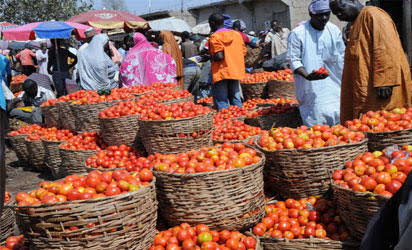
The National Bureau of Statistics (NBS) says the prices of key food items, including tomatoes, beans, garri, onions and ginger, recorded increases across Nigerian markets in May 2026.
This was contained in the Selected Food Prices Watch Report for May 2026, released on Friday in Abuja, which tracks monthly price movements of essential household commodities nationwide.
According to the report, the average price of one kilogramme of tomatoes rose by 32.48 per cent, from N1,177.92 in April 2026 to N1,560.56 in May 2026.
On a year-on-year basis, however, tomato prices increased by 12.05 per cent compared to May 2025.
The NBS said the price of brown beans increased slightly by 0.45 per cent, rising from N1,338.93 to N1,344.93.
However, compared to May 2025, beans recorded a significant decline of 43.61 per cent.
Similarly, white garri rose marginally by 0.53 per cent, while onion prices increased by 1.34 per cent month-on-month.
Despite the monthly increases, both commodities recorded notable year-on-year declines.
The report showed that fresh ginger recorded a notable increase of 5.82 per cent, rising to N5,906.82 per kilogramme in May 2026.
Palm oil prices also edged up slightly, with a litre increasing by 0.01 per cent month-on-month.
The NBS report highlighted significant differences in food prices across states and regions.
Lagos State recorded the highest price of tomatoes at N1,974.81 per kilogramme, while Ekiti State recorded the lowest at N1,017.
For beans, Oyo State had the highest price at N1,941.78, while Taraba State recorded the lowest at N760.
In the case of garri, Abia State recorded the highest price, while Plateau State had the lowest.
The report showed that the South-East and South-South recorded the highest tomato prices, while the North-West recorded the lowest.
For beans, the South-West and South-South had the highest averages, while the North-East recorded the lowest.
Similarly, ginger prices were highest in the South-West and lowest in the North-East.
The statistics bureau noted that the fluctuations reflect ongoing price instability in Nigeria’s food markets, influenced by supply chain challenges, transportation costs and seasonal factors.
It added that the data is intended to guide policymakers and track inflationary pressure on households.