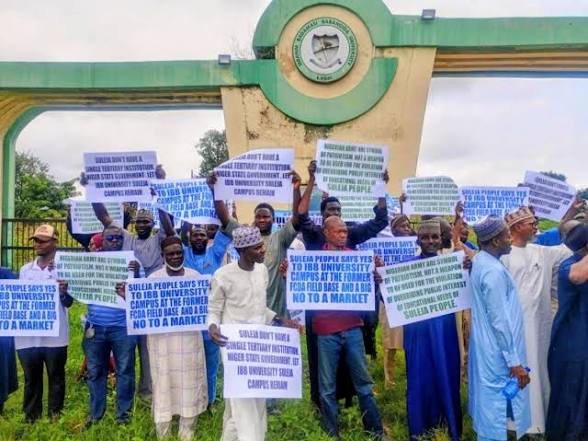
The Suleja Development Association (SUDA) has again opposed the reported plan to convert the former Federal Capital Development Authority (FCDA) Field Base in Suleja into a commercial facility, insisting that the property should remain dedicated to higher education.
SUDA’s latest position comes amid reports that the Niger State Government intends to develop the property through an arrangement involving a military-linked entity. The dispute follows an earlier proposal to convert the site, currently associated with the Suleja campus of Ibrahim Badamasi Babangida University (IBBU), into a market.
The controversy has attracted growing attention in Suleja, with residents and community leaders arguing that the site should be preserved for educational development.
Community says government ignored its concerns
SUDA Public Relations Officer Umar Shuaibu said in a statement on Friday that community representatives had written formally to the government seeking dialogue over the property’s future.
According to him, the association received no response before reports emerged of an agreement involving a military organisation.
Shuaibu said the community would challenge any attempt to use the proposed arrangement to pressure residents into accepting the change.
He said SUDA had documentation relating to its position and was prepared to pursue legal action if necessary.
Dispute centres on proposed market
The latest disagreement follows an earlier controversy over plans to develop a market on the site.
SUDA had publicly rejected the proposed conversion in September, arguing that the property should instead continue to serve as an educational facility.
Reports on the earlier proposal said the planned commercial development involved Nigerian Army Properties Limited (NAPL) and was valued at about N121 billion. Those reports also said the proposed project was the subject of a memorandum of understanding with the Niger State Government.
The Niger State Government’s position on SUDA’s latest allegations should be obtained and included before publication if available.
The history behind the Field Base
The Field Base has a particular historical significance in the development of Nigeria’s capital.
Available historical accounts say the site was established in 1977 as an operational base for the FCDA during the early development of Abuja.
It served as an administrative and operational location while work on the new Federal Capital was being planned and implemented. One historical account describes the Suleja facility as the FCDA’s early headquarters before operations moved to the new capital.
The land itself is the subject of competing historical and legal narratives.
SUDA says it originally formed part of ancestral farmland belonging to local communities and was surrendered for the national capital project in the public interest.
The association argues that the community expected the property eventually to produce lasting developmental benefits.
Property was handed to Niger State
The history of the property does not end with the relocation of the FCDA to Abuja.
Historical reporting indicates that the former Field Base was officially handed over to the Niger State Government and Suleja Local Government Council in 2007.
The site subsequently became associated with IBBU’s Suleja campus.
A 2014 development-plan document from IBBU provides particularly useful historical evidence. It describes the property as approximately 46.47 hectares and identifies it as the former Suleja Field Base.
Importantly, the university’s own development proposal contemplated an Executive Education Campus with academic, commercial, recreational and community uses.
This is relevant because it shows that the property’s educational use predates the current controversy.
Suleja community wants tertiary education
SUDA says its opposition is not simply about retaining an existing university campus.
The association argues that Suleja needs a permanent higher-education institution because of the town’s size, population and proximity to Abuja.
Shuaibu said the community had previously supported efforts to expand higher education at the site.
He also said local stakeholders had proposed locating an IBB University teaching hospital at the Suleja campus, but the project was subsequently associated with another site in Minna.
A May 2026 commentary on the dispute similarly reported that community representatives had advocated for a teaching hospital at the Suleja location before the Niger State Government pursued a different site.
Community says it has already sacrificed for national development
SUDA’s argument also draws heavily on Suleja’s historical relationship with the creation of Abuja.
Shuaibu said the community had made significant sacrifices in support of the Federal Capital project and should therefore receive long-term developmental benefits.
He specifically referred to the community’s claim that large portions of its ancestral territory were incorporated into the Federal Capital Territory.
Those historical and land-ownership claims are SUDA’s account and should be distinguished from independently established land-title facts.
Existing university activities cited by SUDA
The association says the Suleja campus is already providing educational opportunities for local residents through diploma and postgraduate programmes.
Its position is that expanding the campus would provide a longer-term public benefit than replacing the educational facility with a commercial market.
Earlier reporting confirms that the community’s objection is centred on retaining the property for education rather than commercial development.
SUDA rejects political interpretation
Shuaibu rejected suggestions that the dispute was being driven by political party differences.
He said the issue affects residents across political affiliations and concerns the future development of Suleja.
The association wants the government to retain the Field Base as a permanent higher-education centre.
Community has threatened legal action
The latest statement indicates that SUDA is prepared to take the dispute to court if dialogue fails.
The community had already threatened legal action during its September opposition to the proposed market.
Reports at the time said residents gave the Niger State Government a deadline to reconsider the proposed conversion. (Eighteen-Eleven Media)
The latest development therefore represents an escalation of an issue that has been building for several months rather than a completely new dispute.
This distinction is important for publication because the current controversy contains historical claims, go
Why the dispute matters
The Suleja Field Base dispute raises a broader question about how public land should be used when competing interests exist.
On one side is the argument for commercial development and infrastructure investment.
On the other is the community’s argument that Suleja needs permanent tertiary education infrastructure, particularly where an educational facility is already operating.
The next significant development will likely be whether the Niger State Government formally responds to SUDA’s objections and clarifies the status and terms of any agreement concerning the property.