



A meeting of the Lebanese Supreme Defence Council said that a massive blast that occurred in the port of Beirut on Tuesday evening might have been the result of maintenance work at the site.
The council said at an emergency meeting that followed the blast that a door of the port’s hangar, where explosive materials were stored, did not close properly, local media reported.
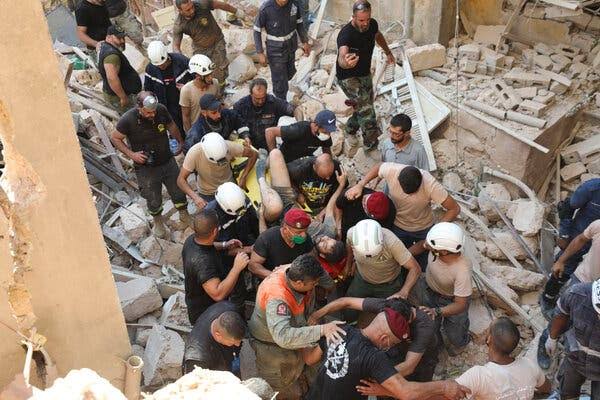
Following the tragic incident, the city’s governor said that half of the Beirut’s buildings were damaged, and hospitals were overcrowded due to a large number of injured people.
More than 100 people were killed and some 4,000 injured.
“(Some) 2,750 tonnes – the amount of ammonium exploded in the port of Beirut – are materials that were seized in 2014 from the Rhosus dry-cargo ship, registered in Moldova, when it was heading to Africa and suffered damages during navigation,” the Defence Council said, as quoted by local LBCI broadcaster.
During the meeting, representatives of the Lebanese security service said that an explosion took place as a door was being welded, the channel reported.
It was discovered some time ago that the hangar’s door was not properly locked, and there was a gap by the wall, which made it easy to both enter and leave the hangar, the emergency meeting of the defence council said.

“A spark led to the burning of explosive materials in the hangar that then led to a blast of 2,750 tonnes of ammonium nitrate, which is equivalent to 1,800 tonnes of TNT,” Lebanese officials said.
The Lebanese government has declared a three-day mourning for the victims of the tragedy starting Wednesday.
In 2014, the Rhosus cargo ship’s owner abandoned the vessel in Beirut.
Meanwhile, high-risk goods – in particular, ammonium nitrate, which was prohibited from being unloaded or transferred to another vessel by Beirut’s port authorities – remained in the hold.
The cargo stored at the ship was then transported to an appropriate place, but, eventually was moved to hangar 12 at the port.
Meanwhile, countries across the world continue offering help as Lebanon confronts destruction caused by the massive Beirut blast.
The Greek Air Force’s C-130 plane with a group of rescuers on board took off for the devastated Lebanese capital on Wednesday morning.
The aircraft carries 13 members of the first special disaster management unit, a rescue dog, two vehicles and special equipment.
“Our country has immediately responded to the Lebanese government’s request through the European Civil Protection Mechanism to send assistance to deal with the consequences of the deadly explosion that occurred in Beirut on August 4.
“A search and rescue team from fire department departed (for Beirut) in the morning,” Greece’s General Secretariat of Civil protection said.
The secretariat remains in constant contact with both the Lebanese authorities and the European Civil Protection Mechanism to provide further assistance if necessary.The Chinese Foreign Ministry has also offered help and extended condolences to the families of the victims.
“China is ready to provide assistance to Lebanon within its capabilities to… deal with this incident,” spokesman Wang Wenbin said at a briefing.
In addition, Poland has offered concrete help.
The state’s Fire Service is ready to dispatch a search and rescue team consisting of 39 rescuers, four dogs and, if necessary, chemical protection specialists as early as Wednesday.
King Abdullah II of Jordan has ordered sending a military field hospital to the neighboring country, according to the PETRA news agency.
Qatar and Iraq earlier reported that they will also send field hospitals to Lebanon.
The massive explosion hit Beirut on Tuesday evening, with about 100 people killed and over 4,000 injured, according to the Lebanese Red Cross.
The city governor has said that half of the city’s buildings were damaged and hospitals are overcrowded due to the large influx of injured patients.
Many more victims are feared to remain under the rubble.
Lebanese Red Cross Secretary General, George Kettneh, told dpa that the death toll could increase.
A civil defence official told dpa they are still searching for around 100 people missing under the rubble, especially in the vicinity of Beirut port.
“There are many people still covered under the rubble,” said the official, who requested anonymity for not having permission to speak to the media.
Lebanon woke up to scenes of massive damage at Beirut’s port and nearby areas in the centre of the capital.
Dozens of damaged cars lined the main highway, apartment buildings were surrounded by shattered glass, and some people slept without windows.
“This is horrific … this is not something usual,” said one man who was sweeping the glass in front of his apartment.
A Lebanese army officer at the scene, who requested anonymity, said there are more casualties still buried inside the port.
Workers started to remove some of the debris to open roads and repair the damage in nearby streets, stretching to the famous Gemayzeh Street, home to most of the city’s pubs and Beirut’s usual bustling nightlife.
The explosion takes place as Lebanon is struggling through its worst economic crisis since the country’s 1975-90 civil war ended.
Prime Minister Hassan Diab vowed to punish the people responsible for the blasts.
He said it was “unacceptable” that a shipment of approximately 2,750 tons of ammonium nitrate was stored in a warehouse in Beirut’s port for six years without safety measures.
Jordan’s army plans to dispatch a military field hospital, with materials and personnel, to provide medical support to Lebanon. Iraq is also expected to send a plane carrying urgent medical aid.
The Lebanese Supreme Defence Council decided at a meeting on Wednesday that a port in the northern Lebanese city of Tripoli will take over the functions of the port in Beirut, which was recently destroyed by a powerful explosion.
“Prepare the port of Tripoli for providing trade operations on imports and exports (instead of the Beirut port),” the council said, as quoted by Lebanon’s National News Agency.
Beirut Governor said that half of the city’s buildings were damaged and hospitals were overcrowded due to the large influx of injured patients.
The Lebanese government has declared a three-day mourning period for the victims of the tragedy starting on Wednesday.
The World Health Organisation (WHO) is sending medical supplies to Lebanon for 500 wounded people as well as 500 surgery kits.
WHO spokesperson, Inas Hamam, disclosed this in an interview with Sputnik.
“Based on a request from the minister of health immediately after the blast, WHO is dispatching trauma kits containing emergency medical supplies enough to treat 500 injured people and surgical kits containing supplies to treat 500 people requiring surgical care.
“Additional supplies will be dispatched as needed,” Hamam said.
“WHO is in constant contact with the local authorities (both the minister of health and hospitals treating the wounded) to further clarify needs and ensure immediate support,” Hamam said.
WHO has also urged unity in the region amid the tragedy.
“Even before the blast, Lebanon was facing civil unrest, economic hardship, coronavirus outbreak, and the Syrian refugee crisis.
“We call for regional solidarity to support all people in need in Lebanon given the additional challenges now faced,” Hamam added.