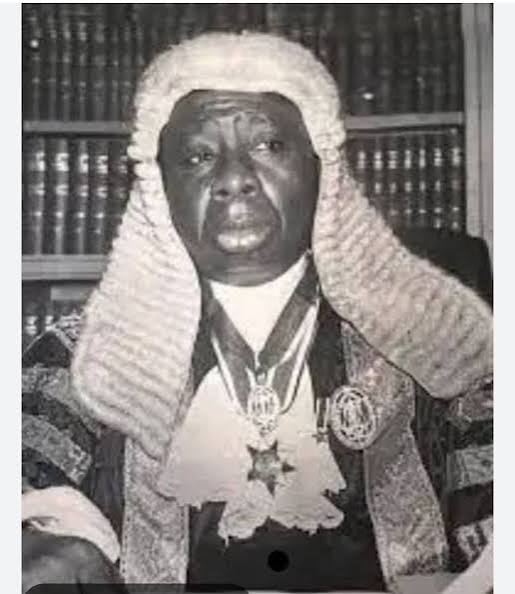
Words may fail me to describe him. Justice Egbert Udo Udoma belonged to the rare, farsighted generation that agitated for political recognition through state creation when it was less fashionable to do so.
When Akwa Ibom State was finally created on September 23, 1987, he was among a few of the prophetic breed still alive to celebrate the fulfilment of a collective dream.
Here is a recall of a moment in my tour of duty as a journalist when I sat with the late jurist for a conversation that taught me a lesson in patience. This happened in the elderly side 1990s.
It was momentous—an exclusive encounter that has left in me a tasteful memory. Times and seasons have erased certain exactitudes from my recollections regarding the precise day and month. Nonetheless, the atmosphere and actualities have not faded.
As head of features at the Weekend Pioneer, published by the Akwa Ibom State Newspapers, my obligation was to produce the weekly interview pull-out for the paper. That week, Udoma, the respected retired Justice of the Supreme Court, was our choice.
Known for strict devotion to punctuality, the Oxford-trained lawyer was not supposed to be kept waiting. Weekend Pioneer’s head of news, Ikpong Essienudom and I arrived Justice Udoma’s country home at Ikot Abasi that morning, almost an hour ahead of time.
We were informed that the retired jurist had just woken up and was having his bath. An aide told us that he would later have his breakfast—which was usually unhurried—before attending to us.
The only choice left for us was to wait patiently. Without being told, we knew that we were incapable of rushing the old man into giving us attention. He had his routines and was taking time to fulfil them. We waited.
After almost an hour, we observed from where we sat, his emergence from the inner room. He was informally dressed. With slow steps, he walked to the breakfast table, and took his seat as someone emerged with a tray filled with steaming pre-arranged delicacies.
He beckoned on an aide to inquire if we had arrived. With our presence confirmed, Justice Udoma proceeded to have his breakfast. Whether out of personal volition or as directed by his boss, the aide tried to find out what we would love to eat—coffee, tea, food, anything. We politely declined all the offers.
As we waited patiently for the elder stateman to finish his meal, I glanced at my jottings. I had spent considerable time looking into the background of the legal luminary. What I jotted down was insignificant compared to his towering biodata.
Born on June 21, 1917, Justice Udoma, a crowned Knight of the British Empire (KBE), was a man of extraordinary accomplishments both within the legal circle and as a nationalist, a champion of justice for the oppressed minorities, a respected statesman, and a history-maker in many respects.
His nationalistic activism, conducted mostly from intellectual podium, was sculptured to reflect his scholarly experience and politicking in the United Kingdom. However, it had an incontrovertible ancestry traceable to his mother—an acclaimed woman activist in the then Opobo Division in the present Akwa Ibom State.
Madam Adiaha Edem Udo Udoma—Justice Udoma’s beloved mother—is remembered as one of the prominent women tragically murdered by the British colonialist police during the 1929 Women’s War popularly christened Aba Women’s Riot—an insurrection against arbitrary taxation enforced by the colonial masters.
There is a statue in her honour in Ikot Abasi local government area. It is an artistic exhibition of a historical fact showcasing a warring, fire-spitting woman fiercely breaking a rifle in pieces.
This is an emblematical retrospection of fearless opposition by the female gender against colonial brutality imposed on the natives—a construct that reminds Nigerian women of the past they must not forget.
So, if Justice Udoma was a political activist, it is absolutely undisputable that he inherited it from his mother. However, he abhorred violence and street-side demonstrations, choosing to conduct his political crusading from a different perspective.
Udoma’s academic laurels, from Nigeria to the United Kingdom, placed him among the world’s best. After Methodist College, Uzuakoli, little Udoma earned a scholarship to Trinity College, Dublin, where he studied law and became the first black President of the University Philosophical Society, known as the Phil.
The Phil has its roots in the Dublin Philosophical Society founded in 1683. It is a students’ group with a focus on rigorous debates and thoughtful paper-reading—two related cerebral exercises that prepared the young Udoma for public speaking.
With this background, it became natural for Udoma, either while leading a protest against colonial victimization, making legal submissions in courts as a practicing lawyer, or giving incontestable rulings at the Supreme Court, to assertively speak with persuasive eloquence.
Often described as a trail-blazing African lawyer and jurist, Justice Udoma was later elected to lead the Phil. His historic ascension of office and impactful leadership has attracted academic comments and studies beyond the Trinity College.
A few years after my interview with Justice Udoma, precisely in 2022, the Phil established the Udoma Sub-Committee in memory of his achievements.
The Sub-Committee is meant to stimulate discussions, endorse, and disseminate information on “anti-racism and inclusivity’ at the Trinity College.
With the formation of the Sub-Committee, Udoma’s persona and reputation have been indelibly molded into the historical fabrics of the global academic community—the Trinity College. The once relatively unknown boy from Ikot Abasi has become a global icon in impactful leadership.
Taking advantage of the scholarship granted him by the Ibibio Union—a visionary prominent socio-cultural group at the time—the young Udoma, seemingly obsessed by unrestrained crave for academic extraordinariness, proceeded to Oxford University to further his education.
It was at this bastion of scholarship that Justice Udoma created another record as the first Nigerian and one of the few black Africans to earn a Doctor of Philosophy (PhD) in law.
Justice Udoma achieved this fame at the age of 27. This historic intellectual exploit illustrates a conclusive validation of focus and dedication to a dream that placed him on a global map of young cerebral achievers.
With his chain of degrees, Justice Udoma returned to Nigeria and went straight into private legal practice after satisfying every condition enshrined in the law. He combined active politics with legal practice and was elected to Nigeria’s Parliament where he served between 1953 and 1959.
His voice was loud and persuasive on issues of Nigeria’s independence and rule of law. His eloquence on matters that concerned minority ethnic groups in Nigeria, especially the Niger Delta region, was resounding. He used his position as President of Ibibio State Union to pursue the rights of his people.
One can only imagine how he felt when Akwa Ibom State was eventually created in 1987. Available facts indicate that he and his compatriots who campaigned for the creation of Calabar-Ogoja-Rivers (COR) States were the first to introduce the issue of state creation into Nigeria’s political lexicon.
He joined the public service after his exit from the parliament in 1959, as a High Court Judge. A few years later, in 1963, he made another history when he was appointed to serve as the Chief Justice of Uganda—a position of weighty recognition based on his professional astuteness.
A writer, identified as Samuel Fury Childs Daly, in 2021, observed that Justice Udoma was the first African Chief Justice of Uganda and represented a “small, elite group of West African judges” who served in different parts of Africa, especially in newly independent countries.
Their duty, according to the writer, “was to fill high-level positions in the judiciaries of eastern and southern Africa which had been vacated by Europeans and South Asians.”
He described Udoma as having “a fascinating career” in Uganda where he gave landmark rulings that helped reshape Uganda’s political and legal ecosystem.
The Nigerian government wasted no time in appointing Justice Udoma to the Supreme Court on his return from Uganda.
A few years later in 1977, he served as Chairman of the Constituent Assembly—a body that designed the constitutional pathway for Nigeria’s return to civilian government in 1979.
As these recollections ran through my mind that day, Justice Udoma dropped his cutleries, shifted his gaze from the empty plates, and grabbed a newspaper. He simply looked at the headlines, shook his head as if he had just observed a witness with false evidence.
Then he stood up, with the majestic pull of someone with a matter at hand that required careful examination and unhurried decision. He strode in our direction. We rose as he walked into the waiting area of his country home, with the prestige and demeanour his persona permitted.
He took his seat with all seriousness. No smiles. Then looking into our faces, he apologized for keeping us waiting, with a little explanation to the effect that age and retirement have slowed him down a bit. We giggled. He almost laughed, too. Within a split second, we saw the human side of the stern jurist.
After almost two hours of waiting, the short apology was soothing. I remained standing as I introduced us. Justice Udoma simply nodded his cerebrally-crowned head. He was used to counsels introducing themselves in court.
Then I asked the first question. It was also the last. It was about his retirement and what kept him busy after 13 years as Justice of the Supreme Court. The plan was to start on the lighter note and progress to the knotty issues of state.
Justice Udoma came prepared with what he wanted to say, irrespective of what type of question was thrown at him. He was brief on the issue of retirement. Then he launched into why he was worried about the state of the nation under the military.
He kept talking. We listened. He made bold comments. So, we paid attention.
Along the line, we jotted down follow-up questions hoping for an opportunity to invade his vocal space. That chance never came. Both of us, at different times, tried to interpose, politely. He ignored us, and kept talking.
At a point, when we tried to distract his thoughts by asking a fresh question—talking into his talk—he would listen with impatience written all over him. At the end, he would say, almost with disgust at our audacity to interrupt him, “as I was saying….”
For almost two hours, he kept moving from one issue of national importance to the other. Then it downed on us that as a Justice of the Supreme Court, interrupting his submission—whether during media interview or when he is speaking from the bench—was a punishable offence.
When he finally ended, we realized that in the course of the narrative, he had answered almost every question we would have asked, without waiting to be asked. He honoured no interjection.
As his aide brought him a glass of water, it was clear that the man was in no mood to entertain further inquiries. We gathered our recording equipment, rose with thanksgiving, took a bow individually and bade him goodbye.
Justice Egbert Udo Udoma, who died in 1998, was a man of great intellectual stature. He was deliberate in words and actions—a visionary who saw today since yesterday. He led the team that introduced the language of state creation into Nigeria’s political vocabulary.
*Sam Akpe writes from www.worsdworthglobal.com