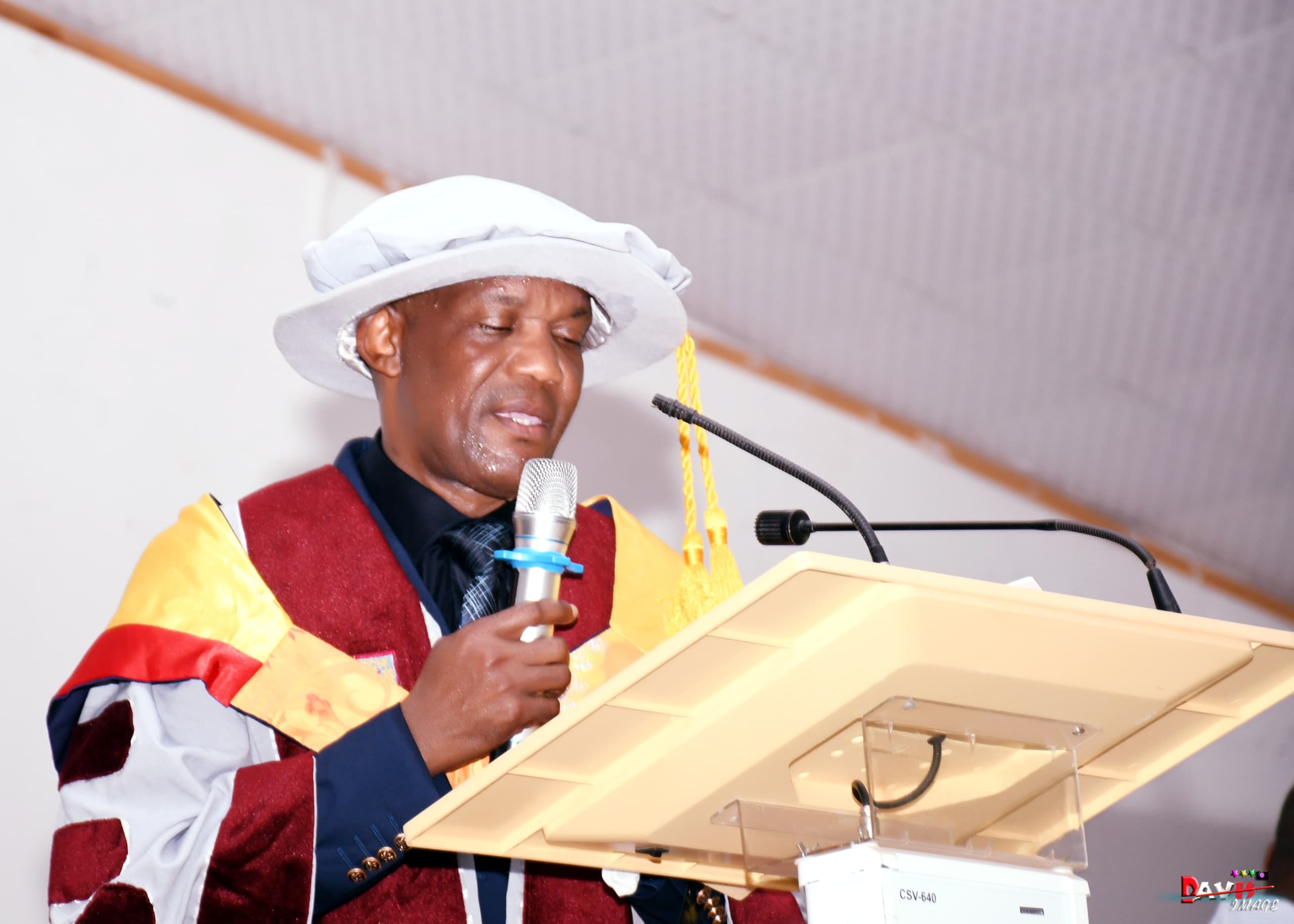
*Decries Process As Motion Without Movement, Short of Service Delivery
*Says Governance Systems Remain Active But Development Outcomes Uneven
*Laments Wider Higher Education Access Mismatch With Underfunding, Quality, Stability
A leading scholar of Public Administration, Prof Ehiyamen Mediayanose Osezua, has strongly decries ongoing reforms in Nigeria’s public sector as mere motion without movement, contending that they are short of service-delivery outcomes.
He says that, “The tragedy of Nigeria is not that it lacks institutions, talent or resources. The greater tragedy is that these have too often not been mobilised with sufficient integrity, discipline, competence and developmental clarity.”
“Governance effectiveness depends
fundamentally on the capacity of institutions to cultivate performance-oriented leadership, enforce ethical and professional norms, and translate
policy intent into measurable public value.” he argues.
Delivering the 11th Inaugural Lecture at the Olusegun Agagu University of Science and Technology (OAUSTECH), Okitipupa, Ondo State, Nigeria titled, “GOVERNING WITHOUT RESULTS:
PUBLIC ADMINISTRATION, LEADERSHIP AND
INSTITUTIONAL FAILURE IN NIGERIA. QUO VADIS?”, Osezua, Dean, School of Management Sciences, says governance systems in the country remain active but development outcomes are uneven.
According to him, “ Nigeria’s experience reflects a broader governance paradox in which administrative systems remain structurally active yet functionally constrained, producing what may be conceptualized as a condition of “governing without results.””
This condition exemplifies the central thrust of this lecture: that governing without results reflects not the absence of administrative structures, but the weakness of institutional mechanisms required to translate “policy intent into public value”.
Alluding to the higher education governance as an empirical lens for understanding institutional failure in Nigeria, Osezua posits that “institutional failure is not solely a function of financial scarcity or policy inadequacy but also of leadership praxis and accountability discipline.”
A useful entry point into the problem of institutional failure in Nigerian higher education, according to him, is the contrast between system expansion and institutional experience.
“As of 20 March 2026, the National Universities Commission recognizes 309 universities in Nigeria, comprising 74 federal, 67 state, and
168 private universities,” Osesua reveals.
“This numerical growth suggests an expanding
university system. Yet the same policy environment now reflects concern about whether the rapid multiplication of institutions has been matched by
adequate funding, infrastructure, staffing, and governance capacity.
“Indeed, in August 2025, the Federal Government imposed a seven-year moratorium on
the establishment of new federal universities, polytechnics, and colleges of education, citing overstretched resources, under-utilized institutions, and declining academic quality.
“The implication is clear: the problem is no longer
simply one of access or proliferation, but one of whether the system possesses the institutional depth to sustain quality.
“Funding data reinforces this concern. In the 2026 education budget proposal, the Federal Government allocated ₦966.9 billion to universities, which
represents the largest single share within the education sector envelope presented by the Ministry of Education. On paper, this appears substantial.
“However, recent official budget defence proceedings before the National Assembly also reveal persistent concern about capital planning, fiscal discipline, monitoring, accountability, and the effective use of appropriated funds in the Nigerian University System. In other words, the challenge is not merely the size of allocation, but the enduring gap between budgetary promises and institutional delivery.
“Universities do not experience budget figures in the abstract; they experience them through laboratories, classrooms, staff welfare, research support, power supply, digital infrastructure, and the regularity of institutional processes.
“When releases are delayed, implementation weak, or capital projects poorly executed, the academic experience remains fragile despite impressive appropriation headlines,” he maintains.
Stressing further, Osesua, a professor at the Department of Public Administration in the School of Management Sciences and a leading scholar on Higher Education and Conflict Management, argues that “Reform, in other words, should not be measured only by policy launches, curriculum redesign, or official roadmaps, but by whether it improves the lived reality of the university as a community of scholarship.”
In his view, this is where the concept of institutional failure becomes especially useful.
“Nigerian universities today do not suffer only from shortage of funds or periodic union disputes. They suffer from a deeper disconnect between reform rhetoric and institutional experience.
“A system may record more universities,
more policies, more roadmaps, and more agreements, yet still leave academics working within unstable calendars, uncertain welfare conditions, weak research support, inadequate infrastructure, and inconsistent administrative implementation.
“The issue, therefore, is not simply whether reforms exist, but whether institutions are sufficiently resilient, accountable, and well-led to convert reforms into results. That, perhaps, is one of the clearest illustrations of what it means to govern a university system without producing commensurate outcomes, “ Osezua, also adjunct professor of Public Administration at Austin Christian University, Texas, USA asserts.
The university sector in his view, provides a microcosm of the broader governance paradox
confronting Nigeria: the coexistence of policy activism and institutional expansion with persistent limitations in service delivery and developmental
impact.
“The rapid expansion of universities, including a significant increase in private institutions, has
improved access but also raised questions about equity, affordability, and quality assurance,” he says, stressing that the future of Nigeria will not be secured merely by changing faces.
“Public administration can be renewed. Leadership can be reformed. Institutions can recover. Trust can be rebuilt. Development can be pursued with seriousness and fairness. The state can once again become a vehicle of hope rather than frustration.
“It will be secured by changing values, strengthening systems, developing competent leaders, rewarding merit, and rebuilding trust in institutions. Our challenge is not a lack of potential, but a failure to consistently translate potential into performance. Our crisis is not merely administrative; it is also moral, developmental, and institutional,” Osezua quips.
Chaired by the institution’s Vice Chancellor, Prof Temi Emmanuel Ologunorisa, the inaugural lecture held at the university’s main auditorium on Tuesday, May 5th, 2026, was also graced by the Deputy Vice Chancellor, Academics and Research, Prof Foluso Olutope Adetuyi; Deputy Vice Chancellor, Administration and Development, Prof Dipo Theophilus Akomolafe and the Registrar, Mr Abiodun Peter Okunniga. Other principal officials at the event are the University Bursar, Mr Ganiyu Bamidele Aminu and Librarian, Dr Adetoun Adebisi Oyelude.