


The Federal Government has commended the business ingenuity of Africa’s foremost entrepreneur, Aliko Dangote, saying the acumen won him the contract for the construction of the novel concrete paved Obajana-Kabba road in Kogi State.
Minister of Works, Housing and Power, Babatunde Raji Fashola, made the remark during the commissioning of the 24km Itori-Ibese concrete road, Itori, Ogun State, constructed by the AG-DANGOTE Construction Company Limited, as a Corporate Social Responsibility Services to the Community.
Fashola said a lot of people had asked why government had decided to award the road contract to Dangote but they failed to understand that what gave the job to Dangote was a combination of law and vision.
“It is a matter of law because there is an existing government policy that allows for government to give tax waiver in exchange of services from private investors, especially in the area of infrastructural facilities provision which the government needs direly.
“On the other hand, Dangote already had a vision that sometime to come, Nigeria will need this kind of service like the road construction with concrete which would not need foreign exchange to execute. So, he keyed into this and I hope other investors can take a cue from him. The law was not made for Dangote. It has been existing before now”
He announced that the final letter of contract award for the Obajana-Kabba road was ready for collection and urged other businesses to come up with proposals as government is in dire need for more infrastructure “at this time when the economy is shrinking”.
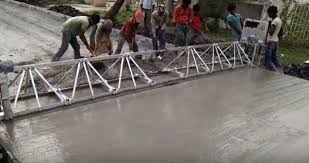
In his address, President of Dangote Group, Aliko Dangote, described the event as historic because “the road is the first concrete road that we, at Dangote Industries Limited (DIL), would be formally commissioning in Nigeria. This 24km road, which is the longest stretch of concrete road in the country today, was constructed by AG-Dangote Construction Limited, our joint venture company with Andrade Gutierrez (AG), the leading construction company in Brazil.”
Dangote explained that his decision to start the campaign for concrete road in Nigeria “is in line with what obtains in other parts of the world. For instance, the Autobahn in Germany, was constructed with concrete, and the famous Accra-Tema concrete road was possibly the first of its type in Africa. The equally popular Marine Drive in Mumbai, India, which was built in 1939, is another example of a concrete road. The Mumbai road is today still performing satisfactorily after almost 80 years in operation. As a matter of fact, it is expected that Mumbai saves about $3 million in maintenance cost every year from the investment in the construction of 450km of concrete roads.
“That is just one city alone. Imagine how it would be like if such savings are made annually in a mega city like Lagos! Such savings can be channeled into other projects that will benefit Lagosians. Austria, USA, Canada, China, Kenya and South Africa are some of the other countries that have introduced concrete in the construction of major highways.
“You will all agree with me that one of the major infrastructural challenges that we face in Nigeria today is lack of good quality roads. Indeed, most of our highways are today in a very deplorable condition due to lack of proper maintenance. That is why travellers on our inter-state routes often spend longer hours on the roads than they should. Obviously, this calls for a review of our existing method of building roads in Nigeria. Roads play an important role in the social and economic development of any nation. The Nigerian cement industry, as our contribution to finding a cost-effective and lasting solution to this problem, has been advocating the construction of concrete roads as a more viable alternative to asphalt roads.
“Another advantage of concrete roads is that cement, the basic raw material for construction, is available locally, and it is cheaper to use in the long run than bitumen, a petroleum-based product that is presently imported. As a matter of fact, in Nigeria, economic losses due to poor condition of our roads is estimated at about $1 billion annually. I believe that the introduction of concrete roads will enable the government to find lasting solution to the poor road network in the country, and also reduce the burden of constantly sourcing for funds to repair roads.”
Dangote said the contract to reconstruct the 42km Obajana-Kabba Road in Kogi State, in concrete is estimated to cost N11.5billion.
“But the Federal Government has granted us a tax waiver to enable us to recoup part of the estimated cost at N5.6 billion in tax credits over five years. The balance will be our donation as part of our CSR.”
Ogun State Governor, Senator Ibikunle Amosun, who commissioned the road, expressed delight in the gesture of management of Dangote Cement in building the road and urged other businesses in the state to emulate Dangote Cement.
He said Ogun State has become the destination of choice to investors as those who have come became prosperous in no distant time.
He said that the state boasted of over 60 per cent of Foreign Direct Investment that came into Nigeria in the last one year.