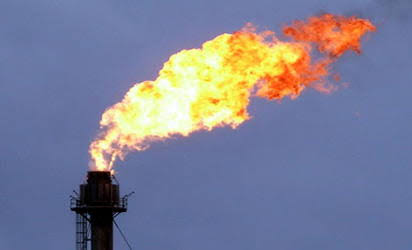
The Nigerian Upstream Petroleum Regulatory Commission (NUPRC) has reaffirmed the Federal Government’s commitment to ending routine gas flaring by 2030, pointing to tougher penalties, investment incentives and projects designed to turn previously wasted gas into commercially useful energy.
The commission said Nigeria had made considerable progress in reducing gas flaring over the years, although infrastructure shortages, high project costs and commercial challenges continue to slow efforts to eliminate the practice.
NUPRC Chief Executive Oritsemeyiwa Eyesan disclosed this on Wednesday at the Emogas International Natural Gas-Based Industry Conference and Exhibition (EINGICE 2026) in Abuja.
Eyesan was represented at the event by Janice Anyanwu, Deputy Director of Gas Utilisation at the commission.
Nigeria Reduces Gas Flaring to Seven Per Cent
According to the NUPRC, Nigeria has significantly reduced the proportion of produced gas that is flared, from historical levels of approximately 90 per cent to about seven per cent.
Despite the improvement, the commission said roughly 500 million standard cubic feet of gas are still being burned daily.
Eyesan attributed the progress to stronger regulatory enforcement and initiatives encouraging oil and gas operators to capture and sell gas that would otherwise be wasted.
She acknowledged that some flare sites remain difficult to commercialise because of inadequate pipelines, expensive processing facilities and insufficient gas volumes to support profitable investments.
These challenges, she explained, must be addressed if Nigeria is to achieve its 2030 target.
NUPRC Highlights Gas Commercialisation Projects
As part of efforts to reduce routine flaring, the commission highlighted the Nigerian Gas Flare Commercialisation Programme, which has offered flare sites to private investors for development.
Eyesan said 42 flare sites had been awarded through the programme, creating opportunities for companies to recover gas and convert it into marketable products.
The projects include small-scale liquefied natural gas (LNG) facilities and liquefied petroleum gas (LPG) processing plants.
Such investments are intended to create commercial value from gas that would otherwise be burned, while potentially increasing domestic energy supplies.
The NUPRC also pointed to financial penalties under Nigeria’s petroleum regulatory framework as an important tool for discouraging unnecessary flaring.
Eyesan cited a penalty of two dollars per thousand standard cubic feet of gas flared, alongside additional sanctions for operators that exceed permitted limits.
Nigeria’s Gas Reserves Reach 215.19 Trillion Cubic Feet
The commission said Nigeria’s proven natural gas reserves stood at 215.19 trillion cubic feet as of January 1, 2026.
Based on its stated assumptions, the regulator estimated that the reserves could support production for approximately 85 years.
Eyesan disclosed that Nigeria produced an average of 7.42 billion standard cubic feet of gas daily in 2025, with about 92.4 per cent utilised.
She said recent policy reforms had strengthened investor interest in the country’s gas sector.
Among the initiatives highlighted were the Ubeta, HI and Ima gas developments, which together have prospective production capacity of about one billion cubic feet per day.
The commission also identified Executive Order 40 of 2024 as one of the reforms supporting investment.
Eyesan said the NUPRC was advancing a gas-swap framework and had introduced a licensing round involving 40 blocks to attract further upstream investment.
Oando Says Africa Needs $1 Trillion Gas Investment by 2050
Meanwhile, Ainojie Irune, Managing Director of Oando Energy Resources Nigeria Limited, urged African countries to focus on converting their natural gas resources into reliable energy supplies and economic opportunities.
Speaking on investment decisions needed to advance gas industrialisation, Irune said Africa’s gas industry would require approximately $1 trillion in investment by 2050.
He argued that the continent’s energy challenge was not simply the availability of natural resources, but the ability to develop infrastructure, attract financing and deliver gas to customers.
Irune noted that nearly 600 million people across Africa still lacked electricity, highlighting the potential role of natural gas in power generation, manufacturing and industrial development.
Over 55 Trillion Cubic Feet of Nigerian Gas Await Development
Irune said Nigeria’s substantial natural gas reserves had yet to translate fully into dependable energy supplies and industrial growth.
According to him, more than 55 trillion cubic feet of discovered gas remained undeveloped or awaited commercialisation.
He identified insufficient infrastructure, uncertainty over payments and delays in investment decisions as obstacles to bringing these resources into production.
Irune explained that gas development depends on coordinated commitments from producers, pipeline companies, power generators, industrial customers, financial institutions and government authorities.
Without guaranteed buyers and dependable transportation infrastructure, he said, investors could be reluctant to finance expensive production projects.
He called for commercially viable gas supply agreements, integrated infrastructure and predictable regulatory policies to encourage investment.
Industry Leaders Push for Reliable Gas Supply
Irune urged African governments and energy companies to place greater emphasis on projects that deliver measurable economic benefits rather than relying on announcements of new discoveries or planned investments.
He maintained that reliable gas supplies, completed infrastructure and actual investment commitments would provide stronger evidence of progress in developing Africa’s energy resources.
The recommendations formed part of discussions at EINGICE 2026, which brought together energy executives, policymakers, investors, regulators and technology specialists.
The conference, themed “Accelerating Africa’s Global LNG Trade Share and Driving Gas Industrialisation”, examined opportunities for expanding LNG exports, strengthening upstream cooperation and supporting gas-based industries.
Participants also discussed the potential application of artificial intelligence and emerging technologies in the energy sector.
For Nigeria, the 2030 gas-flaring target represents both an environmental commitment and an opportunity to improve energy utilisation, attract investment and increase the economic value of its natural gas resources.