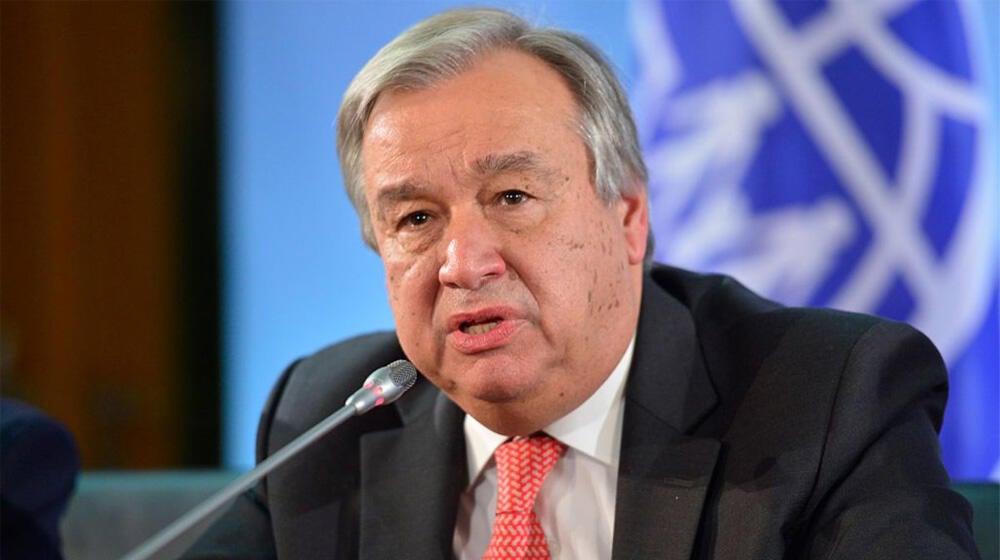
United Nations Secretary-General António Guterres has called on countries to negotiate a legally binding international agreement regulating lethal autonomous weapons systems, commonly known as “killer robots”.
Guterres made the appeal on Monday, November 16, while addressing delegates from more than 120 countries attending the Seventh Review Conference of the Convention on Certain Conventional Weapons in Geneva, Switzerland.
He urged governments to establish clear international rules, including outright prohibitions and restrictions on weapons capable of selecting and attacking targets without meaningful human control.
The UN chief warned that rapid advances in military technology were changing the nature of warfare and creating new humanitarian, legal, ethical and security challenges.
“Even war has limits,” Guterres stressed, urging participating countries to seize the opportunity to prevent the development, proliferation and use of weapons that could cause indiscriminate human suffering.
He also emphasised that protecting civilians must remain central to international efforts to regulate modern warfare.
According to him, the international community must prevent emerging military technologies from increasing the suffering of people caught in armed conflicts.
UN human rights chief demands urgent international action
The appeal follows a similar warning from United Nations High Commissioner for Human Rights, Volker Türk, who has urged governments to reach an agreement on international restrictions governing autonomous weapons.
Türk expressed concern that advances in artificial intelligence, robotics and military automation could make lethal autonomous weapons increasingly accessible.
He argued that machines should never independently determine whether a human being lives or dies.
The UN human rights chief called for prohibiting autonomous weapons specifically designed or used to target people without meaningful human control.
He also advocated restrictions on weapons whose operations and consequences cannot be adequately understood, predicted, explained or controlled by human operators.
Türk maintained that human judgment and accountability must remain central to decisions involving the use of lethal force.
He warned that machines cannot independently appreciate the value of human life or exercise the complex contextual judgment required under international humanitarian law.
What are killer robots?
Lethal autonomous weapons systems are military technologies capable of identifying, selecting and engaging targets with varying degrees of human involvement.
Unlike conventional weapons that require continuous human operation, some autonomous systems can carry out critical targeting functions after activation without further direct human intervention.
The technology may involve artificial intelligence, sensors, computer vision, automated decision-making systems and robotic platforms.
Although military automation can offer operational advantages, human rights organisations and disarmament advocates have raised concerns about accountability, civilian protection, accidental attacks and the possibility of machines making life-and-death decisions.
The central issue facing international negotiators is how to ensure that human beings retain meaningful control over decisions involving the use of lethal force.
UN member states divided over regulation
Despite growing international concern, governments have yet to agree on the exact form of restrictions that should govern lethal autonomous weapons.
Some countries support a legally binding treaty containing explicit prohibitions, while others favour developing rules and guidelines without creating a new binding international agreement.
The disagreement also concerns which weapons should be prohibited, how much human control should be required and how existing international humanitarian law should apply.
The United Nations General Assembly adopted Resolution 78/241 on December 22, 2023, with 152 countries voting in favour, four against and 11 abstaining.
The resolution recognised the humanitarian, legal, security and ethical challenges associated with autonomous weapons and reaffirmed the applicability of international law to their development and use.
What is expected from the Geneva conference?
The Seventh Review Conference of the Convention on Certain Conventional Weapons is taking place at the Palais des Nations in Geneva under the presidency of Swiss Ambassador Julien Thöni.
One of its central responsibilities is to examine the work of the Group of Governmental Experts and determine the next steps towards regulating lethal autonomous weapons.
A particularly important development is the September 4, 2026, report, which contains proposed elements of a possible international instrument.
However, countries have not yet reached agreement on whether the final instrument should be legally binding or what form it should take.
The discussions could therefore determine whether international negotiations move towards a new treaty or another form of regulatory framework.