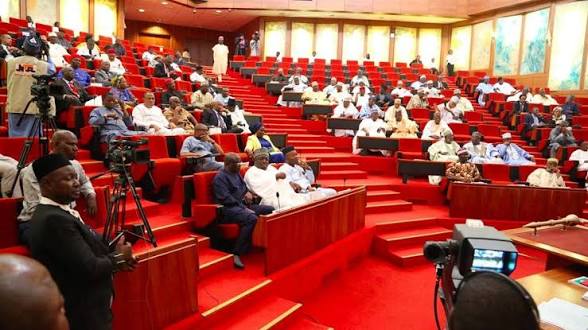
Nigeria has taken another major legislative step towards decentralising its policing system, following a Senate resolution directing the Clerk of the National Assembly, Kamoru Ogunlana, to transmit the State Police constitutional amendment bill to President Bola Ahmed Tinubu for assent.
The decision was reached on Wednesday, November 18, 2026, after lawmakers confirmed that all 36 State Houses of Assembly had approved the proposed constitutional amendment.
The legislation, formally known as the Constitution of the Federal Republic of Nigeria (Sixth Alteration) Bill, 2026, seeks to establish State Police Services as part of Nigeria’s national security architecture.
The Senate’s resolution followed a motion sponsored by Senate Leader, Senator Opeyemi Bamidele, representing Ekiti Central Senatorial District.
Bamidele told lawmakers that both chambers of the National Assembly had fulfilled their part of the constitutional amendment process, with the Senate approving the bill on June 24 and the House of Representatives following on July 23, 2026.
He explained that both chambers secured the required two-thirds majority before the proposed amendment was forwarded to the 36 state legislatures for consideration.
With all state assemblies now having submitted their approval resolutions, the Senate concluded that the constitutional requirements had been satisfied.
The chamber consequently authorised the Clerk to forward the legislation to President Tinubu in accordance with the Acts Authentication Act, 2004.
All 36 states endorse the proposed State Police system
The latest development follows weeks of legislative consultations and verification of approvals across the federation.
Under Section 9(2) of the 1999 Constitution, a constitutional amendment of this nature requires approval by at least two-thirds of the 36 State Houses of Assembly, representing a minimum of 24 states.
The National Assembly had earlier confirmed that 28 states had approved the proposal on November 3. By November 16, the Clerk to the National Assembly announced that all 36 state legislatures had endorsed it.
The unanimous approval means the proposal has exceeded the constitutionally prescribed threshold.
The state-level endorsement also completes an important stage of the constitutional amendment process, allowing the legislation to proceed for presidential assent. Federal Ministry of Info +2
Senate urges Tinubu to submit National Policing Bill
Despite the progress, lawmakers acknowledged that constitutional approval alone would not establish the practical framework needed to operate state police forces.
Bamidele therefore called on President Tinubu to forward a complementary National Policing Bill to the National Assembly for consideration and passage.
The proposed legislation is expected to establish the operational guidelines for subnational policing, including the relationship between state police services and the existing Nigeria Police Force.
Issues such as jurisdiction, recruitment, training, funding, professional standards, accountability and coordination between the different levels of policing will be central to the implementation process.
The Senate’s position suggests that the country must complete both the constitutional and legislative stages before the proposed state policing arrangement can become operational.
Akpabio describes development as historic constitutional milestone
Deputy Senate President Barau Jibrin commended members of the National Assembly’s constitutional review committees for their contributions to the process.
He described the development as an important achievement for the 10th National Assembly and the Tinubu administration.
Jibrin also acknowledged the President’s continued support for the establishment of state police, saying the proposed reform could become an important part of the country’s institutional legacy.
Senate President Godswill Akpabio, in his remarks, welcomed the unanimous endorsement by the 36 state legislatures.
He said the next priority should be to establish clear operational arrangements that would prevent conflicts between state police services and the federal police structure.
Akpabio described the development as a significant constitutional milestone, noting that the country had not witnessed a similar level of legislative agreement on the issue since independence in 1960.
He congratulated lawmakers across the federation and urged them to maintain their commitment to national unity and public service.
Why Nigeria is considering State Police
The push for state police has gained momentum amid persistent security challenges across Nigeria.
Communities in different parts of the country continue to face kidnapping, armed robbery, banditry, communal violence, insurgency and attacks on rural settlements.
The existing Nigeria Police Force operates predominantly under federal control, with its command structure extending across all 36 states and the Federal Capital Territory.
Advocates of decentralised policing argue that state governments and local security institutions should have greater capacity to respond to threats within their territories.
They maintain that a centralised police structure can face difficulties responding effectively to security incidents across a country as geographically large and administratively diverse as Nigeria.
However, the proposal has also generated concerns about political interference, human rights violations, uneven funding and the possibility of state governors using police formations against political opponents.
These competing considerations explain why the operational framework and independent oversight arrangements will be important to the reform.
Presidential assent is not the end of the process
Although the Senate has directed the transmission of the amendment bill to President Tinubu, Nigerians should not interpret the development as meaning that state police stations can immediately begin operating.
Presidential assent would complete the constitutional amendment stage, but the supporting National Policing Bill and implementation arrangements would still be necessary.
The Federal Government has already announced a process for developing the operational legislation.
In August 2026, the Presidential Working Group, chaired by Chief of Staff to the President Femi Gbajabiamila, announced a seven-week roadmap for preparing the National Policing Bill and invited members of the public to submit policy proposals.
The proposed framework is expected to address national minimum standards, state readiness, certification, jurisdictional responsibilities, human rights protection, independent oversight and sustainable funding.
For now, the November 18 Senate decision marks another important stage in Nigeria’s attempt to restructure its policing system.
The real test will come in translating constitutional approval into a functioning arrangement that improves public safety while protecting citizens against the misuse of police powers.