The Nigeria Customs Service (NCS) has collected approximately ₦1.42 trillion in revenue between September and October 2026, while its Lilypond Export Command recorded exports valued at $752.8 million during the third quarter of the year.
The figures highlight the agency’s performance in revenue collection, export processing and border enforcement as it intensifies efforts to strengthen Nigeria’s trade administration and protect the country’s economic interests.
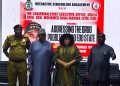
The National Public Relations Officer of the NCS, Deputy Comptroller Abdullahi Maiwada, announced the figures on Thursday during a briefing involving spokespersons of security agencies in Abuja.
The engagement was organised by the Office of the National Security Adviser (ONSA).
Customs revenue exceeds ₦1.4 trillion in two months
Providing a breakdown of the revenue performance, Maiwada disclosed that the Service collected ₦722.9 billion in October, while September contributed ₦697.8 billion.
The combined collection amounted to approximately ₦1.42 trillion within the two-month period.
He attributed the performance to improved trade facilitation, stronger enforcement and revenue administration under the leadership of Comptroller-General of Customs, Bashir Adewale Adeniyi.
The Service also processed 99,839 Single Goods Declarations and 9,195 Pre-Arrival Assessment Reports during the period.
These trade documents are essential to the processing, assessment and clearance of imported goods entering Nigeria.
Lilypond export command records $752.8 million
Nigeria’s export performance also featured prominently in the briefing, with the Lilypond Export Command recording $752.8 million in export transactions between July and September 2026.
Manufactured products accounted for $402.5 million, while agricultural commodities contributed approximately $311 million.
The command’s export activities also generated ₦90.02 million in export surcharges and more than ₦517 million under the Nigeria Export Supervision Scheme.
The figures underscore the contribution of manufactured products and agricultural commodities to Nigeria’s non-oil export activities.
The reported export value represents transactions processed through the Lilypond Export Command and should not be interpreted as Nigeria’s total national exports for the quarter.
Customs interceptions exceed ₦8.1 billion
Beyond revenue generation, the Nigeria Customs Service reported significant progress in its anti-smuggling operations.
Maiwada said the agency intercepted prohibited goods with a combined Duty Paid Value exceeding ₦8.1 billion.
The operations targeted smuggling networks involved in the illegal movement of narcotics, petroleum products and other restricted commodities.
He disclosed that Customs officers intercepted consignments of illicit drugs as well as trucks transporting petroleum products suspected of being smuggled.
The petroleum-related operations included seizures of Premium Motor Spirit (PMS), commonly known as petrol, and tanker trucks carrying Automotive Gas Oil (AGO), or diesel.
According to the spokesperson, the seized substances and petroleum products were transferred to relevant government agencies for further action.
The receiving institutions included the National Drug Law Enforcement Agency (NDLEA), National Agency for Food and Drug Administration and Control (NAFDAC), and Nigerian Midstream and Downstream Petroleum Regulatory Authority (NMDPRA).
Customs strengthens fight against money laundering
The NCS is also expanding its involvement in efforts to combat money laundering and the financing of terrorism.
Maiwada disclosed that the Service had inaugurated a World Customs Organisation (WCO) Anti-Money Laundering and Counter-Financing of Terrorism Mentoring Mission in Abuja.
The initiative is expected to improve the ability of Customs personnel to identify suspicious financial activities associated with cross-border trade and international transactions.
He further revealed that the agency had established intelligence-sharing arrangements with six institutions.
Among the partners are the Economic and Financial Crimes Commission (EFCC), Nigerian Financial Intelligence Unit (NFIU) and National Counter-Terrorism Centre.
The collaboration is also supporting the transition from manual currency declarations to electronic tracking systems, which are expected to strengthen monitoring and improve the identification of suspicious financial movements.
Six endangered pangolins rescued in Ogun
In another major development, the Customs Service reported the rescue of six live endangered pangolins during two intelligence-led operations in Ogun State.
The animals were reportedly intercepted while traffickers were attempting to move them illegally.
Following the operation, the rescued pangolins were handed over to the Green Fingers Wildlife Conservation Initiative for rehabilitation.
Maiwada said the intervention was carried out in accordance with the Convention on International Trade in Endangered Species of Wild Fauna and Flora (CITES), which regulates international trade in protected wildlife.
The operation forms part of wider efforts to prevent wildlife trafficking and protect endangered species from illegal exploitation.
Customs pledges stronger protection of Nigeria’s economy
Maiwada said the agency would continue to strengthen its operations through improved intelligence gathering, technology adoption and cooperation with other security and regulatory institutions.
He maintained that the Service’s responsibilities extend beyond collecting government revenue to include protecting national borders, facilitating legitimate trade and preventing the movement of prohibited goods.
The latest performance figures come as the Nigeria Customs Service pursues its broader modernisation programme under Comptroller-General Bashir Adewale Adeniyi, with particular emphasis on improving efficiency, strengthening compliance and expanding Nigeria’s participation in international trade.