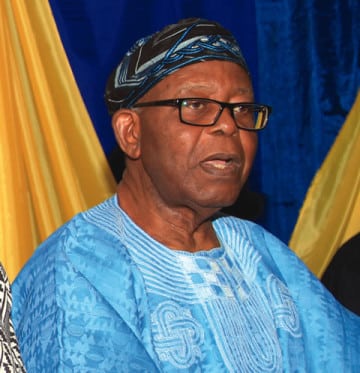
Sir Olaniwun Ajayi, statesman, erudite lawyer and knight of John Wesley (KJW) will be laid to rest, Thursday, December 1, 2016 at his Isara-Remo hometown in Ogun State,
South-West Nigeria. He was 91.
As expected, family and church members, as well as political associates, will see him to his final resting place in a blaze of richly-deserved glory..
The New Independence Group (NIG) joins millions of Nigerians home and abroad to mourn him and commend his humility and commitment to the common of fellow citizens.
Sir Olaniwun Ajayi would surely remain in the hearts of his biological children as a doting father, and as a loving and generous member of the Ajayi extended family of Isara. The Isara-Remo community, both in Nigeria and in diaspora, will continue to cherish his memory as a leader who deeply loved his people and worked, tirelessly, for the progress and development of their common patrimony.
His political associates, particularly his colleagues in Afenifere, the leading pan-Yoruba sócio-political association, will miss his company and wise counseling as a long standing member of the group, one of the few remaining icons of the Chief Obafemi Awolowo political dynasty that dated back to 1952 when the Action Group/Afenifere was formed and was the leading political group in the defunct Western region that comprised of what we now know as Oyo,Osun, Ogun, Ondo, Ekiti, Lagos, Edo and Delta states
.
It is generally believed, among the people of Yoruba extraction in Nigeria, that the government of the Action Group party, between 1952 and 1959, under the Premiership of Chief Awolowo, was the zenith of
development of Yorubaland, the progress of which has been deterioriating under successive administrations after.
Sir Olaniwun Ajayi was, to a large degree, a slice of that golden era of the Yoruba story.
However, what the political world would be missing in the departed erudite lawyer and man of faith are the body of ideas he professed whilst he subsisted here among Nigerians. In a political environment that is bereft of principled commitment to the common good, the elder statesman was a shining light in self-sacrifice, who in spite of an advancing age put his life on the line to rescue his land from rampaging and rapacious men in power.
Sir Olaniwun Ajayi was one of the few members of Nigeria’s political elite who consider governance as a solemn call to service, solely for the betterment of their fellow country men and women.
With his departure, the tribe of political scavengers will continue to maintain the upper hand, a dubious advantage seized when the Army sacked the First Republic in 1966 and introduced a terribly monetized political system which set aside personal integrity and competence as basic requiments for contestation for political offices, thus turning the country to a rentier state.
In Sir Olaniwun Ajayi, an Awoist in mind, body and spirit, Nigerians have lost a major voice in the uncompromising struggle for a country where fairness and justice should be the basis of governance in a multi-faith and multi-ethnic society.
Family members in the House of Oduduwa, within and outside of Nigeria’s borders, have just been denied of a major unifier, a sober voice in the call for unity.
A prolific writer, Sir Olaniwun Ajayi in his seminal work, “This House of Oduduwa Must Not Fall”, espouses laudable ideas on the need for unity amongst his Yoruba ethnic group as condition-precedent for group development and progress in
Nigeria.
But, most importantly, the NIG will remember the departed nationalist for his deep conviction in, and the call for, a fair deal for Nigeria’s federating units, where each and every region that makes up the amalgamated protectorates will be able to develop their potentials for the realization of Nigeria’s latent destiny as a world major power.
In his words,”…Nigeria ought to be the giant of Africa and Africa’s leadership in its own right. But Nigeria’s inability lies in its inorganic political structure from which flows the inability of successive political leaders to govern the country properly, efficiently and effectively. Nigeria ought to and indeed should be in a strong leadership position, where it ought to act or speak on behalf of African countries, particularly where some unfairness or injustice is being inflicted on an African country by any of the western powers”.
This much Sir Olaniwun Ajayi espouses in yet another major work, “Nigeria: Africa’s Failed Asset”.
For this, and so much more, the NIG will continue to cherish his memory as a patriot and a nationalist. Farewell.