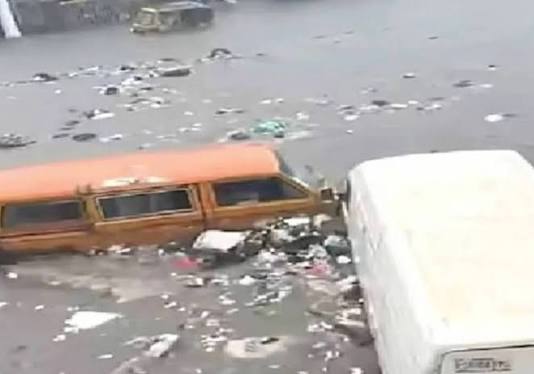
Several residents of Lagos State are counting their losses after heavy rainfall caused flooding in homes, markets and streets across different communities.
The downpour disrupted movement, damaged properties, destroyed businesses and forced some families to leave their homes in search of safety.
Residents who spoke on Friday said the flooding affected areas including Lekki Scheme II, Ajiran, Ikotun Market and Ebute Metta.
Many of them appealed to the Lagos State Government for urgent intervention, especially in drainage clearance, canal desilting and emergency support for affected households.
In Lekki Scheme II, a poultry farmer identified as Mr Alex said he had been trapped inside his home for three days because floodwater had taken over his compound.
He said the flood also destroyed his poultry business, killing chicks and leaving him with serious financial losses.
According to him, the situation was the worst he had experienced in more than 10 years of living in the area.
Alex said Lekki Scheme II was not previously known for severe flooding, but the situation had changed because of poor drainage and alleged obstruction of a major canal.
He claimed that some developers had built close to or over the natural water channel, reducing its capacity to carry stormwater.
He urged the authorities to complete the ongoing canal project and restore proper water flow in the area to prevent future disasters.
In Ajiran, Lekki, another resident, Mr Johnson, said floodwater entered his apartment around 4:00 a.m., forcing his family to move quickly to a neighbour’s upstairs apartment.
He said his children had to be woken from sleep and moved to safety as the water level continued to rise.
Johnson said the flood damaged household items including a refrigerator, mattress, electronics, food items and school books.
He added that the incident also prevented him from going to work and stopped his children from attending school.
According to him, the community experiences flooding during the rainy season, but this year’s impact has been particularly severe.
He also expressed concern over possible health risks, including waterborne diseases and mosquito-borne infections.
At Ikotun Market, a foodstuff trader, Mrs Ifeanyi Kugbala, said floodwater entered her shop and damaged bags of rice, beans and other goods.
She said the loss was devastating because she had borrowed money to restock the shop.
Kugbala said many of the soaked food items could no longer be sold, putting her business and loan repayment at risk.
She blamed the recurring flooding around the market on blocked drainage channels and appealed for regular desilting and improved drainage infrastructure.
In Ebute Metta, a resident of Bola Street, Ms Kehinde, said people living near the canal now become anxious whenever heavy rain begins.
She said residents monitor the canal closely during rainfall because once it overflows, nearby homes and streets are quickly flooded.
Kehinde said Friday’s rain caused the canal to overflow within a short period, sending floodwater into surrounding compounds and roads.
She urged the Lagos State Government to ensure continuous cleaning of canals and drainage systems in flood-prone communities.
Another resident, a journalist who asked not to be named, said he and his family had been staying in a hotel for two weeks after floodwater entered their apartment.
He said the experience had forced him to begin searching for another home.
He advised prospective tenants in Lagos to investigate the flood history of any area before renting, especially during the rainy season.
Residents linked the recurring floods to blocked drains, poor waste disposal habits, unregulated development and inadequate drainage infrastructure.
They called on the government to intensify drainage clearance, enforce environmental laws and provide relief materials to affected families.
They also appealed for support such as food, clean drinking water, mattresses and medical assistance for residents displaced or affected by the flood.