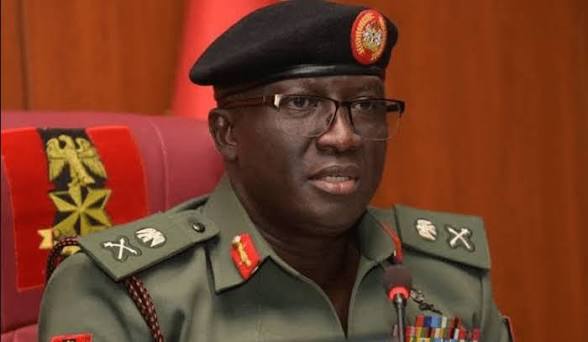
The Chief of Army Staff (COAS), Lt.-Gen. Waidi Shaibu, has urged military planners to adopt innovative approaches to tackle Nigeria’s worsening mass kidnapping crisis, describing it as an evolving security threat requiring new thinking.
Shaibu made the call on Thursday in Abuja during the inauguration of the Army War College Nigeria (AWCN) Wargaming Centre.
The Army Chief said traditional military responses alone were no longer sufficient to address the scale and complexity of kidnapping incidents across the country.
He challenged the Army War College Nigeria to use wargaming techniques and strategic simulation tools to develop practical solutions to mass abductions, particularly in forested and hard-to-reach areas.
According to him, kidnapping has become one of Nigeria’s most persistent security challenges, affecting schools, rural communities and mobility across several regions.
Shaibu noted that insecurity has contributed to declining school attendance in rural areas, as parents increasingly fear attacks on students and teachers.
He stressed the need for strategic solutions that go beyond battlefield operations, calling for improved intelligence-driven planning and rapid response mechanisms.
The COAS also urged defence planners to examine how proposed state policing structures could influence national security coordination and response efficiency.
He emphasized the importance of stronger collaboration among security agencies to ensure timely intervention during kidnapping incidents.
Shaibu added that strategic decision-making must include proper assessment of resources, operational readiness, and command structures.
The newly inaugurated Wargaming Centre at the Army War College Nigeria is expected to enhance research, operational analysis, and strategic planning.
Shaibu described it as a vital facility for developing practical solutions to complex security threats and improving military decision-making.
He encouraged the college to position the centre as a regional hub for defence innovation and strategic studies.
Commandant of the AWCN, Maj.-Gen. Umar Alkali, said the facility marks a major step in strengthening professional military education and leadership development.
He noted that it would produce officers capable of critical thinking and effective operational planning in dynamic security environments.
Director of War and Strategy, Brig.-Gen. Eyitayo Shoda, added that the centre has developed indigenous simulation models covering counterterrorism, counterinsurgency and joint operations.