

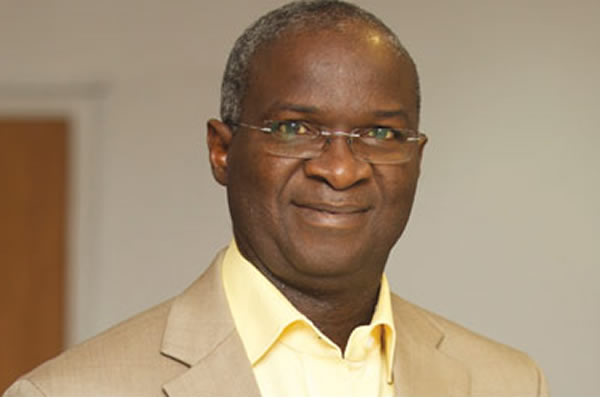
Minister of Power, Works and Housing, Mr Babatunde Fashola, has called for a maintenance focused skill acquisition system in Nigeria, to replace aging infrastructure and provide sustainable jobs for youths.
Fashola stated this on Thursday in Abuja at a one-day meeting on Technical Education Manpower Shortage, organised by the Council for the Regulation of Engineering in Nigeria (COREN).
The minister, represented by his Special Assistant on Works, Dr Femi Hamzat, said the Federal Government was currently investing heavily in infrastructure.
Fashola said N1.8 trillion was allocated to capital projects in the 2016 budget, adding that the Federal Government was currently planning for the infrastructure to be built.
“We are planning to build a second runway at some of our airports; this must be followed by a national maintenance plan.
“We must be thinking of a rail academy like Singapore to maintain and operate our new rail lines. We have to plan better for maintenance of our roads and bridges,” he said.
According to him, the perception of labour intensity work needs to change in our country and it won’t change because I’m speaking about it or that someone else is speaking about it.
He said the perception would change when stakeholders work hard to implement changes in the country’s vocational and technical education system.
“We need to figure out what makes an effective and responsive Technical and Vocational education system, what options are available to accommodate Nigeria’s vast social, economic, educational and cultural conditions.
“We need to examine if our system is aligned with different types of skills required for continuing education growth,” he added.
Prof. Danladi Matawal, Director-General, Nigerian Building and Road Research Institute (NBRRI), said no nation could develop without vocational and technical education.
He said the shortages of artisans in Nigeria had resulted to the importation of a significant number of artisans and craftsmen from neighbouring West African countries.
Matawal said the influx of artisans from these countries into Nigeria to perform jobs that indigenes should have performed was a significant problem.
He advocated for aggressive training for artisans and introduction of incentives to cause a shift in school enrollment to technical courses.


Infrastructure: Fashola advocates maintenance focused skill acquisition system

Leave a Reply








Latest Stories








© 2026 Published by SWAAYA LIMITED, Plot 20, Block G, Scheme 1, Residential 3, OPIC Beachland Estate, Lagos/Ibadan Expressway, Lagos. Gabriel Akinadewo, MD/CEO 08023010222, 08094000056, 08052097814.