(25 October 1939 – 9 August 2026)
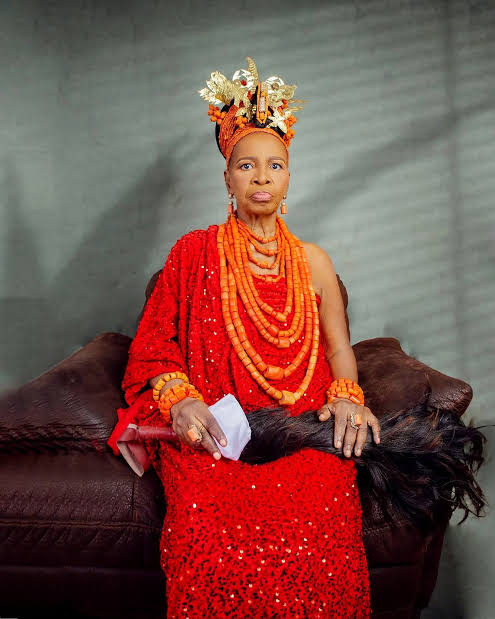
Princess Elizabeth Udinoghameyan Aghayiemwęnre Olowu (née Akenzua) was born into the Benin royal family in Benin City on 25 October 1939.
Her father, Omo N’Oba N’Edo Uku Akpolokpolo, Oba Akenzua II, was Oba of Benin from 1933 to 1978, and her mother was Queen Ehioba Ederaro Akenzua.
Elizabeth was the fourth of her mother’s 10 children. She married her secondary school sweetheart, Babatunde Olatokunbo Olowu (1938–2020), and together they had eight children.
She liked to joke that her two Edo names were whole sentences, and both were deeply meaningful. Udinoghameyan means “one can tell from the seedling the palm nut destined to grow into a tall and fruitful tree,” and Aghayiemwęnre means “I shall be remembered.” Both names truly reflected her life. She later took “Elizabeth” as her baptismal name at college.
Early Life and Education
Her early years were spent at Eguae, the Oba’s palace, where she was drawn into art making from childhood. Surrounded by the palace artists at work, and immersed in Edo art, music and culture, she longed to make what she saw. She would later recall how profoundly this shaped her thinking. She was studious and restlessly inquisitive beyond her years.
Her mother, a woman of many talents, moved effortlessly between crafts. She embroidered her husband’s handkerchiefs, beaded his shoes, and led the Oba’s other wives in painting and restoring the palace walls before major festivals. She was equally skilled at making women’s coiffures (Okuku) and weaving organic fibres into bags.
Princess Mrs Olowu always marvelled at how her father drew his own designs of royal crowns before entrusting them to the court artists responsible for making his royal regalia. He made sure all his children were well educated and insisted that his daughters receive no less, sending them to the finest schools at home and abroad.
She attended Government Primary School, Benin City. After completing her Primary School Certificate Examination in 1955, she moved to Lagos in 1956 to attend Holy Child College, Ikoyi, under the strict tutelage of Catholic Reverend Sisters. Her writing, in both Edo and English, was impeccable and scripted in beautiful cursive handwriting. Her two older sisters, Princess Adesuwa Emovon and Princess Edoba Oguaseki-Ogida (both née Akenzua), were in higher classes at the college.
They were role models and made school feel like a home away from home. All this prepared her for motherhood and gave her the confidence she exuded throughout her life.
At Holy Child College, she came into her own. She immersed herself in the school’s artistic life, designing costumes for Christian plays and capturing the picturesque scenes of Lagos by painting landscapes and seascapes.
In 1960, she won Mr Obi’s Prize as the school’s outstanding art student and the Principal’s Merit Award for the best student in Fine Arts. She also excelled in religious studies, passing the Intercollegiate Religious School Certificate examination with distinction in 1961. Her Christian education would later become a theme in her outdoor sculptures. She obtained her West African School Certificate in 1961. After leaving Holy Child College, she attended the Federal School of Science, Onikan, Lagos, where she obtained her University of London General Certificate of Education in June 1964.
Teaching
In 1965, she was hired as an art teacher at Anglican Girls’ Grammar School, Benin City. She taught there only briefly before gaining admission to the University of Nigeria, Nsukka, that same year. Sadly, the crisis that led to the Nigerian Civil War cut short her programme, and she had to return home to Benin City.
In 1966, she joined the staff of Itohan Girls’ Grammar School, where she taught art with rare mastery. She was indeed a master of crafts as much as of painting and drawing. Under her guidance, students learnt to see possibility in discarded materials: calabashes, carved and painted; old exercise books, reborn as paper beads and coronets; paper mats, woven by hand; snail shells, bones and bottles, turned into vases; and banana fibres and papier-mâché, shaped into new forms and sculptures.
All five institutions she taught in include: Anglican Girls’ Grammar School, Itohan Girls’ Grammar School, Federal Government Girls’ College, Benin City, the University of Benin Demonstration Secondary School and the University of Benin. Her methods shaped a generation of students, many of whom won awards in fine arts. As early as 1969, for instance, Itohan Girls’ Grammar School took first place in the printed-fabric category of the Craft Circle at the Benin West Divisional Festival of Arts.
University of Benin
Professor Cecil Todd, a Yorkshireman, had been recruited to establish the Department of Creative Arts at the University of Benin.
He was invited as guest of honour to open Itohan Girls’ Grammar School’s annual exhibition. He was so impressed by the students’ work that he asked to meet their teacher. Mrs Olowu met with him. He saw her as a perfect candidate for the new department. He invited her to apply to the University and offered her admission in October 1976.
Hers is a story of resilience. With six children and undiminished zeal, Princess Mrs Olowu became one of the four pioneering students who graduated in June 1979. The other three in that cohort were Messrs Tokunbo Browne (Graphics), Sylvester Ukpoki (Painting) and Okotie (Art Education). The few other students admitted in the same pioneer class of 1976 graduated in 1980. She thus became the first sculptor and the first female art graduate of the University of Benin.
In the 1977/78 session, she won the prize for the best art student in the Department of Creative Arts at the University of Benin – the same prize her daughter who later became a professor of art received exactly a decade after. She finished with a second class honours, upper division, Bachelor of Arts degree in sculpture.
She returned to the University for a Master of Fine Arts in sculpture, specialising in bronze casting, completed in 1984. For one year, during the 1981/82 session and while studying for the Master’s degree, she taught the course “An Introduction to Sculpture” in the Department of Fine Arts. During her research, she was determined to improve on the art of casting to meet contemporary needs and wrote a thesis titled “An Investigation into Benin Cire Perdue Casting Technique.”
She often spoke proudly of her lecturers: Dr Doris Rogers, Mr Josiah Onemu, Mr Justus Kanwanya Osakwe and Professor Irein Wangboje. Mr Onemu and Mr Emmanuel Ifeta taught her sculpture. Ifeta, an exceptional sculptor, shaped her style of realistic figurative representation. Along with Dr Rogers, Mr Ifeta supervised her master’s thesis.
Bronze Casting
Two years stand out as turning points in her artistic career: 1966 and 1976. In 1966, she began learning to cast from a blacksmith whose workshop stood just outside the gate of Itohan Girls’ Grammar School, making small objects such as bells. That first experience left her wanting more.
In 1976, she told her father she wanted to learn the more complex traditional Benin lost wax casting method. He granted her request and asked the bronze casters to teach her. She was apprenticed to Chief Ugiakha Omorodion (d.1998) on Igun Street. She always spoke of how respectful, kind and welcoming the caster, his wife Grace Evbenruwa Omorodion, and their first son Nosakhare (now Chief Okao) were throughout her apprenticeship. She went on to become the first woman to cast bronze in Benin City, an art that had been reserved for men for centuries.
She set up her gallery and studio at 125 Sapele Road, Benin City, in 1977 and added a foundry in 1981. She dreamed of a modern studio and foundry with facilities like those she had seen at the Royal Academy of Art in The Hague, which she visited in 1978. The foundry she envisaged would have a pulley system strong enough to lift large crucibles, so that she could melt the quantities of metal needed for large-scale sculpture.
She engaged John Forsythe, a British lecturer at the University of Benin, to install the heavy metal beams needed for this system. Hard as he tried, he could not realise her vision. In 1982, he left Nigeria for the UK. She then turned to Mr Peter Omodamwen, who succeeded in building a modern foundry powered by diesel and air-compressor systems. Princess Mrs Olowu did not simply make wax models. She modelled, invested and cast her own work using the cire perdue (lost wax) technique. She also experimented with sand casting and continued to produce outdoor statuary in her studio.
Life as an Artist
Her talent cannot be confined to one category. She was a sculptor, textile artist, designer, crafter, costumier, performance artist, singer and culture enthusiast. In 1978, she designed and made the commemorative cloth, in two colourways, for the funeral of her father, Oba Akenzua II.
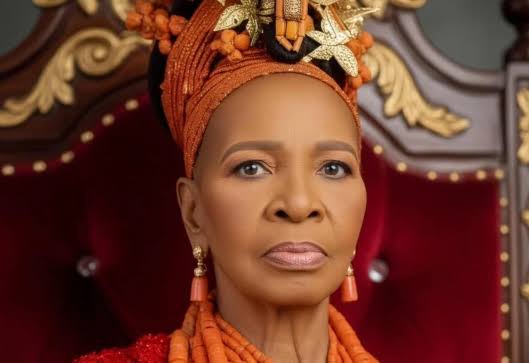
Clad in her own hand-designed appliqué fabric, her hair adorned with coral beads, there was no doubt that she was both a princess and an artist. She was the epitome of Edo culture, yet she embraced other cultures with equal ease. In one photograph, dressed in iro and buba, she described herself simply as “a Yoruba wife.”
Her studio was a beehive of activity. For many years, it drew local and international artists, scholars, connoisseurs and students who came to learn and share knowledge about Edo art and culture. Her work has been studied by several scholars. In 1991, Betty LaDuke devoted a chapter to her in a book Africa Through the Eyes of Women Artists, which has a preface by Elizabeth Catlett. Paula Girshick Ben-Amos and Barbara Blackmun also documented her work. Research on her artistic oeuvre funded in 2022 by the Africa Multiple Cluster of Excellence at the University of Bayreuth, Germany continues. Princess Mrs Olowu is best known for her many monumental sculptures in concrete and bronze.
She held several solo and group exhibitions. In 1985, she won the Bendel State Award for Art and Culture at Bendel Expo ’85 and took first place at the 2nd Tourism Expo in 1988. She also represented the state in the First Better Life fair held in 1988 at Tafawa Balewa Square organised by the First Lady, Mrs Maryam Babangida. She was a member of many associations, including Zonta International (Benin branch), the Holy Child’s College Old Girls’ Association (HCCOGA) and the Friends of the Museum, Benin City. She was also patron of the University of Benin Demonstration Secondary School Old Students’ Association.
Family Life
Princess Mrs Olowu was strict and firm yet loving and kind. She was strong, graceful, simple, confident and fearless. She held herself to the highest moral standards, and she worked so hard that her children learnt to work just as hard. She was a gifted storyteller and a remarkable singer, and her voice carried Edo folk songs and praise songs throughout the house. She raised all eight children without any outside household help.
She and her husband were inseparable. Their lives revolved around their children, and each shared fully in raising them. This is why she would accept no assignment or commitment that would take her away from Benin City and her family. Whenever she disappeared into her studio, her husband cooked for the children; supervised their homework and did the school run throughout their school years; supplied her with materials for her sculptures such as cement and metal rods from his block-making factory; and even lent a hand in casting her work. He encouraged her in no small measure; without his immense support, she could not have achieved what she did.
The children were her young apprentices. They rammed sand into metal boxes for sand casting, sculpted, took impressions from models, stretched wax into thin sheets for modelling, and sorted beads. They took part in her performances; she dressed them in costumes she designed that cast them as distinctive characters, sometimes soldiers, other times royal personages. Whether at Agbado market, Akpakpava where she ran her small businesses, Princess Enterprises and Penelope Enterprises, or at her more established studio, Oba Akenzua II Art Foundation, she always made room for a lesson corner for her children. She and her husband placed a high value on education, and all eight children, five sons and three daughters, received very good university education.
Her extended family held a special place in her heart. She attended many royal family occasions, including palace events, the funerals of relatives, and the weddings of cousins, nieces and nephews. She dressed many of them in her own textile designs and styled their hair for traditional weddings. They in turn, loved and cherished her and affectionately called her “Sisi” or “Iye Dapo.”
When her husband, Babatunde Olowu passed away suddenly in 2020, it was an extremely difficult time for her. In the years that followed, she lived with each of her children in turn, and it became their opportunity to care for and honour her.
Service and Honours
Princess Mrs Olowu served the former Bendel State Government and later, Edo State in various capacities.
She organised skills workshops for the unemployed and for market women to help them supplement their earnings, many of the training sessions were free of charge.
She also represented the state in several local and national exhibitions. She contributed immensely to Nigeria’s art ecosystem, particularly in Edo State.
After a fulfilling teaching career of 35 years, she retired in 2001 but continued working in her studio.
In her last years, she received two more awards that brought her great joy. In 2022, she was honoured in the Art and Culture category at the International Women’s Day Gala sponsored by UN Women and held at the U.S. Consul General’s residence in Ikoyi, Lagos.
She attended in person and was celebrated by five female envoys for her immense contribution to the development of culture in Nigeria. They were the U.S. Ambassador to Nigeria, the French Ambassador to Nigeria, the British High Commissioner, the German Ambassador to Nigeria and the Head of the European Union Delegation.
In 2024, she was inducted into the Edo State Teachers’ Hall of Fame for her many years of outstanding service and dedication to education in the state.
On receiving the award, she became emotional, saying, “Oh, they remembered me!”
True to her name, Aghayiemwęnre, “I shall be remembered,” she will be remembered for her teaching at several levels of education, her pioneering work as a bronze caster and sculptor, and her devotion to Edo culture and family.
She will also be remembered for the many lives she touched. This was a life truly well lived!
She is survived by children and several grandchildren.