


The Independent National Electoral Commission (INEC) has introduced a new measure on ballot paper handling at polling units to check vote buying in the 2019 general elections.
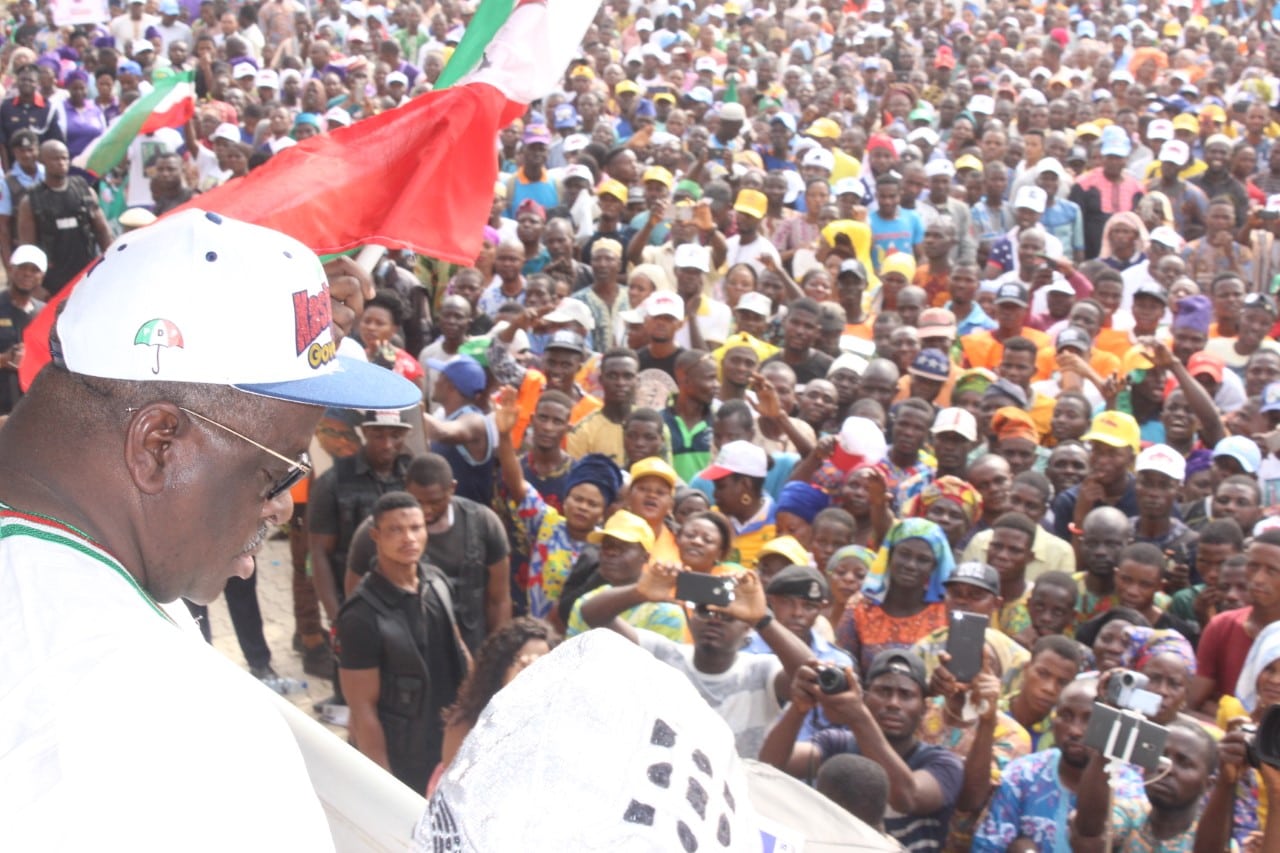
Its Chairman, Prof. Mahmud Yakubu, disclosed this at a public hearing on ‘Vote Buying and Improving Electoral Processes in Nigeria’, conducted by the National Assembly Joint Committee on INEC in Abuja on Monday.
Yakubu said in the 2019 polls, the ballot papers would be handed to voters rolled up before they proceed to the polling booths to cast their votes.
He explained that the voters, in turn, must also roll up and flatten the ballot papers before leaving the polling booths to drop them in the ballot boxes.
Yakubu demonstrated the folding process with a sample of the presidential ballot paper to be used in the 2019 polls.
He said it would guard against the electorate displaying thump-printed ballot papers to agents of vote buyers at the polling units.
The INEC boss described vote buying as a systemic problem that permeates the entire electoral process, including during political party primaries.
While noting that many countries were also grappling with the menace, he said Nigeria must find solutions to its own to serve as a reference point for other nations.
Yakubu decried the lack of arrest and prosecution of culprits despite the existence of criminal laws against vote buying and other forms of bribery and inducements, including the Electoral, EFCC and ICPC Acts.
“Since 1999, we have had several confessional statements by many partisan actors on how an electoral process is subverted and voters and electoral personnel are induced.
“They do this through food items, kitchen utensils, automobiles, electrical appliances, clothing toiletries, sandwich and so on.
“By sandwich, I am not talking about food. There is a way candidates induce voters using two slices of bread; sandwiched in between the two slices is a currency note,” he said.
To address the menace of vote buying, Yakubu said, the country must break the chain of voter inducement.
According to him, the problem cannot be eradicated in secondary elections where many of its perpetrators were beneficiaries of vote buying at party primaries.
He said INEC would continue to devise innovative means to guarantee the credibility of the 2019 general elections and beyond.
Meanwhile, the commission has decried what it called the very poor followership of its activities in the social media by eligible voters for the 2019 general elections.
Mr Rotimi Oyekanmi, the Chief Press Secretary to the INEC Chairman, stated this in Enugu on Monday.
Oyekanmi made the statement at the presentation of Voter Education Implementation and Capacity Building Workshop for INEC’s Public Affairs Officers (PAOs) in Enugu.
In the presentation titled; ‘‘Effective Use of Social Media in Voter Education and Public Enlightenment,’’ Oyekanmi described the poor followership of INEC on the social media as a huge constraint as INEC was preparing for the 2019 general elections.
He noted that out of 85 million registered eligible voters for the 2019 elections, only about one million (approximately 1.8 per cent) were following INEC on twitter; while on Facebook, the commission could only boast of about 314,000 (approximately 0.4 per cent) of registered eligible voters.
Oyekanmi said on Instagram, INEC had about 58,500 followers, representing only 0.06 per cent of eligible voters.
‘‘Looking at the figures, if we are a manufacturing company, we will say that we have customer base but we are an election management body. How do we reach out to voters?
‘‘If you follow us on our twitter page, you will be shocked at the kind of questions that people are asking. Somebody was asking when we will start CVR (Continuous Voter Registration).
‘‘We had an interaction with media executives and they were asking why we are not advertising.
‘‘I replied them that INEC requested N189 billion for the election and if you put it all in advertising, considering the size of Nigeria, it will not be enough,” Oyekanmi said.
He, however, noted that INEC had a communication policy, but that it was awaiting approval.
According to him, the communication policy identified critical stakeholders such as political parties, media, civil society, presidency, domestic and international observers, diplomatic group, persons with disabilities, traditional and religious bodies.
In a presentation on “Fake News and the Electoral Process,” Mrs Hayya Ahmed observed that both the social media and traditional media could be used to spread fake news during elections.
Ahmed, who is a Media Specialist with International Foundation for Electoral Systems (IFES), noted that fake news, if not countered immediately, could create tension and trigger election violence.
‘‘Fake news include fabricated news with no verifiable facts; misinformation or inaccurate information that was mistakenly or inadvertently created or spread with intention to deceive and misinform.
‘‘Fake news is deliberately created to influence public opinion and obscure the truth,’’ she added.
All INEC’s Public Affairs Officers (PAOs) throughout the federation attended the one-day workshop.


INEC Chairman: Politicians put naira inside bread to induce voters


Leave a Reply





Popular Stories
-

Anti-terror fight: U.S. soldiers arrive Nigeria
-
Ifunanya Nwagene’s snake bite complications: Our defence, by Federal Medical Centre, Abuja
-
Ademola Lookman on target in Atlético debut; records assist, makes history in style
-
Police officers allegedly assault content creator, Ijoba Lande, brother; steal iPhone 16 Pro Max, $1,200
-
South Africa to host WAFCON as Morocco pulls out
-
FG, states, LGs share N1.969 trn in December 2025 revenue


Latest Stories







© 2026 Published by SWAAYA LIMITED, Plot 20, Block G, Scheme 1, Residential 3, OPIC Beachland Estate, Lagos/Ibadan Expressway, Lagos. Gabriel Akinadewo, MD/CEO 08023010222, 08094000056, 08052097814.