

Contrary to popular belief, Afenifere chieftain, Chief Olu Falae, declared on Monday that his family members paid ransom to his kidnappers before he was released last week.
He said without the ransom being paid, he may have been killed.
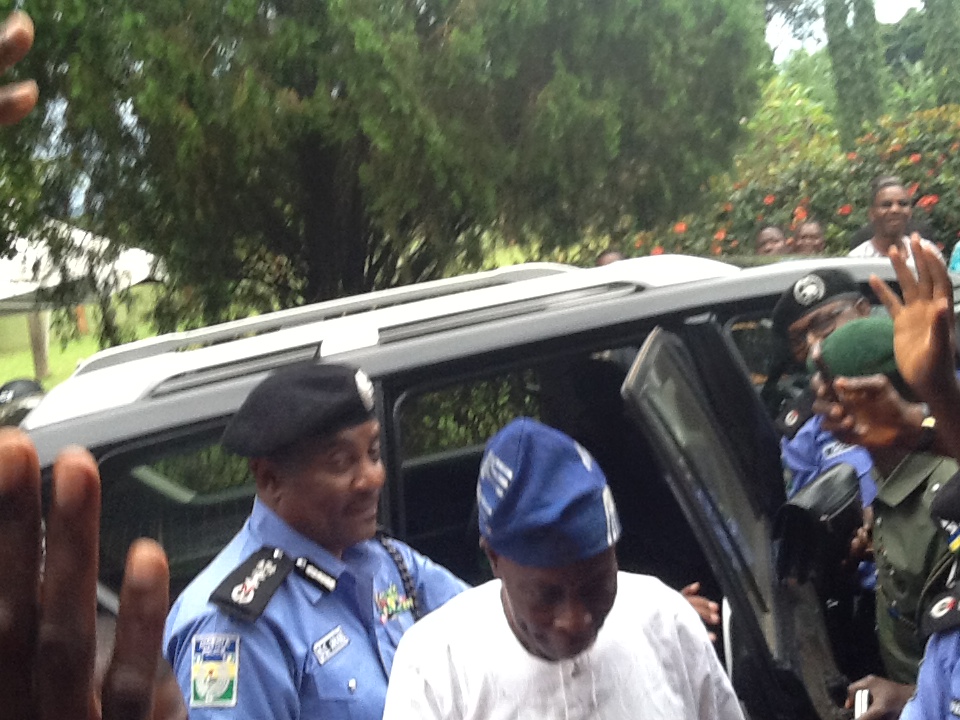
When the former Secretary to the Government of the Federation (SGF) returned to his Akure, Ondo State residence last Thursday, was accompanied by the Inspector-General of Police (IGP), Solomon Arase, and many policemen, an action that fuelled the thinking that Falae was rescued from the kidnappers by the police.
But Falae declared on Monday that it was the ransom paid by his family members that led to his release.
Although he did not state the sum, a source said N10 million was paid.
He spoke when former Chief of Defence Staff, Lt. General Alani Akinrinade, visited him in Akure.
Narrating his ordeal, he said: “They threatened to kill me if the money was not paid. It was a horrible experience. They made me sleep on the floor and threatened my life throughout the period of my captivity. Of course, they are Fulanis.
“It is an insult to our race that a man like me could be abducted by a bunch of hoodlums. One of them even told me that after leaving them, if I go out and say nonsense, they would come back to kidnap me again. Every 30 minutes, they threatened to kill me if the money was not paid. They only stopped the threat when they realised that the money had been paid.
“There were six of them with three or four guns and every half an hour or so, they will say, ‘Baba, we are going to kill you. If you don’t give us money, we are going to kill you.
“On Wednesday, one of them came and said ‘look, we are going to leave here on Thursday morning. Since we cannot leave you here alone, if we don’t get what we want, we are going to kill you.
“And they said they gave me until 3pm and if at 3pm they didn’t get the money, they would execute me. I thank God that at 21 minutes to 3pm, one of them came and said, ‘the money done complete.’
“When they stormed my farm, they slapped me with their cutlasses, shouting that I was not cooperating. And they dragged me barefooted into the bush.
“After dragging me around for about two hours, they stopped somewhere for us to rest and there, they asked me to phone my wife and tell her that I have been kidnapped and taken out of Ondo State by car which was a lie.
“It was about 2.30pm on Monday. We started walking with very few stops until 2am the following morning. I suspect that I must have covered a minimum of 15km. That morning, I did not take anything. So, all day I had no food, no water and I walked close to 15km. How I survived, I cannot really remember. I had no food in my stomach, I had no shoes, my clothes were torn to shreds.
“At some point, one of them gave me rubber slippers. We walked until about 2am. At some point, they called for an Okada. About 2.30am, the Okada man took me way down. I had no clue where we were going. Finally, they dumped me somewhere, where I was until I was released on Thursday.
“In that place, we all slept on the floor on leaves. Unfortunately, the rain came in the night and I was thoroughly drenched where I was lying down. One of them brought a small umbrella to cover my head, my head was covered, but the rest of my body was not covered.
“They offered me bread, but I told them I could not eat it. I demanded for a bottle of coke, which was what I drank everyday to have the requisite strength to survive and to continue on the march, because they were permanently moving.
“They were changing locations at two to three times a day. I suspect because they did not want the police to succeed in tracing them.
“The money was paid on Wednesday but they didn’t allow me to go until Thursday. The following morning, they said I should go. One of them took ropes to stitch my buba which was already in tatters, so that I would not look like a lunatic while leaving that place. So, when I came out of the bush, I was able to find an Okada, a man riding a bike, who gave me a lift to Owo.
“The place was about 10 kilometres from Owo town. The place was between Owo and Ifon. And I walked most of the distances between my farm to that place.
“As I said, miraculously I was not tired, I was not hungry and I was not afraid of them at all. Each time they said, ‘Baba we will kill you,’ I will tell them, ‘no, insha Allah, you will not kill me.’
“I did not break down, but I want to tell you that when I got back home, I became completely exhausted. But I am now 80 per cent fit and I know in the next few days, I will be up again.
“Only two of the kidnappers could speak some English. They were between the ages of 25 and 35. They were Fulani, they spoke Hausa.
“The cattle rearers have been giving me a hard time for the past two or three years. Because I have a dam on the farm, so they like to bring their cattle there to drink water, then they eat other people’s crops.
“This time, they ate up my maize farm, two hectares. We took pictures, and it was videoed, the police went there. They were asked to pay compensation, they begged and paid half of what we claimed and we accepted it.
“That was about two months ago. Whether it was one of them who went to bring his brothers to come and deal ‘with this wicked man,’ I don’t know. It is plausible. Absolutely plausible.
“My view is that this is my home. I have not gone to farm in any other person’s territory. This is my home where I was born. I have every right to farm here and live in peace here. So, this is totally unacceptable.
“I once told the Commissioner of Police that if he cannot protect us and protect my farm, that I will protect myself. There will be self help if government fails to protect its citizens.
“It would have been unfortunate if that were to happen. The IG met me and gave me assurances that they will give us protection. I hope that we as a community in Ondo State and in Yoruba land as a whole must go into consultation to ensure that we enhance our protection. We cannot be slaves in our own territory.”
To Akinrinade, the abduction was the height of insult to the Yoruba race and the country.
“This is a big insult to the Yoruba nation. Chief Olu Falae was traumatized in the hands of these hoodlums. This is a gentle man who is making farming for a living and doing well with it. The fact that the Yoruba people are hospitable in their dealings with other tribes should not be a basis for dis-respecting our leaders including our culture and norms.”


Falae: I was not rescued, my family paid ransom before I was released


Leave a Reply









Latest Stories







© 2026 Published by SWAAYA LIMITED, Plot 20, Block G, Scheme 1, Residential 3, OPIC Beachland Estate, Lagos/Ibadan Expressway, Lagos. Gabriel Akinadewo, MD/CEO 08023010222, 08094000056, 08052097814.