


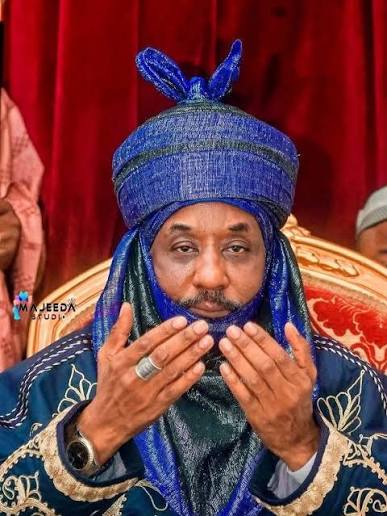
The Emir of Kano, Khalifa Muhammadu Sanusi II, has called on Nigerian politicians to move away from politics driven by domination and embrace leadership built on service, accountability and competence.
Sanusi said such a shift was necessary for Nigeria to build a stronger, more prosperous and inclusive future.
The emir made the call at a national dialogue held in Kano with the theme, “Revisiting the Past, Reconciliation and Building the Future.”
The event was organised by PowerShift Africa and brought together stakeholders who discussed unity, reconciliation, justice and inclusive governance as key tools for national development.
Sanusi was represented at the event by the Danmadamin Kano, Prof. Abubakar Aliyu-Sanusi, a Professor of Economics at Bayero University, Kano.
He urged Nigerians to promote unity, tolerance and collective responsibility in the task of nation-building.
According to the emir, power-sharing should go beyond geographical rotation.
He said the process should ensure that credible, competent and compassionate leaders emerge to serve the people.
Sanusi described the dialogue as timely, noting that Nigeria was facing serious social, economic and political challenges.
He said the country had reached a critical stage that required honest reflection on the past in order to build a better future.
The emir noted that more than six decades after independence, Nigeria was still dealing with questions of nationhood, equity, justice, inclusion and development.
He said although the country had recorded some achievements, it continued to face political instability, ethnic and religious tensions, insecurity, poverty and economic hardship.
Sanusi also called for economic policies to be judged by their impact on the welfare of citizens.
He said any economic policy that fails to improve people’s living conditions cannot be regarded as effective.
The emir urged leaders to prioritise policies that reduce poverty, improve standards of living and promote inclusive growth.
He also stressed the importance of learning from history, strengthening institutions and upholding justice as foundations for sustainable development.
According to him, no country can build a stable future without understanding its past and addressing unresolved grievances.
Sanusi identified insecurity, corruption, poverty and poor infrastructure as some of the major challenges confronting Nigeria.
During a panel session, political analyst Umma Abdullahi said many of Nigeria’s problems were caused by artificial barriers created over the years.
She called for a country where citizens are recognised first as Nigerians, rather than by ethnic, religious or regional identities.
Abdullahi also urged young people to embrace peace, love and patriotism.
The Eze Igbo of Kano, Igwe Ikechukwu Oliver-Abodo, also emphasised the need for national unity and peaceful coexistence.
He said Nigerians should see themselves as one people, regardless of ethnic or religious differences.
Oliver-Abodo noted that many citizens had lived and succeeded outside their places of origin, adding that such experiences should encourage mutual respect and understanding.
The traditional ruler urged leaders to focus on improving citizens’ welfare and creating opportunities for young people.
He said Nigeria could not be divided if citizens remained united and committed to the country’s progress.
Earlier, the Executive Director of PowerShift Africa, Nso Nnamani, said the dialogue was organised to promote national unity and reconciliation.
Nnamani said Nigeria’s biggest challenge was the absence of national cohesion.
He argued that ethnic divisions and political interests had continued to slow down national development.
According to him, meaningful progress can only be achieved through reconciliation, mutual understanding and a shared national vision.
He said every successful nation must have a dream and a clear plan for the future.
Nnamani added that the conference was designed to provide a platform for different ethnic groups to discuss ways of building a more united and prosperous Nigeria.
He said the event would also include symbolic reconciliation activities aimed at strengthening trust among participants from different backgrounds.
Stakeholders at the dialogue agreed that unity, justice, accountability and citizen participation are essential to building a peaceful, prosperous and inclusive Nigeria.