The Monetary Policy Committee (MPC) of the Central Bank of Nigeria (CBN) has announced a resetting of the baseline interest rate, the Monetary Policy Rate (MPR), to 23 per cent from 26.5 per cent.
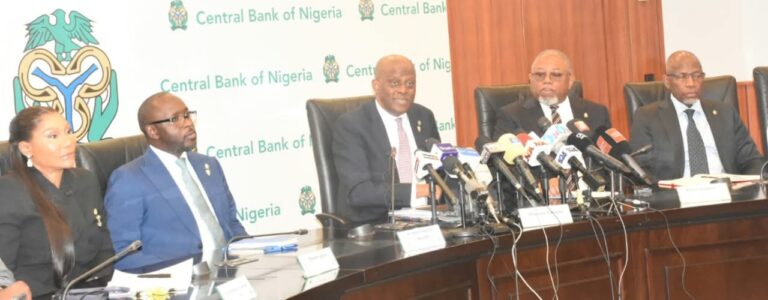
CBN Governor, Mr Olayemi Cardoso, made the announcement on Tuesday in Abuja, while presenting a communiqué from the 307th meeting of the MPC.
According to Cardoso, the committee also recalibrated the Standing Facilities Corridor (SFR) at +50/-300 basis points around the MPR, from +50/- 450 basis points.
He, however, said that the Cash Reserved Requirement (CRR) was retained 45per cent for deposit money banks, 16 per cent for merchant banks and 75 per cent for non-TSA public sector deposits.
“The committee decided to reset the MPR and recalibrate the policy corridor as an important operational realignment.
“It is aimed at strengthening monetary policy transmission and reinforcing the primacy of the monetary policy rate,” he said.
He said that the recalibration of the corridor did not constitute a change in the current monetary policy stance.
He described the step as an operational reset to enhance the effectiveness of monetary policy and support the transition to an inflation-targeting framework.
“Members are of the view that the current macroeconomic environment remains supportive of such a recalibration without undermining the disinflation process,” Cardoso said.
He said that in arriving at the decision, the committee took note that the divergence between the MPR and the prevailing market rates had weakened the effectiveness of monetary policy transmission.
“Members noted that the bank’s ongoing repair of the monetary policy implementation framework, including the adoption of Nigerian Overnight Financing Rate (NOFR) as a transaction-based operational benchmark, has improved the transparency of money market operations.
“The committee, therefore, considered a reset of the MPR and recalibration of the corridor appropriate to better align the monetary policy implementation framework with market realignment.
“This will strengthen policy transmission and restore the MPR as a principal signal of monetary policy,” he said.
The CBN governor said the recalibration represented an operational realignment of the framework and should not in itself be construed as a change in the underlying policy stance.
He said that the MPC broadly observed the increasing resilience demonstrated by the Nigerian economy.
He said that the resilience was reflected by the moderating inflation, robust external reserve buffers, improved external sector fundamentals, and strengthened investor confidence.
“The committee acknowledged the considerable improvement in the balance of payment surplus of 3.51 billion dollars in the second quarter of 2026, compared with 2.38 billion dollars in first quarter.
“Similarly, the current account surplus increased by 67.92 per cent to 7.54 billion dollars in the second quarter , from 4.49 billion dollars in the first quarter.
“The committee particularly noted with satisfaction the progress of the disinflation process, evidenced by three consecutive months of decline in headline inflation.
“This is in spite of the lingering geopolitical tensions in the Middle East and the associated increase in global energy prices,” he said.
Meanwhile, a financial expert, Prof. Uche Uwaleke, said that the decision of MPC to cut the MPR by 350 basis points was justified by moderating inflation, exchange rate stability, improvement in FX market liquidity, and accretion to external reserves.
Uwaleke is the Director of the Institute of Capital Market Studies and President of Capital Market Academics of Nigeria.
He described the MPC decision as a welcome development against the backdrop of the recently signed MoU between the Minister of Finance and the CBN Governor on fiscal and monetary policies coordination.