

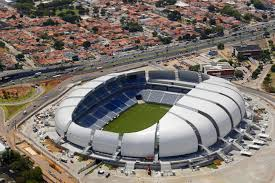
Brazil spent billions renovating and building World Cup stadiums that were supposed to help modernise and improve local soccer.
Almost a year after the tournament ended, the nation is still trying to figure out what to do with them.
Some of the 12 new state-of-the-art stadiums are just now being completed as originally planned. Others are already up for sale.
The Itaquerao Stadium in Sao Paulo hosted the World Cup’s opening match last June, a 3-1 win over Croatia for the host nation. But the venue wasn’t fully finished at the time and only now it’s been completed, 10 months after the tournament.
Part of the glass covers that were supposed to be added to the stadium’s roofing structure were finally installed last month, along with a few other things that were still missing at the $450 million arena.
Attendance has significantly increased at the stadium owned by popular team Corinthians, but the club can’t keep any of the revenue because the money is still being used to pay for its construction.
A year after it handed over the stadium to FIFA for the World Cup, Corinthians still hasn’t been able to reach a naming-rights deal for the arena.
Another stadium only now being completed is the Arena da Baixada in Curitiba, which last month inaugurated the retractable roof that had to be abandoned before the tournament because of construction delays. The roof was in the original project for the World Cup, but FIFA asked organisers to postpone its installation to avoid the risk of not being ready in time.
The club that owns the venue, Atletico Paranaense, boasts that it has the first soccer stadium in Latin America with a retractable roof, but while announcing the termination of a contract with stadium operator AEG last month, the club admitted that “the (financial) return was not the one expected.”
“There are a lot of ways to make money from these stadiums, but you have to work hard to make it happen, it’s not automatic,” local sports marketing specialist, Joao Henrique Areias said. “The way things are now, you can’t expect Brazil to profit from them. And we all know who is going to continue to pay for this bill, it’s the taxpayer.”
Brazil spent about $3 billion on the World Cup stadiums, saying the new venues would become a legacy for the country.
Most were turned over to private operators who are now struggling to profit from soccer. Some have resorted to children’s events, corporate gatherings and religious services to increase revenue.
The new stadiums are better and more modern, but they are also more expensive to maintain, prompting operators to charge more from fans and clubs.


Brazil in dilemma over what to do with 2014 World Cup stadiums

Leave a Reply








Latest Stories








© 2026 Published by SWAAYA LIMITED, Plot 20, Block G, Scheme 1, Residential 3, OPIC Beachland Estate, Lagos/Ibadan Expressway, Lagos. Gabriel Akinadewo, MD/CEO 08023010222, 08094000056, 08052097814.