

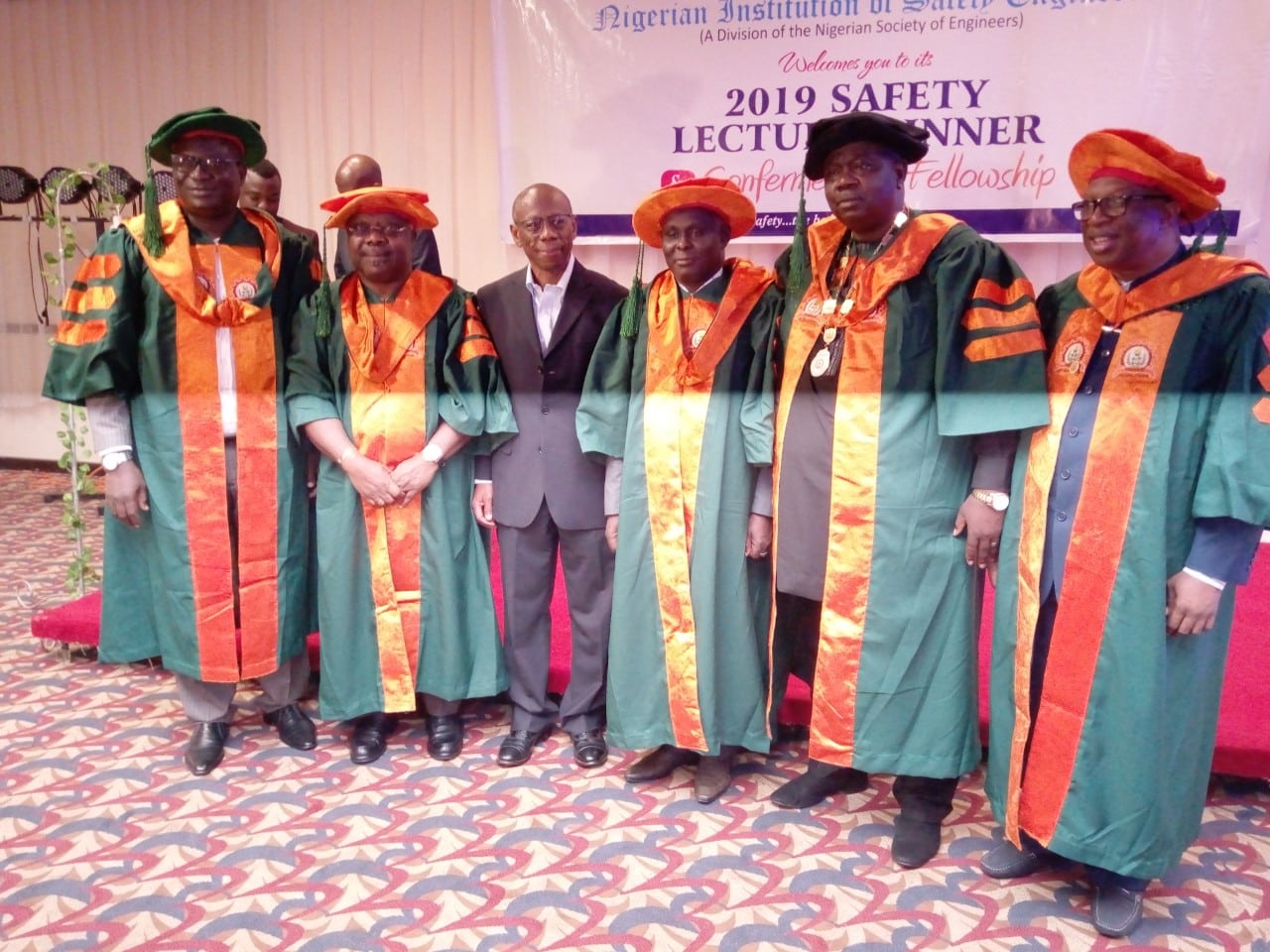
The Nigerian Institution of Safety Engineers (NISE), a division of the Nigerian Society of Engineers (NSE), has appealed to the National Assembly to pass the bill on Occupational Safety and Health proposed in 2008 by the organisation for the safety of public service into law.
Guest Speaker, Engineer Oladimeji Oguntominiyi, the Director, Highways Construction and Rehabilitation, Federal Ministry of Power, Works and Housing, Abuja, disclosed this in his lecture, at the 2019 NISE Dinner and Conferment of Fellowship, tagged ‘Safety in Public Service Institutions- A case study of the Federal Ministry of Power, Works and Housing’.
He said when passed, the bill will lay a strong foundation for implementation of safety programmes, including the regulatory procedure in the country.
He said with the law in place, every organisation will be encouraged to develop Standard Operation Procedures (SOP) that will give a clear guide to all on how to respond to any emergency.
“One of the biggest challenges that exacerbate injury is when operating personnel do not know what to do during emergency. When the law is passed, this will become a thing of the past if a standard procedure is in place and communicated to all.
“Another measure to strengthen the emergency preparedness of an organisation is the setting up of Emergency Response Team. Such team should be made up of officials selected from all the key departments of an organisation who will be in charge with the responsibility of taking care of an emergency that might occur for a period of one week.”
He noted that Public Safety, Health and Environment are major priority for governments, and that the administration of President Muhammadu Buhari is no exception “while virtually all aspects of engineering from civil to mechanical, electrical to chemical and other fields of engineering require safety, all engineers, as part of their trainings are required to incorporate safety in their design, operation and maintenance procedures to protect the users”.
He also said public interest on the issue of road safety has also increased greatly. “Now road safety is a serious issue, because of the demonstrable impact of road accidents on the economy. To ensure safety on the roads, is therefore not just an enduring social obligation but also a commercial obligation.
“According to statistic of the World Health Organisation (WHO) and made public by the Federal Road Safety Corps (FRSC), Nigeria was ranked 191 out 192 countries in the number of death caused by road crashes.
“The findings further claimed that 162 out of every 100,000 Nigerians die from road accidents. This called for a serious concern and concerted effort from the government and private sectors to reduce the crashes.
“Meanwhile, with the current activities of government as its concerns safety of our roads, I am pleased to say that the recent development show that progress is being made. While the progress encourages us, but we will not let ourselves become complacent. We will try to put more efforts, because three of the United Nations Sustainable Development Goals for 2030 deal directly with what we are doing in the ministry.
“Innovation and Infrastructure and SDG11 on sustainable Cities and Communities, we will continue to do all we can to ensure the protection of good health, safety, security and the environment. We will also reduce the rates of disasters to the barest minimum.”
According to the National Chairman of the Nigerian Institution of Safety Engineers, Engineer Adeyemi Oyedepo, “Those who were conferred with the Engineering Safety Fellowship were selected by the institution based on their track records.
“They were not just handpicked by the institution, they were members before they were conferred with the fellowship. The conferment of the Safety Fellowship on them is a wake-up call on them to do more for the engineering sector and Nigeria at large.”


At NISE Fellowship Conferment, engineers make case for Occupational Safety Law

Leave a Reply









Latest Stories








© 2026 Published by SWAAYA LIMITED, Plot 20, Block G, Scheme 1, Residential 3, OPIC Beachland Estate, Lagos/Ibadan Expressway, Lagos. Gabriel Akinadewo, MD/CEO 08023010222, 08094000056, 08052097814.