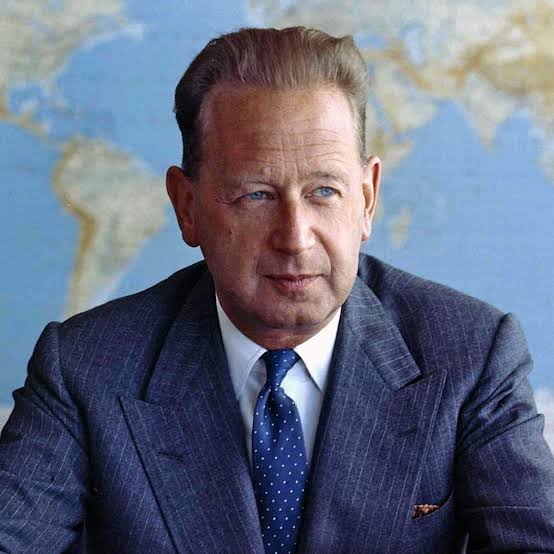
The United Nations (UN) General Assembly, on Thursday, held a commemorative event to mark the 60th anniversary of the death of former UN Secretary-General, Dag Hammarskjöld.
Hammarskjöld was appointed Secretary-General in 1953, at just 47, still the youngest person to ever hold the UN’s top job.
On September 18, 1961, during his second term, he died in a plane crash while en route to negotiate a ceasefire in the Congo.
UN Secretary-General, António Guterres, said that in his passing, the world had lost “a noble servant of peace, and the United Nations lost one of our greatest”.
This year’s special commemoration recognised Hammarskjöld’s achievements, paid tribute to his ultimate sacrifice, and reflected on his enduring legacy.
According to Guterres, the Swedish diplomat is a reference and inspiration.
He recalled that his wisdom and humanity, his unimpeachable integrity and single-minded devotion to duty set the highest standard for public service.
“He was more than a person of action and deft diplomat; he was a person of immense culture, of brilliant and sensitive intellect.
“And it was this deep and broad passion for culture that helped shape him as the leading diplomat of his generation,” Guterres said.
Remembering Hammarskjöld could speak some half dozen languages, the UN chief said he was “perhaps most fluent in the language of our common humanity – recognising diversity as richness, promoting dialogue, tolerance and mutual understanding.”
He added that the Swedish diplomat had championed some of the organisation’s key ideals that have endured long after his death, such as placing human rights at the centre and focusing on prevention, saying they “remain guiding lights pointing the UN true north”.
In addition, Guterres said he had a vision for the UN to become both the measure and the vehicle of humanity’s most generous impulses, and advanced it in practical ways.
The UN chief remembered how Hammarskjöld nurtured and sharpened the UN’s obligation to act, in times of crisis, on the ground, closest to the people the organisation serves, and who rely on it most.
During his two terms, Dag Hammarskjöld presided over the creation of the first UN peacekeeping forces in Egypt and the Congo and intervened to defuse or resolve diplomatic crises.
Speaking at the same event, the President of the General Assembly, Volkan Bozkir, said he revolutionised the Secretariat, creating a professional class of independent international civil servants committed to meeting the needs of the people we serve.
For the leader of the General Assembly, Hammarskjöld took on a role which many considered to be an impossible job.
“However, he set out to share his belief in the capacity of the United Nations to save succeeding generations from the scourge of war role which many considered to be an impossible job,” Bozkir added.