


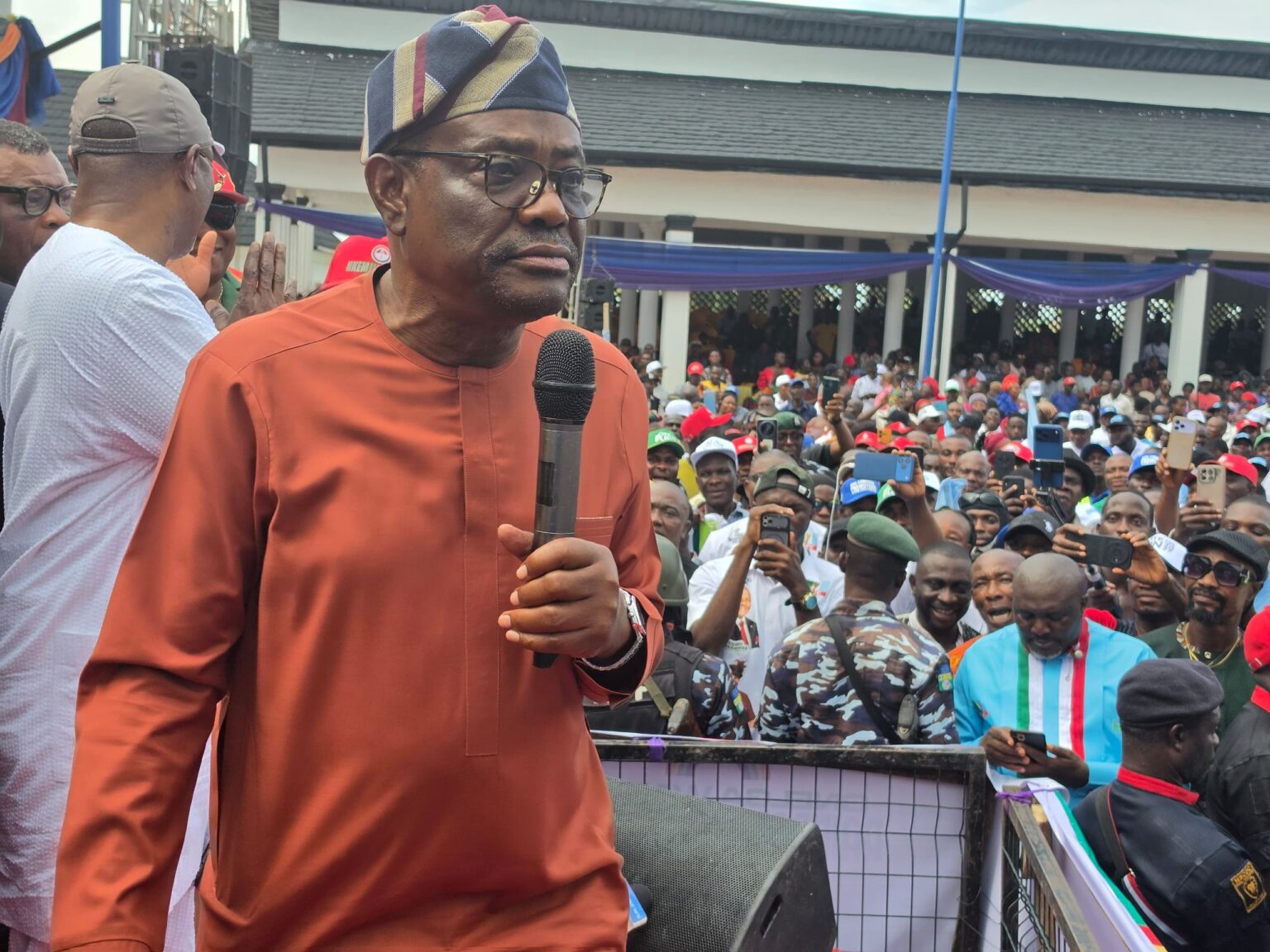
Wike made the remarks on Saturday, October 17, 2026, during a Rainbow Coalition stakeholders’ consultation in Ogba-Egbema-Ndoni Local Government Area (ONELGA) of Rivers State.
The former Rivers State governor maintained that the economic decisions taken by the Tinubu administration, although difficult for many Nigerians, were intended to address longstanding structural problems.
He argued that abandoning the current policy direction could undermine efforts to stabilise the economy.
Wike defends Tinubu’s economic reform agenda
Speaking to political stakeholders and supporters, Wike described the economic situation inherited by the current administration as requiring major intervention.
He said the government’s decisions were intended to correct weaknesses that had affected national development for years.
According to the minister, the benefits of economic restructuring may take time to become fully visible.
Wike maintained that policy consistency was essential to improving economic conditions, encouraging investment and strengthening public finances.
He also recalled his support for Tinubu during the 2023 presidential election, saying he had defended the political direction despite concerns about the difficulties Nigerians might face.
The FCT minister insisted that the 2027 election would provide an opportunity for citizens to assess the administration’s record and its plans for the country’s economic future.
Wike criticises Atiku, Amaechi and Peter Obi
The minister also questioned the suitability of leading opposition candidates seeking to challenge Tinubu in the presidential election.
He criticised former Vice-President Atiku Abubakar, the presidential candidate of the African Democratic Congress (ADC), and his running mate, former Rivers State Governor Rotimi Amaechi.
Wike argued that politicians who have repeatedly sought public office should be judged by their previous achievements and the policies they intend to implement.
He accused some opposition figures of placing political ambitions ahead of national development.
The minister also criticised Peter Obi, the presidential candidate of the Nigeria Democratic Congress (NDC), questioning whether his proposed approach would produce different economic outcomes.
His assessments were political criticisms. The claims about the intentions and likely performance of opposition candidates have not been established as facts.
Atiku, Obi and their parties have separately presented policy positions on economic management, including proposals concerning the cost of living, energy prices and productive investment.
Amaechi challenged over Rivers development record
Turning to Rivers State politics, Wike challenged Amaechi to explain how public resources were managed during his time as governor.
Amaechi governed Rivers State between 2007 and 2015 before serving as Nigeria’s Minister of Transportation.
Wike, who succeeded him as governor in 2015, called for closer public examination of the achievements of former office holders seeking national leadership positions.
He argued that a politician’s record in office should provide a basis for evaluating claims about competence and future performance.
The minister did not provide a detailed financial audit during the meeting to substantiate his criticism of Amaechi’s management of state resources.
Rainbow Coalition explains political strategy
Wike also outlined the role of the Rainbow Coalition, a cross-party political arrangement supporting Tinubu’s 2027 re-election campaign and selected legislative candidates.
He maintained that cooperation between the Presidency and the National Assembly would help the government implement its economic policies.
According to him, disagreements between the executive and legislature could affect the passage of legislation and the delivery of government programmes.
The minister explained that the coalition was seeking support across existing party structures rather than limiting participation to members of one political party.
Although the coalition has received support from some state-level party organisations, its activities have also attracted criticism from some leaders within the ruling All Progressives Congress (APC).
Wike discusses 2027 election preparations
The FCT minister used the stakeholders’ meeting to address preparations for the presidential and National Assembly elections scheduled for January 16, 2027.
He called on coalition officials to organise their campaign activities and engage residents across the local government area.
Wike also stressed the importance of participation in the electoral process.
He maintained that the outcome of the elections would have consequences for Nigeria’s economic policy direction.
The Independent National Electoral Commission (INEC) has scheduled the governorship and State Houses of Assembly elections for February 6, 2027.
ONELGA chairman commends Wike’s projects
Chairman of Ogba-Egbema-Ndoni Local Government Area, Chukwu Shedrack, praised Wike for projects undertaken during his tenure as Rivers State governor.
Shedrack cited road construction, improvements to healthcare facilities and human capital development initiatives.
He said such projects had contributed to development within the council area and reflected the leadership approach he associated with the former governor.
The chairman also expressed support for the Tinubu administration’s economic policies and the political activities of the Rainbow Coalition.
He said local political organisers were preparing for the forthcoming elections.
His assurances about voter support represented the council chairman’s political expectations rather than independently verified voting intentions.
Nigeria’s economy records mixed signals
Wike’s comments come amid continuing national debate over the impact of the economic measures introduced by the Tinubu administration since May 2023.
The reforms include the removal of the petrol subsidy and significant changes to foreign exchange management.
Supporters argue that these policies have helped improve government revenue, foreign exchange management and macroeconomic stability.
However, the changes have also been associated with higher transport costs, pressure on household purchasing power and increased operating costs for many businesses.
According to the National Bureau of Statistics, headline inflation eased to 14.63 per cent in September 2026, compared with 15.39 per cent in August.
Food inflation nevertheless remained elevated at 19.59 per cent.
Nigeria’s economy also expanded by approximately 4.4 per cent year-on-year in the second quarter of 2026.
International financial institutions have acknowledged improvements in some macroeconomic indicators while warning that poverty, food insecurity and living costs remain significant challenges.
Economic reform debate shapes election discussions
The growing debate over economic performance is expected to remain an important issue in the 2027 election campaign.
While Wike maintains that policy continuity is necessary, opposition candidates have proposed different approaches to economic management, social support and investment.
The differing positions highlight questions about how Nigeria can sustain financial stability while improving the daily living conditions of its citizens.
For now, Wike remains publicly committed to supporting Tinubu’s second-term campaign through the Rainbow Coalition, while political parties continue presenting their competing policy programmes ahead of the elections.